 Pod Save America Hosts Call on Democrats to Cut All Israel Military Aid, No Longer Accept AIPAC Funding
 Jews, Israelis Targeted in Austria Amid Surge in Antisemitic Incidents; Local Jewish Community Calls for Action
 ‘All of Our Strength’: Over 1,000 Pro-Israel Activists Gather in DC for Solidarity Conference
 ‘Devastated’: Wesley LePatner, Killed in Manhattan Mass Shooting, Was a Jewish Communal, Philanthropic Leader
 Sen. Angus King Vows to No Longer Vote for Israel Military Aid Until Gaza Conditions Improve
 Europe Won’t Pressure Israel to ‘Commit Suicide’ Amid Gaza Backlash, Palestinian State Push, Says Israeli FM
 Israel’s National Soccer Coach Attacked in Athens Before Soccer Fans Chant ‘F–K Israel, Free Palestine’ at Match
 New York Judge Sentences Neo-Nazi to 5 Years for Livestreaming Bomb Threats Against Jewish Hospitals
 US Pressures Lebanon to Issue Cabinet Decision to Disarm Hezbollah Before Talks Continue
 UK Plans to Recognize Palestinian State in September Unless Israel Meets Conditions, Starmer Says


Israeli Archaeologists Find 44 Byzantine Gold Coins Hidden During Muslim Conquest
Error: Contact form not found.
 by Sharon Wrobel

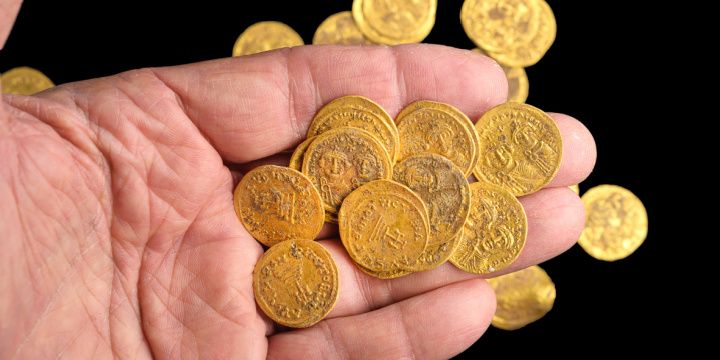
Pure gold coins discovered by Israeli archaeologists. Photo: Dafna Gazit, Antiquities Authority
Israeli archaeologists have discovered 44 pure gold coins, which are believed to have been hidden in a stone wall during the Muslim Conquest of Byzantine Palestine in 635 BCE.
The treasure was found during excavations by the Israel Antiquities Authority at the Banias archaeological site located within the Hermon River nature reserve in northern Israel.
“The coin hoard, weighing about 170 g, was concealed within the base of an ashlar stone wall at the time of the Muslim conquest,” said Yoav Lerer, who led the excavation by the Israel Antiquities Authority. “The discovery reflects a specific moment in time, when we can imagine the owner concealing his fortune in the threat of war, hoping to return one day to retrieve his property.”
Lerer added that the find may also provide some insight on the state of the economy of the city of Banias during the last 40 years of Byzantine rule.
“The coin hoard is an extremely significant archaeological find as it dates to an important transitional period in the history of the city of Banias and the entire region of the Levant,” said Israel Antiquities Authority Director Eli Escusido.
Israel Antiquities Authority coin expert Gabriela Bijovsky assessed that some of the gold coins were minted by Emperor Phocas (602–610 BCE), and others by Emperor Heraclius (610–641 BCE). Most of the coins are of the Emperor Heraclius dating the coin hoard to the time of the Muslim Conquest, according to Bijovsky.
“What is particularly interesting is that in his early years as emperor, only his portrait was depicted on the coin, whereas after a short time, the images of his sons also appear,” Bijovsky pointed out. “One can actually follow his sons growing up – from childhood until their image appears the same size as their father, who is depicted with a long beard.”
During the excavation in the northwestern residential quarter of the ancient city of Banias, the archaeologists also unearthed remains of buildings, water channels and pipes, a pottery kiln, bronze coins, and fragments of many pottery, glass, and metal artifacts. The finds date from the end of the Byzantine period during the early seventh century BCE through the early Middle Ages in the 11th–13th centuries, according to the Israel Antiquities Authority.
Banias, now a popular national park, was first established by Canaanites. The site was originally named Paneas after the Greek god Pan and served as a cultic site during the Hellenistic period. Records of settlements were found around the site during Early Roman periods, the Byzantine period, the Crusader period and until the Moslem Conquest in 1132 BCE.
“The Banias Nature Reserve, endowed with its unique nature and landscape, does not cease to surprise us from a historical-cultural point of view,” said Israel National Parks Authority Director Raya Shurky.





