 Pod Save America Hosts Call on Democrats to Cut All Israel Military Aid, No Longer Accept AIPAC Funding
 Jews, Israelis Targeted in Austria Amid Surge in Antisemitic Incidents; Local Jewish Community Calls for Action
 ‘All of Our Strength’: Over 1,000 Pro-Israel Activists Gather in DC for Solidarity Conference
 ‘Devastated’: Wesley LePatner, Killed in Manhattan Mass Shooting, Was a Jewish Communal, Philanthropic Leader
 Sen. Angus King Vows to No Longer Vote for Israel Military Aid Until Gaza Conditions Improve
 Europe Won’t Pressure Israel to ‘Commit Suicide’ Amid Gaza Backlash, Palestinian State Push, Says Israeli FM
 Israel’s National Soccer Coach Attacked in Athens Before Soccer Fans Chant ‘F–K Israel, Free Palestine’ at Match
 New York Judge Sentences Neo-Nazi to 5 Years for Livestreaming Bomb Threats Against Jewish Hospitals
 US Pressures Lebanon to Issue Cabinet Decision to Disarm Hezbollah Before Talks Continue
 UK Plans to Recognize Palestinian State in September Unless Israel Meets Conditions, Starmer Says


Zelensky Shouldn’t Count on Netanyahu to Increase Ukrainian Assistance
Error: Contact form not found.
 by Irit Tratt

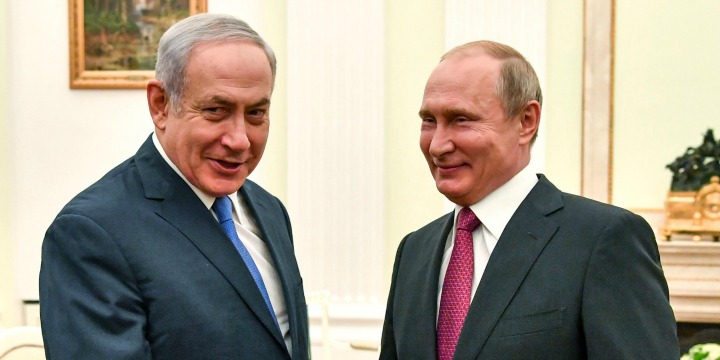
Russian President Vladimir Putin shakes hands with Israeli Prime Minister Benjamin Netanyahu during their meeting at the Kremlin in Moscow, Russia, July 11, 2018. Photo: Yuri Kadobnov / Pool via Reuters.
As the Russia-Ukraine War enters its 10th month, Ukrainian President Volodymyr Zelensky is taking stock of the political shifts occurring in Israel. Zelensky is hopeful that Benjamin Netanyahu’s electoral victory will lead to a greater willingness to supply Ukraine with military support and boost its defensive posture through transferring military technology, including the Iron Dome air defense system and the Barak-8-surface to air missile.
With Zelensky stressing Ukraine’s request for military help, Netanyahu promised to think “how he can help” the embattled nation during a phone call last month. Zelensky’s attempts to press Israel’s incoming government to buoy Ukraine’s military effort are wedded to the belief that Russia’s growing collaboration with Iran will prompt a Likud-led coalition to accede to Kyiv’s demands. However, as with the previous Israeli government, Israel could aggravate its situation in Syria if it formally sides with Ukraine over Putin. Zelensky’s optimism also discounts Netanyahu’s historical ability to withstand diplomatic pressure, and previous decisions by Israel to put realpolitik ahead of moral and humanitarian concerns.
Sentiments expressed by Netanyahu during Zelensky’s congratulatory phone call mirror past statements made on the topic of arming Ukraine with defensive weapons. In an October interview with USA Today, Netanyahu affirmed that he would “look into” boosting Ukraine’s military capabilities. Yet that same month, in an interview with CNN, Netanyahu underscored how today’s tragic situation will compound in severity absent “very firm and prudent stewardship.” Netanyahu recognizes the need to cooperate with Russia, which grants Israel the freedom to strike Iranian targets over Syrian skies primarily patrolled by Russian forces. As Prime Minister, Netanyahu nurtured a relationship with Putin. Shortly after former Israeli leader Naftali Bennett took Israel’s prime ministerial reins, Israeli journalist Barak Ravid reported that Russia’s ambassador to Israel, Anatoly Viktorov, passed along a personal letter of appreciation from the Russian leader to Netanyahu, whose response to Viktorov was, “Tell President Putin I will be back soon.”
In his memoir, “Bibi: My Story,” Netanyahu details his resistance to requests for Israeli concessions from past leaders like Bill Clinton. Netanyahu also defied Barack Obama, whose intimidation techniques against the Jewish state prompted Netanyahu to reply, following one meeting, “Mr. President, I’m sure that you mean what you said. But I am the prime minister of Israel, and I’ll do whatever I need to do to defend my country.”
Zelensky has called out Israel for its reluctance to militarily assist a free democratic state invaded by an authoritarian regime. During a video address to members of Israel’s Knesset soon after Russia invaded Ukraine, Zelensky chided Israel over its “inaction” and failure to answer Ukraine’s pleas for assistance. Time has not tempered Zelensky’s actions, with Ukraine voting against Israel at the United Nations on several occasions. Sadly, Ukraine’s dissonance with Israel extends beyond the confines of the UN. In its “2019 Global 100: Index of Antisemitism, “the Anti-Defamation League (ADL) found that antisemitic trends in Ukraine persist today, with 72 percent of Ukrainians polled responding that Jews have too much power in the business world, and over half stating that Jews wield too much influence over global affairs. Obviously, given that Zelensky is Jewish, he doesn’t subscribe to these beliefs — and the country clearly was confident enough to elect a Jewish leader, who has become a national hero. But the problems still remain.
It remains unclear how much pressure US President Joe Biden will exert on Netanyahu over Israel’s position in Ukraine, or how effective that will be, in light of Netanyahu’s previous efforts to resist US pressure. Publicly, the Biden administration has moderated its rhetoric, especially since Israel’s caretaker prime minister, Yair Lapid, agreed to the US-brokered Maritime agreement with Lebanon back in October. While a diplomatic win for the US, Israeli lawmakers, including Netanyahu, questioned the deal and blamed Lapid for his “surrender” that granted Israel some freedom in area gas exploration but strengthened Hezbollah’s presence in the region. Privately, Haaretz notes that at the behest of US officials, Israel funded “strategic materials” worth millions of dollars to a NATO member state responsible for supplying Ukraine with military equipment. The article reveals that Israel recently eased its restrictions on NATO members delivering artillery to Ukraine with Israeli-made components like “electro-optical and fire-control systems.”
To his credit, Zelensky’s heartfelt condolences following the November 23 terrorist attacks in Israel may signal a softening of tone for the Ukrainian leader. Still, his confidence in Israel’s new coalition government recalibrating relations with Ukraine should be restrained — despite Russia’s growing collaboration with Iran — given Netanyahu’s past commitment to his convictions when faced with situations that compromised the security interests of Israel.
Irit Tratt is a writer who resides in New York. Her work has been published in The American Spectator, The Jerusalem Post, JNS, and Israel Hayom.