 Pod Save America Hosts Call on Democrats to Cut All Israel Military Aid, No Longer Accept AIPAC Funding
 Jews, Israelis Targeted in Austria Amid Surge in Antisemitic Incidents; Local Jewish Community Calls for Action
 ‘All of Our Strength’: Over 1,000 Pro-Israel Activists Gather in DC for Solidarity Conference
 ‘Devastated’: Wesley LePatner, Killed in Manhattan Mass Shooting, Was a Jewish Communal, Philanthropic Leader
 Sen. Angus King Vows to No Longer Vote for Israel Military Aid Until Gaza Conditions Improve
 Europe Won’t Pressure Israel to ‘Commit Suicide’ Amid Gaza Backlash, Palestinian State Push, Says Israeli FM
 Israel’s National Soccer Coach Attacked in Athens Before Soccer Fans Chant ‘F–K Israel, Free Palestine’ at Match
 New York Judge Sentences Neo-Nazi to 5 Years for Livestreaming Bomb Threats Against Jewish Hospitals
 US Pressures Lebanon to Issue Cabinet Decision to Disarm Hezbollah Before Talks Continue
 UK Plans to Recognize Palestinian State in September Unless Israel Meets Conditions, Starmer Says


US Middle East Policy Misses the Mark
Error: Contact form not found.
 by James M. Dorsey

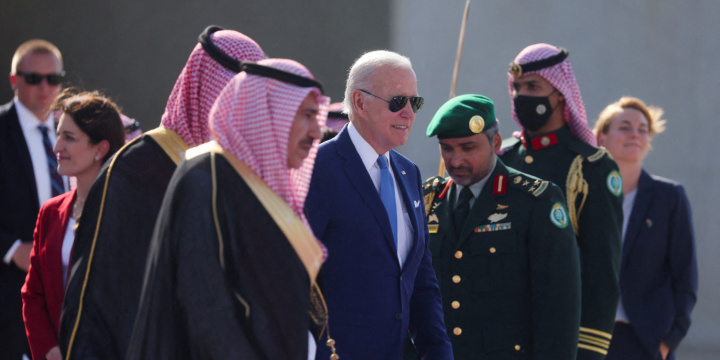
U.S. President Joe Biden walks to board a plane following an Arab summit, at King Abdulaziz International Airprot, in Jeddah, Saudi Arabia, July 16, 2022. REUTERS/Evelyn Hockstein
The Biden administration excels in scoring its own goals, especially in the Middle East.
Missed in the hype of Chinese President Xi Jinping’s recent visit to Saudi Arabia was the low-key reception of President Joe Biden when he went on a pilgrimage to Jeddah in July to repair legitimately strained relations with the kingdom. Rather than ensuring a level playing field, US policy creates an opportunity for China.
“China is making a long-term play, both for its own sake, and to stymie and confuse American goals in Eurasia. China’s Middle Eastern arms sales, mooted military bases, and yuan-denominated futures contracts and purchases bring military and financial dimensions to Sino-US competition in the Gulf. The US is not prepared for this challenge,” said scholar Lucille Greer in a just published book.
To be sure, bad blood plays a role in US-Saudi troubles. Saudi Crown Prince Mohammed bin Salman (MBS) will not forgive Biden for publicly condemning him for the 2018 killing of journalist Jamal Khashoggi, and for the optics of the administration’s harsh verbal response to the kingdom’s refusal to push OPEC+, the cartel of oil-producing countries plus Russia, to increase production.
Even so, the Xi visit, despite long-term Chinese ambitions, was as much about strengthening the Gulf’s hand in demanding clarity on the future US commitment to Gulf security. Given the personal animosity between MBS and Biden, Saudi Arabia has left it primarily to the United Arab Emirates to spell out what the Gulf wants from the United States.
Speaking three weeks before the Chinese leader’s visit, Anwar Gargash, the diplomatic adviser of United Arab Emirates President Mohammed bin Zayed, insisted that “our primary strategic security relationship remains unequivocally with the United States. … Yet, it is vital that we find a way to ensure that we can rely on this relationship for decades to come through clear, codified, and unambivalent commitments.”
To bridge the growing trust gap, the United States will have to respond in positive and confidence-inspiring terms to Gargash’s demand.
Xi demonstrated his understanding of the efficacy of being attentive to Gulf concerns when he agreed during his visit to a joint statement that stressed the need to “strengthen joint cooperation to ensure the peaceful nature of Iran’s nuclear program” and for Iran to respect “principles of good neighbourliness.”
The acknowledgement was in line with Chinese policy but served as a reassurance to Saudi Arabia given China’s close relations with Iran. On the other hand, the United States has long confronted Iranian ambitions.
Since the days of President Barack Obama, the US has fueled doubts in the Middle East by its talk of a pivot to Asia and Biden’s focus on the Indo-Pacific.
With all parties — the Gulf, the United States, and China — in fundamental agreement on maintaining the Middle East’s current security architecture, Chinese military sales, nuclear cooperation, and technology, particularly its nuclear, military, and dual-purpose applications, are likely to be major frontlines in regional US-Chinese competition.
While the US dominates militarily in the competition with China, it has yet to find an effective way in leveraging its advantage. To a degree, the US is hobbled by its justified conditions on weapons sales that have stopped it from selling cutting-edge killer drones and ballistic missiles to Saudi Arabia; these are areas where Chinese weaponry has made inroads in the kingdom.
Even so, the United States has trump cards it can play.
Beyond the agreement that the United States has a primary role to play and arms sales, it’s the United States rather than China that is helping Saudi Arabia complete an overhaul of its defense and national security architecture, the most radical military reform since the creation of the kingdom in 1932.
The reforms aim to enable the kingdom to defend itself, absorb and utilize US weapons systems, and make meaningful military and defense contributions to regional security, according to political-military analyst and former Pentagon official Bilal Y. Saab.
“Through the vehicle of defense reform, the Biden administration has an opportunity to engage the Saudis on critical national security matters while safeguarding US strategic interests and honoring American values,” Saab said.
“It’s a wise form of US assistance that isn’t politically controversial, doesn’t cost much US taxpayer money, and doesn’t require a significant US presence on the ground. It is perhaps the only way to reset the currently tense relationship by gradually rebuilding trust between the two sides,” Saab concluded in a detailed study.
So far, the US assistance has continued uninterrupted despite the strains in the relationship.
However, to put the relationship back on an even keel and secure greater Saudi and Gulf sensitivity to US concerns, the United States will have to find a way to offer Gulf states the clarity and commitment they need, and in politically usable ways at home.
That could be easier said than done with an administration that sometimes portrays an increasingly complex world in binary black-and-white terms.
Dr. James M. Dorsey is an award-winning journalist and scholar, an Adjunct Senior Fellow at Nanyang Technological University’s S. Rajaratnam School of International Studies, and the author of the syndicated column and blog, The Turbulent World of Middle East Soccer.