 Pod Save America Hosts Call on Democrats to Cut All Israel Military Aid, No Longer Accept AIPAC Funding
 Jews, Israelis Targeted in Austria Amid Surge in Antisemitic Incidents; Local Jewish Community Calls for Action
 ‘All of Our Strength’: Over 1,000 Pro-Israel Activists Gather in DC for Solidarity Conference
 ‘Devastated’: Wesley LePatner, Killed in Manhattan Mass Shooting, Was a Jewish Communal, Philanthropic Leader
 Sen. Angus King Vows to No Longer Vote for Israel Military Aid Until Gaza Conditions Improve
 Europe Won’t Pressure Israel to ‘Commit Suicide’ Amid Gaza Backlash, Palestinian State Push, Says Israeli FM
 Israel’s National Soccer Coach Attacked in Athens Before Soccer Fans Chant ‘F–K Israel, Free Palestine’ at Match
 New York Judge Sentences Neo-Nazi to 5 Years for Livestreaming Bomb Threats Against Jewish Hospitals
 US Pressures Lebanon to Issue Cabinet Decision to Disarm Hezbollah Before Talks Continue
 UK Plans to Recognize Palestinian State in September Unless Israel Meets Conditions, Starmer Says


‘A Scientific Breakthrough’: Tel Aviv University Launches Third Nanosatellite in Two Years
Error: Contact form not found.
 by Algemeiner Staff

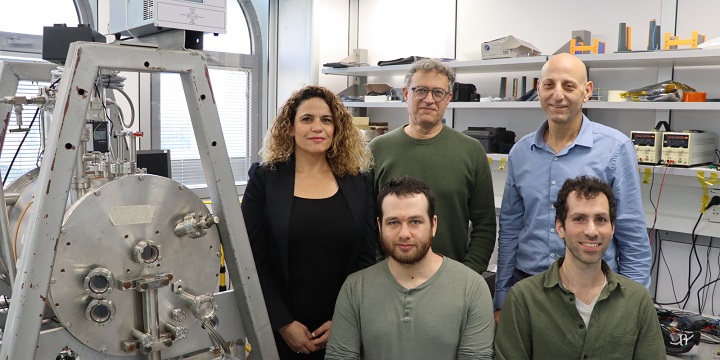
The team behind Tel Aviv University’s nanosatellite TAU-SAT3, launched in January 2023, in clockwise order: Orly Blumberg, Prof. Ofer Amrani, Prof. Meir Ariel, Dr. Dolev Bashi, and Idan Finkelstein. Photo: TAU
A nanosatellite developed at Tel Aviv University fired off into space on Tuesday from Cape Canaveral, Florida, marking the third such launch for the Israeli university in less than two years.
The nanosatellite, named TAU-SAT3, was launched to an altitude of some 340 miles and is expected to orbit Earth for about five years. It will be powered throughout this time by batteries manufactured by the Israeli company Epsilor. Measuring 20 centimeters, it will be smaller than a single pixel when looked at from Earth.
While it is expected to carry out several scientific tasks, the satellite’s main role will be communicating with an optical ground station built on the roof of a building on the TAU campus. The station is the first of its kind in Israel, and one of only a handful worldwide, which can lock onto, monitor, and draw data from the nanosatellite.
TAU-SAT3 marks a scientific breakthrough according to the researchers behind the project, as it “is designed to pave the way toward demonstrating quantum communication [from space] via a quantum nanosatellite, to be built in the future at TAU.”
Quantum communications is an emerging field that seeks to use the principles of quantum physics in order to better secure sensitive messages, which currently rely on encryption algorithms that are expected to be ineffective in the future.
“Once current encryption methods are cracked by quantum computing, all data will be exposed — including personal medical and financial records, email and WhatsApp messages, etc.,” explained Prof. Yaron Oz, who leads TAU’s Center for Quantum Science and Technology. “This makes quantum encryption highly relevant to protecting everyone’s privacy.”
Quantum mechanics, in contrast, offer an “unconditionally secure” method of encryption, he added. “Whenever a hostile entity tries to intercept a transmitted message, the message immediately dissipates. Moreover, the interception attempt is detected — unlike current encryption methods, in which interceptions remain undetectable.”
Prof. Meir Ariel, head of TAU’s Center for Nanosatellites, explained that when TAU-SAT3 “passes over Israel, the device will emit light at various wavelengths, and the telescope of the optical ground station will identify the tiny flash, lock onto it, and track it. The nanosatellite will simultaneously send both optical and radio signals back to earth.”
When the optical device carried on the nanosatellite “turns toward the optical ground station, the antenna will face in a different direction,” he added. “As a result, a significant portion of the data might be lost.”
The novelty in the latest mission, then, will be “the ability of the communication systems installed in both the nanosatellite and the ground station to reconstruct the lost data in real time using smart signal processing algorithms developed at TAU,” said Ariel.