 Pod Save America Hosts Call on Democrats to Cut All Israel Military Aid, No Longer Accept AIPAC Funding
 Jews, Israelis Targeted in Austria Amid Surge in Antisemitic Incidents; Local Jewish Community Calls for Action
 ‘All of Our Strength’: Over 1,000 Pro-Israel Activists Gather in DC for Solidarity Conference
 ‘Devastated’: Wesley LePatner, Killed in Manhattan Mass Shooting, Was a Jewish Communal, Philanthropic Leader
 Sen. Angus King Vows to No Longer Vote for Israel Military Aid Until Gaza Conditions Improve
 Europe Won’t Pressure Israel to ‘Commit Suicide’ Amid Gaza Backlash, Palestinian State Push, Says Israeli FM
 Israel’s National Soccer Coach Attacked in Athens Before Soccer Fans Chant ‘F–K Israel, Free Palestine’ at Match
 New York Judge Sentences Neo-Nazi to 5 Years for Livestreaming Bomb Threats Against Jewish Hospitals
 US Pressures Lebanon to Issue Cabinet Decision to Disarm Hezbollah Before Talks Continue
 UK Plans to Recognize Palestinian State in September Unless Israel Meets Conditions, Starmer Says


Some Politicians Finally Find Their Voice on Fighting Antisemitism and Campus Hate
Error: Contact form not found.
 by Alexander Joffe

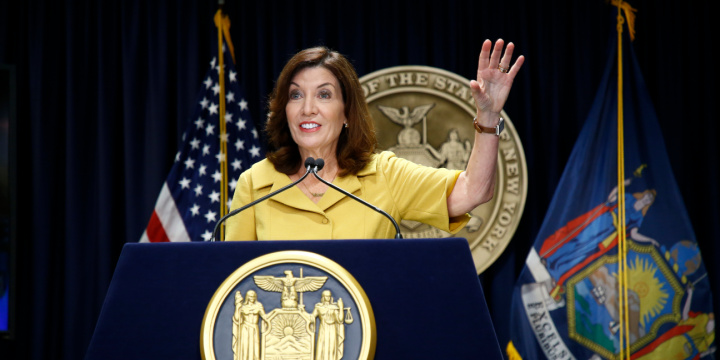
Governor Kathy Hochul speaks at a press conference in Midtown Manhattan on October 13, 2021 in New York City. Photo: John Lamparski/NurPhoto via Reuters Connect
The calendar year ended with politicians holding conferences and making statements in opposition to antisemitism, as well as the anti-Israel Boycott, Divestment, and Sanctions (BDS) movement.
At the state level an event was held in New York City, sponsored by the Orthodox Union, that featured New York Governor Kathy Hochul (D), Sen. Charles Schumer (D-NY), and Homeland Security Secretary Alejandro Mayorkas. Hochul announced a new “Hate and Bias Prevention Unit” to be run through the state’s Department of Human Rights, with the goal of bringing together “stakeholders and the trusted voices that can rise up with us.”
In Virginia, a commission appointed by Governor Glenn Youngkin (R) released its report on antisemitism in the state. The report cited instances of anti-Israel bias, including evidence that diversity, equity and inclusion (DEI) administrators were pervasively biased against Israel, and also criticized former President Trump for meeting Kanye West and white supremacist Nick Fuentes. The report, and an open letter from the Virginia Attorney General, recommended the state adopt anti-BDS laws and that Youngkin use his executive power to ban BDS on campus.
At the national level, Sen. Benjamin Cardin (D-MD) convened a cross-governmental working group on antisemitism with representatives of various agencies as well as non-profits. Cardin stated, “A unified, national strategy on countering antisemitism is needed. While finding the proper balance between protecting free speech and protecting Americans from harm, we need to up our game, rebuild coalitions with other groups that have been the target of hate-based violence, and institutionalize coordination that counters antisemitism wherever it is found.”
Also at the national level, a White House roundtable was convened. It was headed by Doug Emhoff, husband of Vice President Kamala Harris. Speakers at the 90 minute session included students who spoke about BDS and antisemitism on campus. The Biden administration also announced an interagency task force to address antisemitism and Islamophobia. White House Press Secretary, and former BDS supporter Katine Jean-Pierre stated, “This strategy will raise understanding about antisemitism and the threat it poses to the Jewish community and all Americans, address antisemitic harassment and abuse both online and offline, seek to prevent antisemitic attacks and incidents, and encourage whole-of-society efforts to counter antisemitism and build a more inclusive nation.” Some observers criticized the administration for including Islamophobia in the task force.
And in Great Britain, Prime Minister Rishi Sunak stated in a letter to a pro-Israel group that the Conservative government would find a way to formally ban BDS and to expand trade with Israel.
The sudden spate of conferences, speeches, and initiatives from politicians opposing antisemitism responded to long documented upswings in antisemitic violence and rhetoric, which in some ways was brought to a head by the controversies surrounding Kanye West, Kyrie Irving, and former president Donald Trump. But other political figures also continue to normalize antisemites and BDS supporters such as Rep. Ilhan Omar (D-MN).
Street level antisemitic violence against Jews also continues to rise. In this regard, the release of hate crimes statistics by the FBI was sharply criticized since it omitted data from New York City, Los Angeles, and Miami, the former two locations having seen dramatic increases in violence targeting Jews in the past few years, largely by African-Americans. The FBI blamed local officials for not providing data, but the larger picture is of law enforcement reluctance to provide data that demonstrates precisely who is targeting American Jews.
The electoral return of Benjamin Netanyahu in Israel and his coalition of “far right” parties provides another context for international criticism and/or calls for boycott. Prior to the election, Sen. Robert Menendez (D-NJ), a staunch supporter of Israel, had warned of cooling US-Israel relations should Itamar Ben-Gvir become a member of the governing coalition. European officials also warned of cooling relations, with one stating that intelligence exchanges would be curtailed should Ben-Gvir become the Israeli minister in charge of the police. Others on the far left advocated for an arms embargo.
On campus, it was revealed that the Students for Justice in Palestine (SJP) chapter at George Washington University was being investigated by the institution for damage incurred during an October protest against the appearance of a former Israeli official at the school’s Hillel. Palestine Legal, the legal defense wing of the BDS movement, alleged that the SJP chapter was being unfairly targeted, while SJP’s campus allies, notably the Jewish Voice for Peace (JVP) chapter, stated that no damage had been done to Hillel or other property. The SJP chapter was exonerated by the university, but blamed the JVP chapter for the damage.
A variety of anti-Israel events were also held on campuses including at Harvard University, Tufts University, the University of Maryland, and John Jay College. At the Graduate Center of the City University of New York (CUNY), protestors disrupted an event on the Israeli-Palestinian conflict. The event had been introduced by the university president. Despite these and other activities, an anonymous op-ed in the University of Michigan newspaper complained that two decades of BDS activity on campus had produced few tangible gains in terms of divestment from Israel.
The Department of Education has launched an investigation of the UC Berkeley Law School after student organizations adopted a bylaw prohibiting “Zionist”speakers from appearing on campus. The investigation will address “whether the university failed to respond appropriately” to complaints “from Jewish law students, faculty, and staff, that they experienced a hostile environment at the law school based on their shared Jewish ancestry.”
The student union of Queen Mary University of London disaffiliated itself from the National Union of Students (NUS), alleging that NUS president Shaima Dallal had been removed because of “anti-Palestinian racism,” rather than her BDS related antisemitism. A BDS resolution at London City University was overridden after a complaint to the Charity Commission that the student union’s decision was political and thus outside its legal objectives.
At the faculty level, the Middle East Studies Association (MESA) held its annual conference at the end of November, and gave its highest “academic freedom” award to six Palestinian NGO’s that are leaders in BDS and lawfare again Israel. These included Adameer and Al-Haq, organizations with demonstrated links to the Popular Front for the Liberation of Palestine. The rationale, as MESA’s president put it, is that “international scholars and human rights advocates have relied on well-researched and meticulously-documented reports from these six organizations.” MESA formally adopted BDS early in 2022, and has made opposition to the International Holocaust Remembrance Alliance (IHRA) working definition of antisemitism a central “academic freedom” cause.
The author is a contributor to SPME, where a version of this article was first published.