 Pod Save America Hosts Call on Democrats to Cut All Israel Military Aid, No Longer Accept AIPAC Funding
 Jews, Israelis Targeted in Austria Amid Surge in Antisemitic Incidents; Local Jewish Community Calls for Action
 ‘All of Our Strength’: Over 1,000 Pro-Israel Activists Gather in DC for Solidarity Conference
 ‘Devastated’: Wesley LePatner, Killed in Manhattan Mass Shooting, Was a Jewish Communal, Philanthropic Leader
 Sen. Angus King Vows to No Longer Vote for Israel Military Aid Until Gaza Conditions Improve
 Europe Won’t Pressure Israel to ‘Commit Suicide’ Amid Gaza Backlash, Palestinian State Push, Says Israeli FM
 Israel’s National Soccer Coach Attacked in Athens Before Soccer Fans Chant ‘F–K Israel, Free Palestine’ at Match
 New York Judge Sentences Neo-Nazi to 5 Years for Livestreaming Bomb Threats Against Jewish Hospitals
 US Pressures Lebanon to Issue Cabinet Decision to Disarm Hezbollah Before Talks Continue
 UK Plans to Recognize Palestinian State in September Unless Israel Meets Conditions, Starmer Says


If God Is in Control, Do We Really Have Free Choice?
Error: Contact form not found.
 by Jeremy Rosen

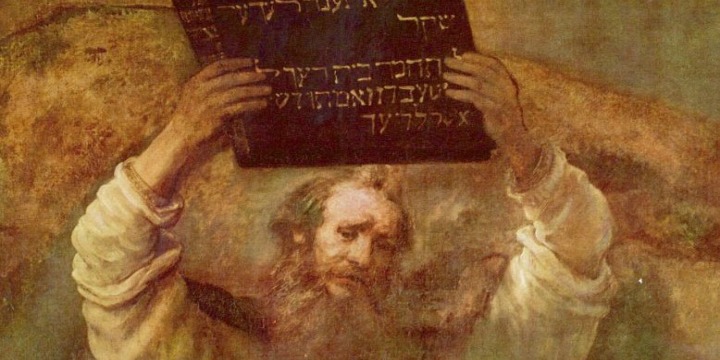
Moses Breaking the Tables of the Law (1659), by Rembrandt. Photo: Wikimedia Commons.
In this week’s Torah portion, Moses and Aaron are locked in a power struggle with Pharaoh, who seemingly holds all the cards. It is a battle both physical and spiritual, with God exercising superior authority. The theological issue of course is that if God has decided in advance to “harden Pharoah’s heart” what happens to the issue of free will? And does it matter? And why does God drag the whole process out? Couldn’t God have simply ended it by killing the firstborn right away?
The traditional way of looking at this question is that the theatrical was necessary to wear down Pharaoh’s obduracy, and to inspire a nation of slaves, downtrodden and depressed — to give them a sense of purpose and positive identity.
But let’s leave God out of it for the moment. The Torah is describing a very important common thread throughout history — the ebb and flow of battles, struggles, and empires. After all, Egypt was the most powerful empire of the time and locked in constant conflict with the Hittites and Assyrians of the North, the Nubians of the South, and the nomadic Hyksos from the east. History is rarely just the conflict of two kingdoms or powers. There are crucial moments and crucial allies and enemies. The Torah’s narrative is as much about the politics and arrogance of power and human fallibility, as it is about Divine intervention.
Pharaoh was the master of his universe, technologically and financially, and believed in his gods and magicians. He was faced with Moses — someone with no army, no kingdom, and no assets, but someone with a sense of his identity and a mission. Why should he, from his point of view, have paid any attention to Moses and Aaron? He could crush them. But slowly, first his experts, then his people began to see his policies are failing. Yet he still could not see it until the collapse of his regime. It calls to mind Stalin and Hitler, both convinced they were right and all-powerful. And I dare say Putin and the Chinese and Iranian regimes will learn the lesson too eventually.
But to return to the question of free will, we like to think we all have the freedom to make choices. And to me, the extent we do is why theologians have always placed so much emphasis on free will. If they believe that God knows exactly what will happen but still gives us the freedom to choose, how unfair was it for God to harden Pharaoh’s heart so that he wouldn’t give in?
Since B.F. Skinner’s experiments with Behaviorism, we have come to realize how much of our behavior is both planned and predictable. In recent years, scientific progress has reinforced the extent to which we know we are the results of our genes as well our environment. And the mining of information about us from advertising and artificial intelligence’s ability to “read our minds and preferences” narrows down the field of choice a great deal. And yet it is clear there are still areas where we do have choices and the capacity to defy predictions, however limited they may be.
Pharaoh was not willing to see another point of view, and we often try to convince ourselves that we are right when it comes to politics, religion, and morality.
This is why it is so important to have a Torah, a moral code, and a set of rules to remind us of what are better choices. And to remind us that just possibly an unseen, non-material Divine conscience might have its uses. This message about Pharaoh is as relevant as it was thousands of years ago.
The author is a writer and rabbi, currently based in New York.