 Pod Save America Hosts Call on Democrats to Cut All Israel Military Aid, No Longer Accept AIPAC Funding
 Jews, Israelis Targeted in Austria Amid Surge in Antisemitic Incidents; Local Jewish Community Calls for Action
 ‘All of Our Strength’: Over 1,000 Pro-Israel Activists Gather in DC for Solidarity Conference
 ‘Devastated’: Wesley LePatner, Killed in Manhattan Mass Shooting, Was a Jewish Communal, Philanthropic Leader
 Sen. Angus King Vows to No Longer Vote for Israel Military Aid Until Gaza Conditions Improve
 Europe Won’t Pressure Israel to ‘Commit Suicide’ Amid Gaza Backlash, Palestinian State Push, Says Israeli FM
 Israel’s National Soccer Coach Attacked in Athens Before Soccer Fans Chant ‘F–K Israel, Free Palestine’ at Match
 New York Judge Sentences Neo-Nazi to 5 Years for Livestreaming Bomb Threats Against Jewish Hospitals
 US Pressures Lebanon to Issue Cabinet Decision to Disarm Hezbollah Before Talks Continue
 UK Plans to Recognize Palestinian State in September Unless Israel Meets Conditions, Starmer Says


Biden’s Pressure and Israel’s Judicial Reform
Error: Contact form not found.
 by Yoram Ettinger / JNS.org

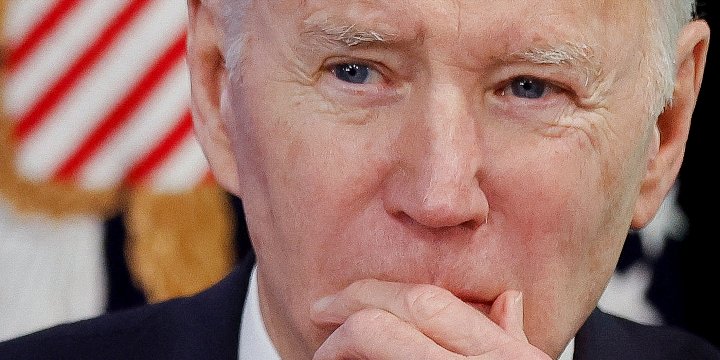
Joe Biden, President of the United States. Photo: Wikimedia Commons
JNS.org – Israel’s proposed judicial reform ranks very low on US President Joe Biden’s order of priorities, far below scores of pressing domestic, foreign and national security threats and challenges.
His opposition to it does not stem from the content of the reform itself, but is rather an attempt to leverage the explosive Israeli domestic controversy as a means to intensify pressure on Israel. This pressure has several goals:
• Gradually forcing Israel back to the 1967 ceasefire lines;
• Ending Jewish construction and proliferating Arab construction in Judea and Samaria (the West Bank);
• Advancing the establishment of a Palestinian state on the mountain ridges of Judea and Samaria, which overpower the coastal sliver of pre-1967 Israel;
• Redividing Jerusalem;
• Preventing game-changing Israeli military actions against Palestinian terrorists and Iran’s ayatollahs.
Israel’s judicial reform and US democracy
If the president and his advisers had studied the proposed reform, they would have noticed that it is an Israeli attempt to adopt key features of the US democratic system, ending the current situation wherein Israel’s judiciary is its supreme branch of government. The reform aims to provide Israel’s legislative and executive branches with the effective authority (currently infringed upon by the judiciary) accorded to it by voters.
For example:
• Israeli Supreme Court justices should not be appointed—as they are today—by a committee controlled by justices (who possess veto power) and lawyers, but rather by a committee dominated by legislators;
• The attorney general and the Knesset legal advisers should be appointed (and fired) by—and subordinated to—the executive, not the judiciary. Their role should be to advise, not to approve or veto policy, as is the case today. Their advice should not be binding, as it is today.
• Supreme Court justices should not be empowered to overturn Basic Laws (Israel’s quasi-constitution).
• Supreme Court justices should have a limited power to nullify and overturn legislation.
• Supreme Court justices should decide cases according to the letter of the law, and not its “reasonableness” (which is utterly subjective), as is the case today.
• The Supreme Court should not be able to overturn legislation via a three-judge panel (out of 15 justices), as is the case today.
• The Supreme Court should be supreme to lower-level courts, not to the legislature and executive, as it is today.
U.S. pressure on Israel
Biden’s pressure tactics with regard to the reform issue reflect the return of the U.S. State Department to the center-stage of policy-making. The State Department opposed Israel’s establishment in 1948, and has been a systematic critic of Israel since then. It has also been consistently wrong on crucial Middle East issues.
The recent pressure on Israel represents the multilateral and cosmopolitan worldview of the State Department establishment in general, and of Secretary of State Antony Blinken and National Security Advisor Jake Sullivan in particular. This worldview espouses a common ideological and strategic denominator with the United Nations, international organizations and Europe, rather than unilateral US foreign policy based on US interests and national security.
It sees the Middle East through a Western lens, assuming for example that dramatic financial and diplomatic gestures can convince Iran’s ayatollahs or Palestinian terrorists to abandon deeply rooted, fanatic ideologies. Middle East reality has proven such assumptions wrong.
The presidential pressure mirrors that applied to Israel since 1948 (except during 2017-2020), which has always resulted in short-term tension/friction and occasional punishment, such as a suspension of delivery of military systems and failure to veto anti-Israel UN resolutions.
However, simultaneously with the near-continuous presidential pressure on Israel since 1948, there has been a dramatic enhancement of mutually beneficial defense and commercial cooperation between the two countries. Israel’s unique technological and military capabilities have contributed to its growing role as a leading force and dollar multiplier for the United States. Israel’s unique contribution to the US defense and aerospace industries, high-tech sector, armed forces and intelligence has transcended US foreign aid to Israel in value, and has eclipsed US-Israel friction over less critical issues (e.g., the Palestinian issue).
Indeed, the current bilateral friction is very moderate compared to the past, for example the Obama-Netanyahu tension over the 2015 nuclear accord with Iran; the United States’ brutal opposition to Israel’s bombing of Iraq’s and Syria’s nuclear reactors; Washington’s ferocious resentment of Israel’s application of its law to the Golan Heights; its determined opposition to the reunification of Jerusalem and the renewal of Jewish construction in Judea and Samaria, the Golan Heights and Greater Jerusalem; its strong-handed pressure for Israel to withdraw to the suicidal 1947 partition lines; etc.
Moreover, in hindsight, past US pressure was based on erroneous assumptions and could have, but for Israeli defiance, actually undermined vital US interests. For example, had Israel refrained from bombing Iraq’s and Syria’s nuclear reactors in 1981 and 2007, respectively, the United States and the world at large would have been confronted with a potential nuclear confrontation in 1991 and a potential nuclearized civil war in Syria since 2011.
Middle East perceptions
Rogue Middle East regimes consider US pressure on Israel an erosion of Israel’s posture of deterrence, and therefore an inducement to intensify terrorism and war. Thus, such pressure gravely destabilizes the region and undermines US interests (while advancing those of China, Russia and Iran), while threatening the survival of vulnerable, pro-US oil-producing Arab regimes.
Most Israeli prime ministers—especially from Ben Gurion through Shamir—defied US presidential pressure, yielding short-term friction but enhancing Israel’s long-term strategic standing. On a rainy day, the US prefers allies which can withstand pressure and are driven by clear principles and national security requirements.
Succumbing to—and accommodating—US presidential pressure ignores precedents, overlooks Israel’s base of support in the co-equal, co-determining US legislature, undermines Israel’s posture of deterrence, whets the appetite of anti-US and anti-Israel rogue regimes and adds fuel to the Middle East fire—at the expense of Israel’s and the United States’ national security and economic interests.
Yoram Ettinger is a former ambassador and head of Second Thought: A U.S.-Israel Initiative.
This article was first published by The Ettinger Report.