 Pod Save America Hosts Call on Democrats to Cut All Israel Military Aid, No Longer Accept AIPAC Funding
 Jews, Israelis Targeted in Austria Amid Surge in Antisemitic Incidents; Local Jewish Community Calls for Action
 ‘All of Our Strength’: Over 1,000 Pro-Israel Activists Gather in DC for Solidarity Conference
 ‘Devastated’: Wesley LePatner, Killed in Manhattan Mass Shooting, Was a Jewish Communal, Philanthropic Leader
 Sen. Angus King Vows to No Longer Vote for Israel Military Aid Until Gaza Conditions Improve
 Europe Won’t Pressure Israel to ‘Commit Suicide’ Amid Gaza Backlash, Palestinian State Push, Says Israeli FM
 Israel’s National Soccer Coach Attacked in Athens Before Soccer Fans Chant ‘F–K Israel, Free Palestine’ at Match
 New York Judge Sentences Neo-Nazi to 5 Years for Livestreaming Bomb Threats Against Jewish Hospitals
 US Pressures Lebanon to Issue Cabinet Decision to Disarm Hezbollah Before Talks Continue
 UK Plans to Recognize Palestinian State in September Unless Israel Meets Conditions, Starmer Says


The Grinch Who Stole Yom Ha’atzmaut
Error: Contact form not found.
 by Mitchell Bard

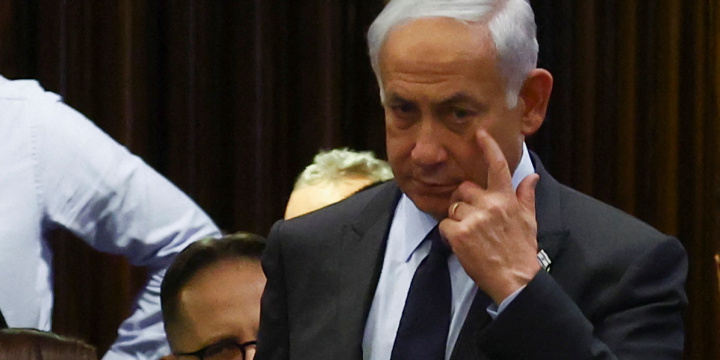
Israeli Prime Minister Benjamin Netanyahu gestures as he attends a meeting at the Knesset, Israel’s parliament. Photo: Reuters/Ronen Zvulun
This should have been one of the most significant years in the history of Israel. It should have been a yearlong celebration of the 75th anniversary of the rebirth of the Jewish State. While we will still celebrate Yom Ha’atzmaut, it will not be as festive as we all expected a year ago.
For many in Israel and the Diaspora, Benjamin Netanyahu has become the Grinch.
Instead of reveling in the incredible accomplishments of Israel over the last seven and a half decades, many people fear it is unraveling, as representatives of the people seek to turn the country from a democracy to a theocracy or an autocracy. Unfounded as those concerns may be, the desire to prevent those possibilities, and of some to bring down the government, has brought tens of thousands of Israelis into the streets to protest rather than celebrate.
American Jews are not in a very joyful mood either. Many see a prime minister who doesn’t care about their concerns or see them as having any say in the present or future of their homeland. Most are liberal and have been offended since the Obama administration by Bibi’s cultivation of Republicans at the expense of their friends in the Democratic Party. Many cannot tolerate Netanyahu or anyone else who they believe bent the knee to Donald Trump.
The far left that sees America primarily through the lens of race sees Israel through the prism of the “occupation,” which they say has lasted nearly 55 years, more than half of Israel’s lifespan. For them, Israel long ago ceased being a democracy, and they would have tried to spoil the party with or without the Grinch.
Reform and Conservative Jews have been angry at the Grinch, as well as predecessors and successors because of their cowardice in the face of the Orthodox establishment that governs religious observance in Israel. Even the compromises made to win recognition and a place at the Western Wall have been forsaken. Orthodox Jews in America, by and large, support the views and actions of the Orthodox establishment in Israel.
Young Jews seem increasingly alienated from Israel. They were born during a time when Israel has appeared to be in no peril, and more bully than victim. They and other idealists who believe in peace and harmony cannot understand how Israel can continue to deny Palestinians their right to self-determination. They don’t see terrorism as a real threat, so a Palestinian state is a matter of justice, not security, to them.
For many on the right, there is frustration with what they see as the inability of reasonable people to understand the need to reform Israel’s judiciary. They see it as strengthening rather than weakening democracy. Unlike America’s youth, conservatives, including most Orthodox Jews, see Israel as a country surrounded by adversaries and increasingly threatened by enemies within. They see an American administration that is hostile and unwilling to act against the greatest threat to Israeli and American interests in the Middle East — Iran.
The umbrella organization for Jewish Federations in the United States, JFNA, is holding its annual conference in Israel for what was expected to be a celebration of Israel at 75. It still will be, but not with the same ruach. In a rare case of publicly opposing the Israeli government, JFNA sent an open letter to Netanyahu opposing the proposed reform that would allow 61 members of the Knesset to override Supreme Court decisions. Nevertheless, the organizers were pressured to rescind invitations to Netanyahu and reform architect Simcha Rothman. The calls were rejected, but JFNA acknowledged that protesters “care deeply and sincerely about the future of Israel.”
Thousands of protestors planned to demonstrate during the event, and block the road to try (no doubt unsuccessfully) to prevent Netanyahu from speaking. Some have bought tickets to the conference and may try to disrupt his address, despite pleas from the organizers not to do so. It will also not be surprising if many American participants attend the weekly Saturday night protest in Tel Aviv the day before.
It is ironic that many Americans see Netanyahu as the Grinch. Those my age remember him as the erudite and fearless champion of Israel who could eviscerate the country’s critics on the floor of the UN or on television. He is no less skilled in hasbara today, but many now see it as a worn-out act that does not have the same resonance.
Part of the problem is that so much of the criticism of Israel comes from the left, to which Netanyahu is tone deaf. He cannot speak to them except in disgust. Israel needs liberal Zionists to speak for the country to this audience, but they are primarily engaged in criticism of the government and not interested in hasbara. Of course, they could never change the minds of the Human Rights Watch crowd, but, unlike Netanyahu, they at least speak the same language as progressives.
One of the most effective spokespeople, actress Noa Tishby, lost her job as special antisemitism envoy after criticizing the government’s plan to overhaul the judiciary. Apparently, the previous government had not renewed her contract, and she wasn’t qualified for that job, but she is the type of person Israel needs for hasbara. Understandably, Netanyahu won’t employ someone who opposes his policy, but that makes her more credible when she speaks to people beyond Bibi’s choir.
Not everything can be blamed on the Grinch. Some of the reserve about celebrating Israel has less to do with the government’s policy than the objective conditions of Jews worldwide. The growing uncertainty and insecurity provoked by the normalization and intensification of antisemitism do not inspire gaiety.
Party or not, Israel has much to celebrate. Its accomplishments over the last 75 years will be the subject of my next column.
Mitchell Bard is a foreign-policy analyst and an authority on US-Israel relations who has written and edited 22 books, including “The Arab Lobby,” “Death to the Infidels: Radical Islam’s War Against the Jews” and “After Anatevka: Tevye in Palestine.”