 Pod Save America Hosts Call on Democrats to Cut All Israel Military Aid, No Longer Accept AIPAC Funding
 Jews, Israelis Targeted in Austria Amid Surge in Antisemitic Incidents; Local Jewish Community Calls for Action
 ‘All of Our Strength’: Over 1,000 Pro-Israel Activists Gather in DC for Solidarity Conference
 ‘Devastated’: Wesley LePatner, Killed in Manhattan Mass Shooting, Was a Jewish Communal, Philanthropic Leader
 Sen. Angus King Vows to No Longer Vote for Israel Military Aid Until Gaza Conditions Improve
 Europe Won’t Pressure Israel to ‘Commit Suicide’ Amid Gaza Backlash, Palestinian State Push, Says Israeli FM
 Israel’s National Soccer Coach Attacked in Athens Before Soccer Fans Chant ‘F–K Israel, Free Palestine’ at Match
 New York Judge Sentences Neo-Nazi to 5 Years for Livestreaming Bomb Threats Against Jewish Hospitals
 US Pressures Lebanon to Issue Cabinet Decision to Disarm Hezbollah Before Talks Continue
 UK Plans to Recognize Palestinian State in September Unless Israel Meets Conditions, Starmer Says


Could Nuclear Arms Race in Asia Lead to Middle East Weapons?
Error: Contact form not found.
 by Alon Levkowitz

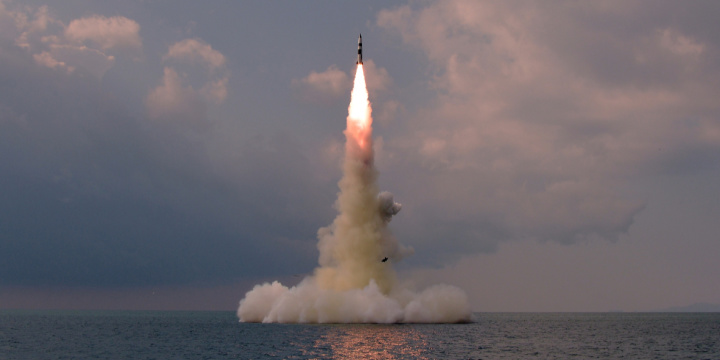
A new submarine-launched ballistic missile is seen during a test in this undated photo released on October 19, 2021 by North Korea’s Korean Central News Agency (KCNA). KCNA via REUTERS
For many decades, it was only the superpowers — the United States, the Soviet Union/Russia, and China — that held nuclear weapons. No other states in northeast Asia had any nuclear capability, despite their concerns about the nuclear threat posed by the superpowers.
Japan and South Korea had a security alliance with the United States that included US forces deployed on Japanese and South Korean soil. It also included a nuclear umbrella that obviated the need for either country to develop nuclear weapons of their own.
In 2006, North Korea held its first nuclear test. Despite the change in the regional nuclear equation, Japan and South Korea did not question the US nuclear umbrella; nor did they openly debate the idea of developing an independent nuclear capability that would not be dependent on the United States.
For the past few years, the nuclear discourse in Japan and South Korea has been held behind closed doors, out of the public domain. This changed when doubts were raised about Washington’s security commitment amid rising concerns in Seoul and Tokyo that the nuclear umbrella is not deterring the North Korean nuclear and missile threat. Specifically, Washington has not been able to prevent dozens of North Korean missile launches over the past two years.
North Korea is not the only threat that led to the change in the nuclear discourse, especially in Tokyo. The Chinese threat, together with rising concerns about Russia and its war in Ukraine, have led Tokyo to reevaluate its defense policies, particularly with regard to obtaining nuclear capabilities.
The nuclear discourse in South Korea and Japan has expanded beyond their borders to include scholars in the United States who support the logic of a nuclear option for Tokyo and Seoul.
Concurrently with the Tokyo-Seoul discourse on developing nuclear weapons, North Korea has been talking about developing and using a tactical nuclear weapon. Moscow has similarly threatened to use a tactical nuclear weapon if Ukraine threatens its interests.
When Pyongyang and Moscow claim they will not use a “regular” nuclear weapon that would cause the deaths of thousands but would only use tactical nuclear weapons, they are trying to minimize the perceived impact of a tactical nuclear weapon in order to legitimize its use in a conventional war like the one in Ukraine. The North Korean threat to use a tactical nuclear weapon to upgrade its nuclear deterrence vs. the United States should raise concern in Washington, Tokyo, and Seoul. The legitimizing of the use of tactical nuclear weapons in conventional war is a slippery slope leading toward the legitimizing of the development and use of nuclear weapons by any state.
Moscow’s and Pyongyang’s attempts to normalize the use of tactical nuclear weapons have implications for the Middle East. If they succeed in this mission, they will indirectly legitimize Iran’s acquisition of a nuclear weapon.
Dr. Alon Levkowitz is a Senior Lecturer in Asian Studies at Bar-Ilan University and a senior research fellow at the Begin-Sadat Center for Strategic Studies. A version of this article was originally published by The BESA Center.