 Pod Save America Hosts Call on Democrats to Cut All Israel Military Aid, No Longer Accept AIPAC Funding
 Jews, Israelis Targeted in Austria Amid Surge in Antisemitic Incidents; Local Jewish Community Calls for Action
 ‘All of Our Strength’: Over 1,000 Pro-Israel Activists Gather in DC for Solidarity Conference
 ‘Devastated’: Wesley LePatner, Killed in Manhattan Mass Shooting, Was a Jewish Communal, Philanthropic Leader
 Sen. Angus King Vows to No Longer Vote for Israel Military Aid Until Gaza Conditions Improve
 Europe Won’t Pressure Israel to ‘Commit Suicide’ Amid Gaza Backlash, Palestinian State Push, Says Israeli FM
 Israel’s National Soccer Coach Attacked in Athens Before Soccer Fans Chant ‘F–K Israel, Free Palestine’ at Match
 New York Judge Sentences Neo-Nazi to 5 Years for Livestreaming Bomb Threats Against Jewish Hospitals
 US Pressures Lebanon to Issue Cabinet Decision to Disarm Hezbollah Before Talks Continue
 UK Plans to Recognize Palestinian State in September Unless Israel Meets Conditions, Starmer Says


The Over-Burdened Camel: Israel’s Ultra-Orthodox and the Military Draft
Error: Contact form not found.
 by Jack Omer-Jackaman

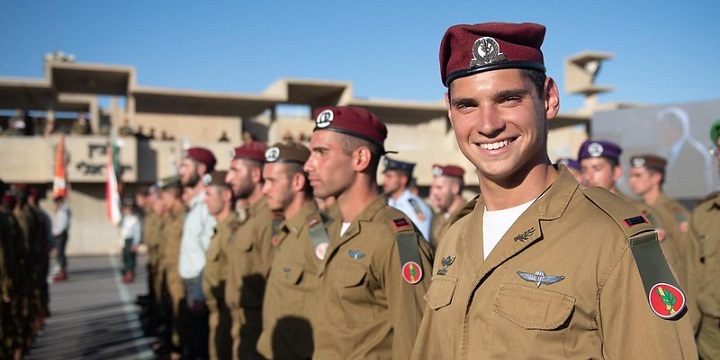
IDF soldiers completing the ground forces combat officers course in 2022. Photo: IDF / CC BY-NC 2.0 / https://creativecommons.org/licenses/by-nc/2.0/
In 1952, Israel’s founding father and then-Prime Minister, David Ben-Gurion, was tempted to revisit his decision of three years earlier granting a portion of the new state’s ultra-Orthodox community exemption from the compulsory military draft.
To test the waters on a potential reversal, Ben-Gurion visited Rabbi Avraham Yeshaya Karelitz, the fabled Chazon Ish. In arguing against the idea of drafting ultra-Orthodox Jews, the rabbi deployed the Talmud, specifically the story of two camels meeting on a narrow path, one unburdened and the other struggling under the weight of a heavy load. Which should make way for the other? The unburdened animal, of course. To the rabbi, it was the ultra-Orthodox who were represented by the weary, over-laden camel, for they alone were carrying the weight of providing the Jewish direction of Zionism’s predominantly secular national revolution. In return for this spiritual service, non-ultra-Orthodox Israel should “make way” by shouldering the bulk of the responsibility for the nation’s protection.
Karelitz’s reading of the national burden has plagued and split Israel ever since.
Whether for reasons of political expediency or from sympathy for an ultra-Orthodox community decimated by the Holocaust, Ben-Gurion backed down. The exemption remained, but only for 400 Torah students. It was then, crucially, extended by Menachem Begin in the late 1970s to include all ultra-Orthodox men, a state of affairs which has remained ever since, as the exempt population has increased inexorably.
Under the status quo (enshrined not in law but by Defense Regulation and currently subject to annual extensions granted by the High Court), ultra-Orthodox men can, on claiming to be in full-time study in a yeshiva, defer military conscription until the age of 26, after which they become permanently exempt. The vast majority do so: of the approximately 11,000 ultra-Orthodox men who turned 18 in 2022, only 10 per cent were conscripted into the IDF.
Never far from the headlines, the question has been brought front and center again in recent weeks by the government’s floating of a new Draft Bill, which seeks to both codify the existing regulation in law and reduce the age at which ultra-Orthodox men can be considered permanently exempt to either 23 or 21. Until earlier this month, the issue was intimately connected with the urgent need to pass the 2023-24 state budget, with some of the coalition’s ultra-Orthodox factions threatening to scupper the budget — and thus bring down the government — if promises made in the coalition agreements to pass the Draft Bill before the budget were not kept. But wiser heads prevailed, the budget passed, the lights stayed on, the government lived to fight another day, and the question of the Draft Bill was delayed — though not for long.
The lowering of the age of permanent exemption would suit not only the ultra-Orthodox but a Finance Ministry acutely aware of the related burdens on the state of both ultra-Orthodox economy inactivity and the subsidizing of extended study in yeshivot. The bill, economically-minded proponents argue, allows an earlier end to studies (without the fear of being enlisted in the IDF) and, consequently, a potential earlier entry to the job market and the wider economy. Based on this logic, it is economically vital to reduce the age sufficiently to enable ultra-Orthodox men to consider a professional future prior to getting married and starting a family, which typically occurs between 21 and 23; hence the Ministry’s preference for 21. Whether the proposed remedy would stimulate greater economic participation or not, the issue of ultra-Orthodox inactivity is acute: latest research shows that the community remains far more prone to unemployment — running at 47 percent, for men at least; ultra-Orthodox women work in far higher numbers. The ultra-Orthodox are also twice as likely to live in poverty than the rest of Israel.
While the IDF in principle accepts the reduction of the exemption age, it opposes the preference for 21, believing it undermines any potential incentive for joining the army. The current deferral until 26 followed by exemption creates at least a potential enticement for ultra-Orthodox men for whom the yeshiva is not an attractive option — enlisting in the IDF for 3 years allows them to enter the workforce and earn a living at 21 after finishing service. Such an option provides a route to a professional path relatively early in life denied to those who defer service and remain in yeshivot until 26. Lowering to 21, on the other hand, provides no incentive for such a person to enlist: they could simply remain in yeshiva until 21, and still enter the job market at the same age.
To much of non-ultra-Orthodox Israel, bargaining over the age of exemption is hardly the point: the exemption itself is unfair and gives the lie to the notion of the IDF as a “People’s Army.” Why, they ask, should virtually a whole Jewish-Israeli community be spared the burden of fighting — and too often dying — for the state, to which the rest of the Jewish-Israeli population is beholden? (To the 10 percent ultra-Orthodox conscription rate, contrast 88 percent for those emerging from the Israeli state school system.)
At risk, they argue, is the very legitimacy of the foundation of the IDF as a universal conscription army, a fear supported by the numbers. If the similarly exempt Israeli-Arab population is added to that of the ultra-Orthodox, the percentage of the 18-year-old population conscripted each year is around 50 per cent, meaning, as former Director General of the Ministry of Defense, Major General Amir Eshel, put it, “the IDF isn’t really a people’s army. It’s a half-of-the-people’s army.” That the bill aims to placate these concerns by offering financial inducements to those who do serve (higher wages, potential housing benefits) has been met not with relief, but with objections that this would signal the drift of the IDF from a citizen army to a dangerously business-like professionalism: IDF Inc.
The disproportionate growth of the ultra-Orthodox population will continue to exponentially exacerbate the problem. Projections indicate that if the exemption remains, 126,000 of the 241,000 Israelis reaching the age of 18 by 2050 will neither enlist in the IDF nor perform other national service. Approximately 57 percent of these will be ultra-Orthodox. Will the Middle East by then become bathed in an unprecedented sunshine of peace to accompany the proportional reduction of serving soldiers? It is spectacularly unlikely. Thus, opponents of exemption agree with Karelitz that one of Israel’s camels is unfairly burdened, just not the one he identified.
The High Court, since its so-called activist turn under Aharon Barak in the early 1990s, has agreed with opponents of exemption. Freeing some from the obligation to serve imposed on others, it has repeatedly found, is a violation of the principle of equality — “the very soul,” as a judgement of the Barak Court in 1998 had it, “of [Israel’s] entire constitutional regime.” It has overruled previous legislative attempts to enshrine the exemption in law on these grounds. (It has no budget oversight; if it did it might have been expected to query the equality of the latest budget, whose largesse lavished upon the yeshivot, at tax-payers expense, rather undercuts the Finance Ministry’s desire to promote greater paid employment.)
Such is the court’s almost certain opposition to the new bill that the only plank of Justice Minister Levin’s judicial revolution which truly concerns the ultra-Orthodox parties is that of a Knesset override of High Court rulings. Absent such an override coming into effect prior to the passage of a Draft Bill, the current High Court would be highly unlikely to allow a bill of the kind being proposed to pass unchecked. Thus do Israel’s two great culture war battle fronts merge.
The import of the issues is hard to over-state: Israel’s economic future, already rocked by the spooking of the markets and business by judicial reform; the viability of an IDF which has vouchsafed the country more times than anyone would dare to remember remaining a “People’s Army”; the military resources on which an Israel assailed on multiple fronts is able to draw; and the country’s fragile social cohesion, never more brittle than when such divisive questions of synagogue and state are in play. All are at stake.
The secularist Ben-Gurion bequeathed an unintended irony: in seeking to aid in the rebuild of an ultra-Orthodox community and culture decimated by the Holocaust, he excused a portion of its young men from the kind of dangerous service which had just claimed the lives of an extraordinary one percent of the entire Jewish population of Israel in the War of Independence. As the ever-excellent Haviv Rettig Gur argued last week, the job has been accomplished so spectacularly over the succeeding 75 years that not only is the number and diversity of yeshivot huge, but the size and political influence of the community has grown so substantially as to render what might have been a temporary remedial measure into a seemingly permanent feature of Israeli political-military-cultural life. How Israel tries to resolve these national tensions will be fascinating to watch; they may just be unresolvable.
Dr. Jack Omer-Jackaman is Research Associate at BICOM and Deputy Editor of Fathom Journal.