 Pod Save America Hosts Call on Democrats to Cut All Israel Military Aid, No Longer Accept AIPAC Funding
 Jews, Israelis Targeted in Austria Amid Surge in Antisemitic Incidents; Local Jewish Community Calls for Action
 ‘All of Our Strength’: Over 1,000 Pro-Israel Activists Gather in DC for Solidarity Conference
 ‘Devastated’: Wesley LePatner, Killed in Manhattan Mass Shooting, Was a Jewish Communal, Philanthropic Leader
 Sen. Angus King Vows to No Longer Vote for Israel Military Aid Until Gaza Conditions Improve
 Europe Won’t Pressure Israel to ‘Commit Suicide’ Amid Gaza Backlash, Palestinian State Push, Says Israeli FM
 Israel’s National Soccer Coach Attacked in Athens Before Soccer Fans Chant ‘F–K Israel, Free Palestine’ at Match
 New York Judge Sentences Neo-Nazi to 5 Years for Livestreaming Bomb Threats Against Jewish Hospitals
 US Pressures Lebanon to Issue Cabinet Decision to Disarm Hezbollah Before Talks Continue
 UK Plans to Recognize Palestinian State in September Unless Israel Meets Conditions, Starmer Says


Does Judaism Still Need Priests Today?
Error: Contact form not found.
 by Jeremy Rosen

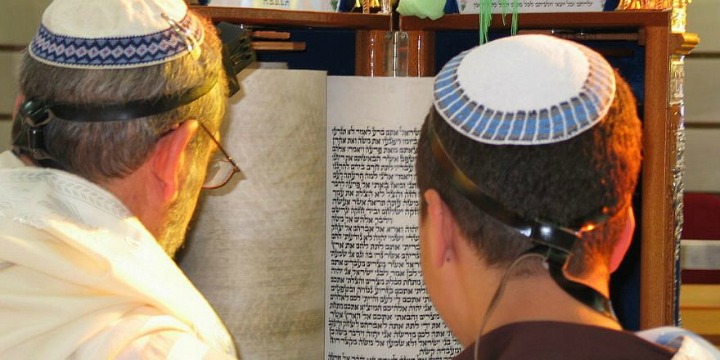
Reading from a Torah scroll in accordance with Sephardi tradition. Photo: Sagie Maoz via Wikimedia Commons.
The earth opened up, fire came down from heaven, and sticks sprouted almond blossoms and nuts. What does it mean? Whether it is heaven, earth, nature, or humanity, we are all part of one Divine cosmos, and we are all interrelated.
The Book of Bamidbar is full of rebellions against the authority of Moses. No leader ever goes without a challenge. The most serious challenge came from Korach. It was a direct challenge to Moses over the issue of the priesthood. He had a vested interest because he came from the same Levite family as Aaron. Korach was joined by 250 senior tribal leaders who argued that even non-Levites should be able to offer incense, and brought incense burners to prove their point. They could have learned from what happened to Nadav and Avihu, the sons of Aaron who were burnt at the altar for bringing incense which they were not commanded to do (Leviticus 10). One may wonder why they were not afraid. Did they honestly believe their cause was just?
Others, like Datan and Aviram who joined in with the rebellion, had their personal issues. The disrespectful way that they replied to Moses reflected their agenda. The earth opened up and fire enveloped the camp. After the rebellion was put down the Torah describes a miraculous event that confirmed the exceptional position of the priesthood. Each chieftain, including Aaron, was given a stick of an almond tree which was placed in the tabernacle. Overnight, only the staff of Aaron sprouted and produced blossoms and almonds, confirming his position as the Divinely designated High Priest to the exclusion of the others.
Both political leadership and religious leadership were the foundation of Israelite life. But it was the hereditary priesthood that was the more controversial, which is why it needed to be supported supernaturally.
Interestingly, both the monarchy and the priesthood proved to be corrupt at different times. And for the past 2,000 years, they have been inoperative other than symbolically — though we still refer to them with nostalgia as an important part of our tradition.
In my opinion, the series of supernatural events this week was important to make the point that the priesthood needed to be supported miraculously, because that was how people expected things to be justified then.
As Maimonides has said, only those who have the least capacity to understand and rationalize will be impressed by miracles. Indeed, in the Bible, no sooner had a miracle occurred than within a short time, the people were acting as if it never happened.
The Torah distinguishes the things that humans can achieve and the things that God can achieve. Miracles or magic are performed by humans to solve a problem. An intervention by God is to stress the importance of an idea and an institution — that everything is interconnected if only we can look beneath the surface.
We shouldn’t expect everything to be explained in a rational logical way. The Torah is teaching us that there is a non-rational divine energy working in this world. The priesthood was necessary at a particular time. Different times require different solutions. But the one constant is the spiritual. Just as we need the Divine world as well as the physical world, we can look at the Torah both rationally and mystically.
Moses himself said that he wished that everybody could be on the highest level religiously. In reality, we need people to devote themselves to these duties and functions, whether we call them priests, prophets, or, in our day, teachers and religious leaders. Times change. We might have needed priests once. But we need other ways of getting closer to God now.
The author is a writer and rabbi, currently based in New York.