 Pod Save America Hosts Call on Democrats to Cut All Israel Military Aid, No Longer Accept AIPAC Funding
 Jews, Israelis Targeted in Austria Amid Surge in Antisemitic Incidents; Local Jewish Community Calls for Action
 ‘All of Our Strength’: Over 1,000 Pro-Israel Activists Gather in DC for Solidarity Conference
 ‘Devastated’: Wesley LePatner, Killed in Manhattan Mass Shooting, Was a Jewish Communal, Philanthropic Leader
 Sen. Angus King Vows to No Longer Vote for Israel Military Aid Until Gaza Conditions Improve
 Europe Won’t Pressure Israel to ‘Commit Suicide’ Amid Gaza Backlash, Palestinian State Push, Says Israeli FM
 Israel’s National Soccer Coach Attacked in Athens Before Soccer Fans Chant ‘F–K Israel, Free Palestine’ at Match
 New York Judge Sentences Neo-Nazi to 5 Years for Livestreaming Bomb Threats Against Jewish Hospitals
 US Pressures Lebanon to Issue Cabinet Decision to Disarm Hezbollah Before Talks Continue
 UK Plans to Recognize Palestinian State in September Unless Israel Meets Conditions, Starmer Says


Are Identity Politics Good for Jews?
Error: Contact form not found.
 by Philip Slayton

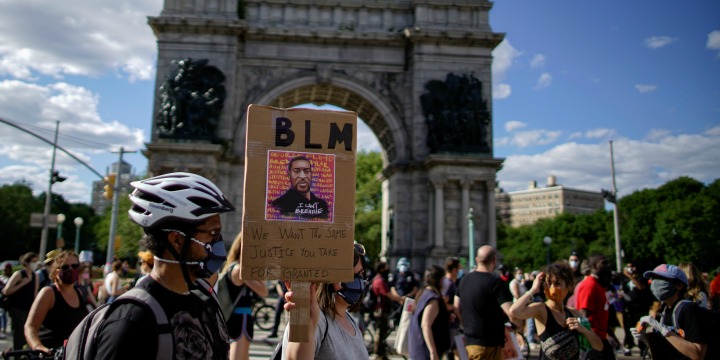
A demonstrator holds a sign while gathering with others during a protest against racial inequality in the aftermath of the death in Minneapolis police custody of George Floyd, in front of the at Grand Army Plaza in the Brooklyn borough of New York City, New York, US, June 7, 2020. Photo: REUTERS/Eduardo Munoz.
The following op-ed is an excerpt from “Antisemitism: An Ancient Hatred in the Age of Identity Politics” by Philip Slayton (2023).
What happens to Jews in the turbulent and destructive age of identity politics? How do they assert their identity? How do other identity groups see them?
As for how Jews assert their identity, two trends — one liberal, the other tribal — pull in opposite directions. Writ large, Jews do not look like a modern identity group as I have described it, constantly limiting its characteristics and seeking to exclude from membership those who do not fit an ever-narrowing definition, hostile to those who do not share its identity and therefore cannot understand it. Quite the contrary, in some respects, there is more universalism than particularism in the world Jewish community. This is the liberal trend, exemplified by modern self-identification definitions of “Jew.”
But some Jews go in a different direction and embrace identity politics. They make many of the complaints and claims that other identity groups make. They express much of the same anger. They burn with a sense of victimhood. They consider their personal worth constantly questioned or denied. An undeniable history of persecution, and particularly the Holocaust, defines them. They claim to be oppressed, marginalized, victimized, and — paradoxically — ignored. They demand dignity, attention, and respect, and do it very effectively. They see antisemitism everywhere. This is the tribal trend.
Identity politics makes Jews more vulnerable, but also gives them an advantage. They are more vulnerable in three ways. First, in an age of particularism, with society no longer held together by universal beliefs, with tolerance for others disappearing, with groups competing for attention, with troubling history readily shoved into the shadows, it is more acceptable and common to criticize and attack anyone who does not share your identity. Criticism and prejudice are simply politics as usual.
And so, antisemitism seems more natural and acceptable, and flourishes more easily, than ever before. Second, identity politics is exclusionary. It accentuates the idea of the Jew as the proverbial Other. It can even summon up and seek to justify the specter of property expropriation (majorities always want to take property away from minorities). Third, attempted assimilation into the broader community, a long-standing technique of Jewish minorities, is much more difficult in the age of identity politics. Meaningful broad communities that welcome others and ignore distinctions are dying rather than developing.
Mind you, assimilation of Jews into the broader community has seldom been successful. Stefan Zweig wrote, “For Jews, adaptation to the human or national environment in which they lived was not only a measure taken for their own protection, but also a deeply felt private need. Their desire for a homeland, for peace, repose and security, a place where they would not be strangers, impelled them to form a passionate attachment to the culture around them.” The passionate attachment was seldom reciprocated. Zweig was writing about Vienna at the beginning of the 20th century, before what he calls the “tragic downfall.” Jean-Paul Sartre called assimilation “a dream.”
The political theorist Hannah Arendt “wanted, above all, for her fellow Jews to abandon the delusion that a disavowal of their Jewishness or the goodwill of other peoples would somehow save them.” She called this delusion “worldlessness,” driven by a misplaced and shameful survival instinct that made Jews victims.
Pauline Wengeroff, describing her life as a Russian Jew in the 19th century, writes about how Lithuanian Jews in the 1860s and 1870s included “so many men of completely European culture, men whose great achievements in the most diverse fields of literature, science and art, were acknowledged with secular honors and titles.” Soon she was describing the pogroms of the 1880s: “First to suffer were the Jews of Kiev, Romny, Konotop and other places. They were helpless before the attacks of the wild masses.” Finkielkraut has called assimilation a dreadful misunderstanding. “Genocide was not imposed on the Jews in spite of their effort to assimilate, but in response to this very attempt. The more they hid their Jewishness, the more terrifying they became to others.”
But identity politics offers Jews one advantage. It validates the inclination to strike back when criticized and attacked. Historically, this inclination was often weak and sometimes absent, but now the gloves are off. Jews are magnificently free to behave aggressively as if they were an identity group like any other. Identity politics magnifies defensive reactions. Defense becomes offense. Amy Chua writes, “When groups feel threatened, they retreat into tribalism. They close ranks and become more insular, more defensive, more punitive, more us-versus-them.”
There are not many Jews in the world. In every country except Israel, they are a very small percentage of the general population. Yet in the countries of the Diaspora, the Jewish voice is alive and powerful. Tiny Jewish communities, often feeling on the defensive, propelled, and united by fear of antisemitism, act like a real identity group and attract much attention. They demand it.
Philip Slayton is a Canadian lawyer and writer, a Rhodes Scholar, and former President of PEN Canada. His latest book, “Antisemitism: An Ancient Hatred in the Age of Identity Politics,” is available now. Follow him on Twitter @philipslayton