 Pod Save America Hosts Call on Democrats to Cut All Israel Military Aid, No Longer Accept AIPAC Funding
 Jews, Israelis Targeted in Austria Amid Surge in Antisemitic Incidents; Local Jewish Community Calls for Action
 ‘All of Our Strength’: Over 1,000 Pro-Israel Activists Gather in DC for Solidarity Conference
 ‘Devastated’: Wesley LePatner, Killed in Manhattan Mass Shooting, Was a Jewish Communal, Philanthropic Leader
 Sen. Angus King Vows to No Longer Vote for Israel Military Aid Until Gaza Conditions Improve
 Europe Won’t Pressure Israel to ‘Commit Suicide’ Amid Gaza Backlash, Palestinian State Push, Says Israeli FM
 Israel’s National Soccer Coach Attacked in Athens Before Soccer Fans Chant ‘F–K Israel, Free Palestine’ at Match
 New York Judge Sentences Neo-Nazi to 5 Years for Livestreaming Bomb Threats Against Jewish Hospitals
 US Pressures Lebanon to Issue Cabinet Decision to Disarm Hezbollah Before Talks Continue
 UK Plans to Recognize Palestinian State in September Unless Israel Meets Conditions, Starmer Says


The Torah Tells Us That Faith Is Better Than Magic
Error: Contact form not found.
 by Jeremy Rosen

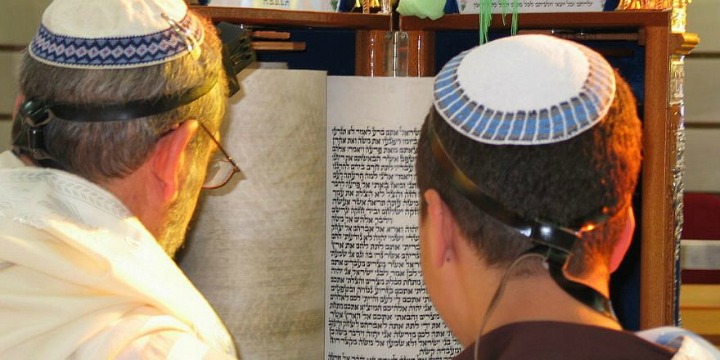
Reading from a Torah scroll in accordance with Sephardi tradition. Photo: Sagie Maoz via Wikimedia Commons.
This week, we have two very different Torah pashas combined into one. Yet despite their differences, there are some important themes running through them.
The first section starts with the law of the Red Heifer, a young, red, cow that was sacrificed. Its ashes were then gathered by the priest, mixed with water, and used to purify ritually impure people. The irony is that the ashes that purified others made the priest who carried out the ceremony impure. This is not logical. But it has the function of reminding us that there is a spiritual world as well as a physical world, and we should try to combine them.
This section also deals with Moses and the Jews wandering in the desert in the period after the Exodus. Once again there is no water, and the people complain. God tells Moses to go and gather everybody and speak to the rock. A generation before, the same thing happened; afterwards, Moses was commanded to hit the rock with his staff. This time, however, he ignored the instruction to speak to the rock, and struck the rock twice with his stick, and again the water flowed. Two sides of the same person.
Because of his actions, God decreed that Moses would not be able to enter the land of Canaan. The commentators argue as to why Moses was punished. It may be to avoid his being worshiped as the agent of God instead of God. We don’t worship people. But we accept a Divine perspective that is beyond us.
At this point in the narrative, Miriam and Aaron have died, the new generation is ready to invade, and Torah describes the diplomatic measures taken to avoid conflict as they head towards Canaan. Once again, there is a problem, and the people complain. A plague of snakes attacks the camp. Moses is told to make an image of a snake, to put it on a pole and if people look up at this snake, they will be cured.
Once again this seems irrational. Since when does an image of a snake cure anybody? The Mishna explains that the purpose was to get people to look up toward the snake and then on toward HaShem. The point was that thinking of God and faith would heal them.
The second part of the reading is concerned with the attempt of the Balak king of Moab to get the non-Jewish magician Bilaam to come and curse the Israelites, because he realized that there was no way he could resist the invasion. The whole of the narrative seems irrational again. Is Bilaam really a magician or is he just a tool? Cursing others does not work. Magic is simply deception — a trick.
All of these different texts have a similar message: nothing in life is as it seems. Many things in life are uncertain and unpredictable. It is natural to look for solutions and easy answers, which is why so many people turn to magic. But the Torah tries to move the people away from the idolatrous magic of Egypt and all around them in the land of Canaan, and to instead put their trust in HaShem. HaShem’s role is to help us. The other side wants to help themselves.
The author is a writer and rabbi, currently based in New York.