 Pod Save America Hosts Call on Democrats to Cut All Israel Military Aid, No Longer Accept AIPAC Funding
 Jews, Israelis Targeted in Austria Amid Surge in Antisemitic Incidents; Local Jewish Community Calls for Action
 ‘All of Our Strength’: Over 1,000 Pro-Israel Activists Gather in DC for Solidarity Conference
 ‘Devastated’: Wesley LePatner, Killed in Manhattan Mass Shooting, Was a Jewish Communal, Philanthropic Leader
 Sen. Angus King Vows to No Longer Vote for Israel Military Aid Until Gaza Conditions Improve
 Europe Won’t Pressure Israel to ‘Commit Suicide’ Amid Gaza Backlash, Palestinian State Push, Says Israeli FM
 Israel’s National Soccer Coach Attacked in Athens Before Soccer Fans Chant ‘F–K Israel, Free Palestine’ at Match
 New York Judge Sentences Neo-Nazi to 5 Years for Livestreaming Bomb Threats Against Jewish Hospitals
 US Pressures Lebanon to Issue Cabinet Decision to Disarm Hezbollah Before Talks Continue
 UK Plans to Recognize Palestinian State in September Unless Israel Meets Conditions, Starmer Says


Earthquakes Had a Large Impact on Historic Israel; Is a New One Coming?
Error: Contact form not found.
 by Jacob Sivak

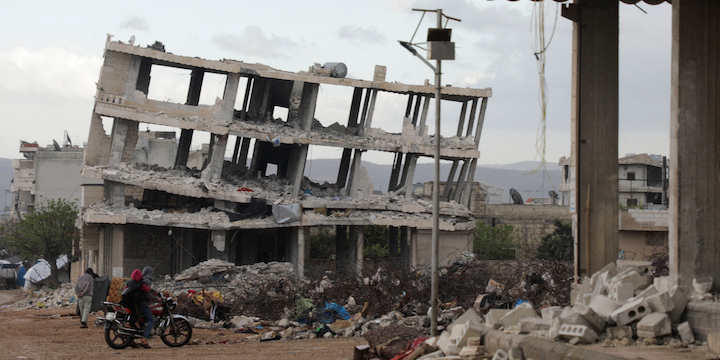
People ride a motorbike past buildings damaged by an earthquake that hit Syria on February 6, in the rebel-held town of Jandaris, Syria March 29, 2023. Photo: REUTERS/Mahmoud Hassano/File Photo
The tragic earthquake that struck southern Turkey and northwest Syria this February is a reminder that the Middle East, located at the junction of three of the Earth’s major tectonic plates, is one of the world’s most earthquake-prone regions. Israel has had its share of such disasters, and buried in the seismic history of Israel is the story of 2,000 years of Jewish continuity in the Holy Land.
While it is common to speak of 20 centuries of exile, Jewish life in the Holy Land didn’t cease with the destruction of the Second Temple in 70 CE, nor after the Bar Kochba revolt in 135 CE (nor after two more revolts against the Eastern Roman Empire — the 4th century Gallus revolt and the 7th century one against Heraclius). True, many Jews were killed and dispersed, but a significant number continued to live in Palestine (the name given to the land by the Romans after the Bar Kochba revolt) for centuries afterward.
Initially, the center of Jewish life shifted northward to Galilee. A reconstituted Sanhedrin continued to function until 358 CE (its last function helped define the Jewish calendar), and the Romans recognized a Jewish Patriarch in Palestine until 425 CE. Moreover, the Jerusalem Talmud was written here during this period.
The level of post-Temple Jewish life in the Holy Land, especially in Galilee, became clear to me during my first visit to Israel, due to the number of synagogue ruins in evidence at sites such as Bar’am and Beit Alpha. The remains of at least 80 synagogues, dating from the first to the sixth centuries CE, have been identified, according to “Twenty Centuries of Jewish Life in the Holy Land,” edited by Dan Bahat). While many are concentrated in the Galilee, they have been found throughout the area, including east of the Jordan River.
The Beit Alpha synagogue, for example, was a substantial two story structure with a mosaic floor depicting, among other things, the zodiac and the Akedah (the binding of Isaac). An inscription notes that it was built in the sixth century. The synagogue continued to function after the Arab conquest of 637, but was destroyed in 749 by a powerful earthquake, estimated as 7.3 on the Richter scale, which leveled many towns of the Galilee, including 30 synagogues in and around Tiberius.
In 1033, another series of severe earthquakes caused tens of thousands of deaths throughout the Holy Land and produced a devastating tsunami on the Mediterranean coast. A letter found in the Cairo Genizah, written in Hebrew, records the devastation in Ramla, at that time an important administrative and commercial center. It had a large Jewish population that included “prominent merchants, traders and artisans, as well as members of the leadership of the Palestinian Yeshiva.”
The expulsion of Jews from Spain (1492) and Portugal (1497) led to the establishment of a significant 16h century Jewish community in Tzfat (Safed). Tzfat became an important center for Jewish scholars, including Joseph Caro, author of the “Shulchan Aruch,” and the Kabbalist Isaac Luria, as well as an important focus for the wool trade and the textile industry. But in 1759, an earthquake tore through northern Israel, devastating Tzfat and other cities.
Tzfat enjoyed a few years of Jewish renewal in the early 1830s, due to an influx of European Jews. By 1834 they represented half the inhabitants. That same year, however, the Jews of Palestine were caught between Egyptian and Ottoman rivalries, and local Arabs took it out on the Jews of Hebron and Tzfat. The situation in Tzfat was particularly appalling. The Jews there experienced a month-long attack of looting and killing by the local Arab population. Five hundred were killed.
After a few years of peace and renewal, the Jewish population of Tzfat increased again. But in 1837, another severe earthquake, with an epicenter near Tzfat, and felt strongly from Beirut to Jerusalem, destroyed the entire Jewish Quarter and part of Tiberius. Thousands of Jews died. On July 11, 1927, an earthquake north of Jericho affected vast areas from Lebanon to the Negev and Transjordan, killing about 350 and ruining some 800 structures (mainly in Nablus).
Records show that, on average, earthquakes of disastrous proportions take place in Israel about once a century. Since the last one, the Jericho Earthquake, occurred almost 100 years ago, experts have been speculating about the next big one. There is every likelihood that the epicenter will be somewhere along the Jordan Rift Valley, possibly in or near the northern Israeli city of Beit She’an.
In 1927, the population of Palestine and Transjordan (Today’s Jordan) amounted to less than 1.5 million. Today, the population of the same area (Israel, Gaza, the West Bank, and Jordan) is about 25 million. Earthquakes don’t discriminate. The expression “earthquakes don’t kill, buildings do” is a warning that needs to be taken seriously by everyone, Israelis, Palestinians and Jordanians.
Jacob Sivak, a Fellow of the Royal Society of Canada, is a retired professor, University of Waterloo.