 Pod Save America Hosts Call on Democrats to Cut All Israel Military Aid, No Longer Accept AIPAC Funding
 Jews, Israelis Targeted in Austria Amid Surge in Antisemitic Incidents; Local Jewish Community Calls for Action
 ‘All of Our Strength’: Over 1,000 Pro-Israel Activists Gather in DC for Solidarity Conference
 ‘Devastated’: Wesley LePatner, Killed in Manhattan Mass Shooting, Was a Jewish Communal, Philanthropic Leader
 Sen. Angus King Vows to No Longer Vote for Israel Military Aid Until Gaza Conditions Improve
 Europe Won’t Pressure Israel to ‘Commit Suicide’ Amid Gaza Backlash, Palestinian State Push, Says Israeli FM
 Israel’s National Soccer Coach Attacked in Athens Before Soccer Fans Chant ‘F–K Israel, Free Palestine’ at Match
 New York Judge Sentences Neo-Nazi to 5 Years for Livestreaming Bomb Threats Against Jewish Hospitals
 US Pressures Lebanon to Issue Cabinet Decision to Disarm Hezbollah Before Talks Continue
 UK Plans to Recognize Palestinian State in September Unless Israel Meets Conditions, Starmer Says


PBS Misleads on the Real Causes of Palestinian Violence and Terror
Error: Contact form not found.
 by Tamar Sternthal

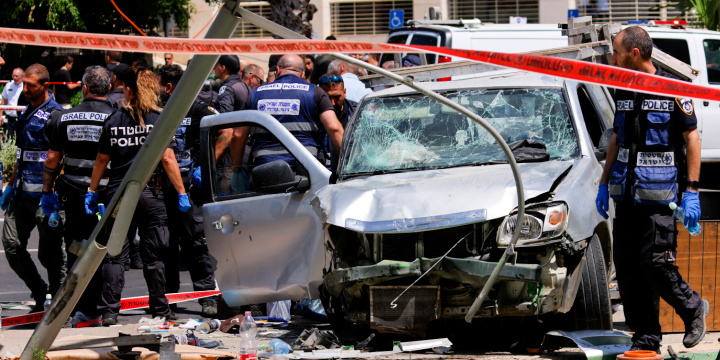
Israeli police at the scene of a terror attack in Tel Aviv. Photo: Reuters/Amir Cohen
At first glance, PBS’ two-part series on the Palestinian-Israeli conflict appears to be the picture of balance: The July 10 broadcast sets out to capture the Palestinian experience in the West Bank city of Nablus (“Cycle of violence and economic turmoil pushes young Palestinians to take up arms“), while the July 13 episode ostensibly approaches the conflict from the Israeli viewpoint (“Israelis describe living with the threat of violent attacks“).
But a closer look at special correspondent Leila Molana-Allen’s broadcasts unmasks a skewed account obscuring the driving forces behind Palestinian terrorism, along with a faux balance encapsulated by what she misleadingly terms a “cycle of violence.”
Like her 2020 debacle of coverage deflecting the United Nations Relief and Works Agency’s responsibility for its own failures, Molana-Allen’s twin broadcasts turn the lens on domestic Israeli matters as the culprit for escalating Palestinian violence, while completely overlooking Iran’s role and downplaying Palestinian Authority responsibility.
Thus, the segment purportedly focusing on the threat of Palestinian terrorism facing Israelis is a rather bizarre and clumsy melding of largely unrelated topics: namely Israel’s domestic upheaval around the government’s highly controversial judicial overhaul, and to a lesser degree, plans to extend Israeli settlements, with growing Palestinian violence. The broadcast opens with her muddled analysis:
Hundreds of thousands took to the streets in protest on Tuesday after a bill which would allow the government to pass any law it likes, unimpeded by Supreme Court oversight, passed its first parliamentary vote. Once it has free reign to pass law, the new government in the agreement that brought it to power says it plans to extend Israeli settlements.
Netanyahu and his ministers frequently speak of increasing security measures in Palestinian areas. As divisions grow over the potential impact of these policies, army veteran Ronen Olshever fears for his family’s future.
Olshever then states: “I am very worried about the violence. I am very worried about my kids.”
But most of the tens of thousands of Israeli protesters are out in the streets because they are worried that the government’s plans will weaken Israeli democracy. The conflation of the fraught internal domestic issue with the problem of Palestinian violence is Molana-Allen’s own tortured imposition.
Indeed, the most current publication of the Israel Democracy Institute’s Israeli Voice Index, a monthly survey carried out to gauge Israeli public sentiment on a variety of issues, found that Israeli feelings about security and feelings about democracy are two separate issues. Its authors stated about the June results, which were published before the Jenin incursion in early July:
This month, we found a sizable increase in the percentage of those who are optimistic about the future of Israel’s security. However, there was only a very slight rise in the share of those who are optimistic about the future of democratic rule in Israel.
If Israeli fears about Palestinian violence were tied to concern for the future of Israeli democracy under the current government, the two figures would coincide. But a review of the the Israeli Voice Index figures over many months reveals that Israeli public feelings on the two issues fluctuate independently.
By artificially tying the two issues together, Molana-Allen deflects attention from the real issues driving Palestinian terror: Palestinian Authority complicity and Iranian meddling, as detailed by CAMERA’s Sean Durns.
From the judicial overhaul, Leila Molana-Allen turns to the settlements, relying on hyperbole and inaccuracy to build her flimsy case.
Regarding the construction of Israeli settlements in the West Bank, she errs: “As more and more Israeli towns become established here that [two-state] option is disappearing fast.”
The reference to the establishment of “more and more” Israeli settlements is baseless, because in the last two decades exactly one new settlement has been approved and established.
As The New York Times reported in 2017 (“Israel Approves First New Settlement in Decades“):
Israel’s government on Thursday approved the establishment of a new settlement in the West Bank for the first time in more than two decades…
For years, Israel refrained from establishing new settlements, under pressure from previous American administrations and in deference to peace efforts with the Palestinians. But it has continued to expand existing ones.
In the July 10 Newshour broadcast, “Cycle of violence and economic turmoil pushes young Palestinians to take up arms,” the special correspondent conceals the fact that the Lions’ Den terror organization has itself claimed responsibility for attacks against civilians and soldiers on numerous occasions:
The Lion’s Den supporters say the group only defends the borders of the city when Israeli soldiers try to enter.
But the IDF accuses its members of multiple preplanned attacks on both soldiers and civilians.
Contrary to Molana-Allen’s suggestion, the Lions’ Den has itself claimed responsibility for attacks against civilians and soldiers outside of Nablus on numerous occasions, including the fatal shooting of Israeli soldier Ido Baruch near the Shavei Shomron settlement.
But, in this tinderbox, the choice to pursue work over weapons doesn’t guarantee safety. The IDF says it only targets militants, a position that aided by the fact that militant groups like Islamic Jihad regularly claim any young man killed as a fighter.
9/20/22: “Martyr” Musa Sarsour murdered 84-yo Shulamit Rachel Ovadia in Holon and committed suicide afterwards.
9/22/22: “Martyr” Muhammad Abu Jum’a attacked bypassers in the Shilat junction with a knife.
11/5/22: “Martyr” Mus’ab Nafal threw stones at Israeli civilians near Ramallah.
11/15/22: “Martyr” Muhammad Suf murdered three Israeli civilians near the Ari’el industial zone.
1/11/23: “Martyr” Sanad Samamra carried out a stabbing attack in the Havat Yehuda outpost near Hebron.
3/24/23: “Martyr” Karm Salman tried to enter Kdumim with a loaded gun and attack civilians.
5/26/23: “Martyr” Alaa’ Qaysiya carried out a stabbing attack in the Tene Omarim settlement south of Hebron.
Concealed by PBS’ abundant distractions, lies the salient truth that the vast majority of the Palestinians killed this year in what PBS misleadingly labels “the cycle of violence” have been combatants, while virtually all of the Israeli fatalities have been civilians.
In the course of some 15 minutes of reporting over the course of two broadcasts, PBS fails to deliver this most basic fact, deflecting with feigned balance and tortured causality.
Tamar Sternthal is the director of CAMERA’s Israel Office. A version of this article previously appeared on the CAMERA website.