 Pod Save America Hosts Call on Democrats to Cut All Israel Military Aid, No Longer Accept AIPAC Funding
 Jews, Israelis Targeted in Austria Amid Surge in Antisemitic Incidents; Local Jewish Community Calls for Action
 ‘All of Our Strength’: Over 1,000 Pro-Israel Activists Gather in DC for Solidarity Conference
 ‘Devastated’: Wesley LePatner, Killed in Manhattan Mass Shooting, Was a Jewish Communal, Philanthropic Leader
 Sen. Angus King Vows to No Longer Vote for Israel Military Aid Until Gaza Conditions Improve
 Europe Won’t Pressure Israel to ‘Commit Suicide’ Amid Gaza Backlash, Palestinian State Push, Says Israeli FM
 Israel’s National Soccer Coach Attacked in Athens Before Soccer Fans Chant ‘F–K Israel, Free Palestine’ at Match
 New York Judge Sentences Neo-Nazi to 5 Years for Livestreaming Bomb Threats Against Jewish Hospitals
 US Pressures Lebanon to Issue Cabinet Decision to Disarm Hezbollah Before Talks Continue
 UK Plans to Recognize Palestinian State in September Unless Israel Meets Conditions, Starmer Says


The Depravity of Selfies at Auschwitz
Error: Contact form not found.
 by Ben Poser

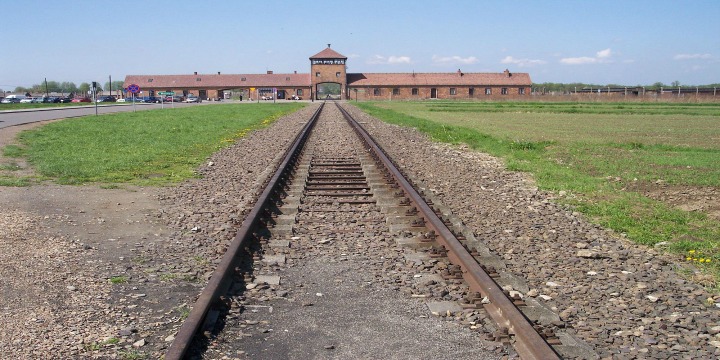
The entrance to Auschwitz-Birkenau in Poland. Photo: Wikimedia Commons.
“Would you mind taking a picture of me?” a random young woman asked me a few weeks ago. I froze, disgusted and horrified by her cheerful request.
I was on the floor below the Longacre Theatre in New York City. I had just emerged from the play “Leopoldstadt,” Tom Stoppard’s masterpiece depicting how the outside world will never care how “assimilated” Jews become, let alone insist they are.
The play, while witty — and making use of lighter-hearted drama, like a baby boy’s b’rit milah being “on” and “off” again multiple times due to his bewildered, secular mother’s inability to choose whether her son should bear the indelible mark of Jewishness — is not a comedy. It is a sobering story of how Jews must never trust that the abnegation of their identity will save them from others’ envy and bloodlust. That they must stand unconquerable in the face of nations’ fraudulent promises of acceptance and safety in exchange for their Jewish souls.
I could therefore think of no cogent reason why this girl, let alone anybody, would feel the least bit jovial after seeing Stoppard’s lovable family of Viennese semi-crypto-Jews subjected to every sadistic humiliation the years 1899 to 1955 had to offer.
What appeared to have prompted this incident was that I had taken a picture of a poster for the show, which leaned against a wall behind an empty merchandise stand. The girl apparently saw this and was inspired to ask me to take a picture of her in front of that same poster.
As my moment of utter shock died away, a guttural “Yes” croaked itself out of me; I did mind. Taking my response for agreement, however, she thrust her phone into my hand and did what I immediately knew was coming. She posed in front of the poster, smiling without a care as if it were a distant great pyramid whose pinnacle she was “pinching,” or a dutifully unmovable Buckingham Palace guard.
The very dear friend with whom I had seen the play looked at me in despairing amusement. “In New York, you have to be a little more direct than that,” she admonished me as we moved toward the stairs which led to the exit.
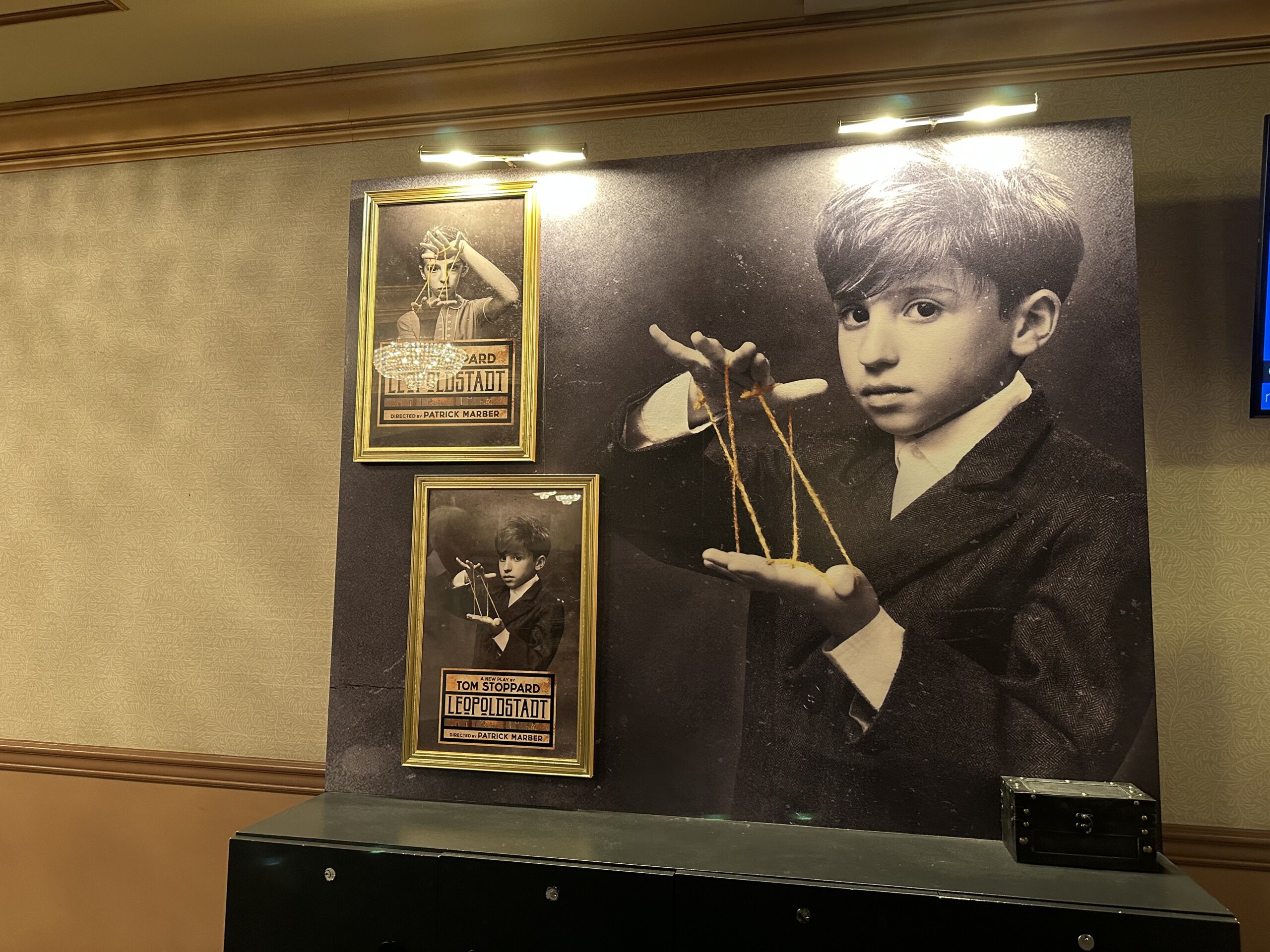
A display at the Longacre Theatre in New York City.
The disgust I felt, mixed with the weighty brew of emotions with which the play had left me, made my stomach tighten. As my friend and I turned back from the sidewalk into the main lobby to buy copies of the script, my legs trembled. I knew I had experienced a phenomenon of which I was aware, but which I never thought I would ever witness personally, let alone like this.
As my friend and I began the long walk through the sweltering night back to my hotel, I recalled an article another friend had texted to me the evening before I left for New York. Coming from The Daily Mail, it, suitably, was as lurid as it was blood-curdling: “Look at ME… I’m at Auschwitz!”
“Dozens of tasteless photos of tourists posing at Auschwitz have surfaced online after the memorial museum called on visitors to show respect at the former death camp where over a million people were killed,” wrote the Mail’s Ed Wight. “From a glamour model who claims to have Spain’s biggest breasts posing beneath the ‘work sets you free’ sign at the entrance to the death camp,” the article continued, “to tourists posing tastelessly on the tracks that transported over a million to their death, MailOnline has uncovered some of the vulgar snaps taken at one of the world’s most important sites.”
Though the article itself — like most things today — neither surprised nor even shocked me when I first saw it, its full horror only broke through when I saw this pathology played out before me.
As I already well knew, men and women the world over believe that it is appropriate to degrade themselves in front of the Internet for attention. Others, as the Mail article informed me, take pictures of themselves — some happy, some fashionably detached — at a place where nearly all of the 216,000 Jewish children deported there were gassed to death and rendered to ashes.
“My face in this picture is not very happy,” Spain’s supposedly best-endowed model told her 1.2 million Instagram cultists, though, she reassured them, “I fulfilled one of my dreams by coming here.”
In this sense, this kind of “Instaporn” does not have to be sexual to be degrading. Making a trip to Auschwitz all about the subject rather than the millions murdered there, all for faceless living millions’ glassy-eyed stares, is as degrading as any sexual content.
Auschwitz is a place to cry, outwardly or inwardly. It is the sump of the universe; the place where all the evil possible in human nature found the fulfillment of its own depraved dreams — the unique place where Jews and non-Jews alike can feel the ache every human soul feels when it contemplates a million ghosts’ un-mourned deaths. Only true, undiluted narcissism is impervious to that ache.
Still, how can we penetrate such a twisted yet rampant affliction? What do we mean by “narcissism” — a term nearly as mutilated today as “capitalism,” “liberalism,” or “nationalism”?
The word itself comes from the Greek story of Narkissos, found in Book III of Ovid’s “Metamorphoses.” The handsomest youth ever born, the seer Teiresias had told Narkissos’ mother, Liriope, that the boy would live to ripe age “if he never knows himself.” As he approached manhood, the dashing huntsman, desired by many, spurned all suitors male and female. His disinterest in others was not, however, in pursuit of something higher than promiscuity. As Allen Mandelbaum’s masterful translation reads, “he / had much cold pride within his tender body: / no youth, no girl could ever touch his heart.”
One day, while hunting deer across “lonely fields,” Narkissos caught the eye of the beautiful forest nymph Ekho. Though a curse from Hera — enraged by Ekho’s talkative diversions whenever Zeus was chasing her fellow nymphs — had barred Ekho from being able to utter anything but an “echo” of another’s last words, she still “was inflamed with love.”
When Narkissos asked “Is anyone nearby?” Ekho could only repeat his question. Finally, the youth, “stupefied,” cried out “Let’s meet.” As Ovid writes:
…And with the happiest reply
that ever was to leave her lips, she cries:
“Let’s meet”; then, seconding her words, she rushed
out of the woods, that she might fling her arms
around the neck she longed to clasp. But he
retreats and, fleeing, shouts: “Do not touch me!
Don’t cling to me! I’d sooner die than say
I’m yours!”; and Echo answered him: “I’m yours.”
“So, scorned and spurned,” Ekho retreated to a cave, where she wasted away in love, her bones “turned to stone,” and nothing remaining of her but the echo which greets wanderers’ voices.
Cold and proud Narkissos, for his part, met a rightful end; having rejected one suitor too many, the young man in question beseeched the gods that Narkissos should “fall in love,” but “be denied the prize he craves.”
Sure as Teiresias’ oracle, a thirsty Narkissos came upon a quiet pool “whose waters, silverlike, / were gleaming, bright.” Quenching one thirst, yet another arose as he beheld the “twin stars that are his eyes” as well as “his ivory neck, his splendid mouth, the / pink blush on a face as white as snow.” In Ovid’s famous words:
in sum,
he now is struck with wonder by what’s
wonderful in him. Unwittingly,
he wants himself he praises, but his praise is
for himself; he is the seeker and the sought,
the longed-for and the one who longs; he is the
arsonist — and is the scorched.
Bewitched by lust only for his own reflection, Narkissos — just like the lonely woman whose love he had so cruelly repulsed — wasted away until only a white-petaled flower, the narcissus, remained where his “entrancing flesh” once lay.
Narcissism is self-destruction through an all-consuming obsession with the “me” we see in the mirror. The reflection itself exists, but only as the optical illusion our eyes behold. It is the mind which transforms that mere storm of photons hammering polished glass or a still pond into an exact clone of oneself. That face, beautiful or hideous, is our only concern. The real “you,” which cannot be “seen,” is not just invisible but irrelevant. We fall in love not with ourselves, but with a false self. A self no one, not even we, can love; for, as Ovid says, it “does not exist.”
A narcissist is immune to love from or for real people. Narkissos died as alone as any person for whom others, let alone their deaths, are a mere distraction from his or her own self-idolatry. Fittingly, they die as alone as those whose suffering could never reach them, then or now.
The grotesque glint I saw in that young woman’s eyes came from a soul that six million stolen lives — even the small, named, human children she had just seen onstage — could not move, even to courteous reverence.
The very last line of “Leopoldstadt” is “Auschwitz.” That anyone aches to gaze at his or her own reflection at its end should pierce every human heart. All the more so that twerking “influencers” at the site of humanity’s most diabolical crime are now no longer impossible.