 Pod Save America Hosts Call on Democrats to Cut All Israel Military Aid, No Longer Accept AIPAC Funding
 Jews, Israelis Targeted in Austria Amid Surge in Antisemitic Incidents; Local Jewish Community Calls for Action
 ‘All of Our Strength’: Over 1,000 Pro-Israel Activists Gather in DC for Solidarity Conference
 ‘Devastated’: Wesley LePatner, Killed in Manhattan Mass Shooting, Was a Jewish Communal, Philanthropic Leader
 Sen. Angus King Vows to No Longer Vote for Israel Military Aid Until Gaza Conditions Improve
 Europe Won’t Pressure Israel to ‘Commit Suicide’ Amid Gaza Backlash, Palestinian State Push, Says Israeli FM
 Israel’s National Soccer Coach Attacked in Athens Before Soccer Fans Chant ‘F–K Israel, Free Palestine’ at Match
 New York Judge Sentences Neo-Nazi to 5 Years for Livestreaming Bomb Threats Against Jewish Hospitals
 US Pressures Lebanon to Issue Cabinet Decision to Disarm Hezbollah Before Talks Continue
 UK Plans to Recognize Palestinian State in September Unless Israel Meets Conditions, Starmer Says


Deir Yassin: The ‘Massacre’ That Never Was
Error: Contact form not found.
 by Bailey Pasternak

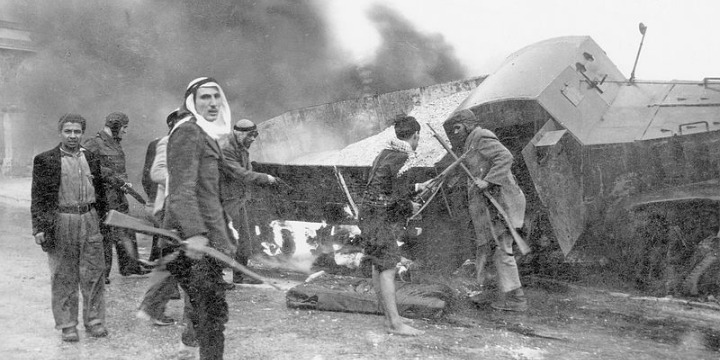
A Jewish truck that was attacked by Arab irregulars on the main road to Jerusalem, 1948. Photo: Wikimedia Commons.
Israel’s legitimacy is consistently challenged by the false notion that its very establishment in 1948 is a kind of “original sin.” That is, that the land was acquired through unjust means. Proponents of this narrative decry the founders of Israel as rapacious conquerors who took the land by force and expelled or murdered anyone that got in their way.
Why Deir Yassin?
A central story to this narrative is the April 9, 1948, battle over the Arab village of Deir Yassin. However, this event is not commonly referred to as a battle, but invariably (and incorrectly) described as a “massacre,” which is used as evidence of alleged Jewish cruelty toward Arabs.
In the early days of the War of Independence, 100,000 Jews were trapped in Jerusalem, as Arab fighters blockaded the road from Tel Aviv to Jerusalem.
Low on food, water and other crucial supplies, these Jews were in dire need of support. As a result, opening the road to Jerusalem became an important strategic goal of the Israeli side.
In April 1948, Jewish militias initiated Operation Nachshon, a campaign to capture Arab strongholds and villages along the road and establish a corridor that would enable convoys to safely travel to Jerusalem.
Deir Yassin was located very close to the road and less than a mile away from neighboring Jewish villages. Residents of Deir Yassin fired at these Jewish villages days before the battle. Due to Deir Yassin being a stronghold of Arab fighters, it became a legitimate military target amid evidence combatants within the village were targeting Jewish civilians.
Additionally, leading up to the battle, the Haganah acquired intelligence that more than 150 Iraqi and Syrian fighters entered the village in March and were preparing to launch an attack. While this piece of intelligence was eventually proven to be false, Deir Yassin was nevertheless considered to be hostile.
Planning the Attack
Contrary to an orchestrated massacre, the Israeli soldiers surrendered the element of surprise in order to warn the civilians of Deir Yassin prior to the attack so they could evacuate before the fighting broke out.
They planned to drive a truck with a loudspeaker on it up to the village, which would play a recording in Arabic that explained civilians should flee and to leave two paths leading out of the village open in their attack so that civilians could make it safely to a neighboring Arab village.
The Tricky Part
Though the attack on Deir Yassin was militarily sanctioned and designed to minimize civilian casualties, the operation did not go to plan. This was not, however, because Jewish soldiers suddenly decided to murder civilians. Rather, there was heavy resistance mounted from within the village and dozens of civilians were killed.
In the aftermath of the battle, there were numerous different testimonies given about what had occurred. British police interviewed survivors of Deir Yassin, who claimed that the Jewish soldiers raped women, cut fetuses from the stomachs of pregnant women, and executed civilians.
However, Arab researchers Sharif Kan’ane and Nihad Zeitawi interviewed survivors of the attack in 1987 and not a single testimony mentioned rape or any mistreatment of Arab women. Additionally, Kan’ane and Zeitawi compiled a list of all of the villagers who were killed — 107 in total, which is significantly less than the initially reported figure of more than 200 dead villagers.
Another Arab researcher, Walid Khalidi, wrote a book about Deir Yassin in which he used the statements from 30 survivors, as well as other information that has been written about the battle. According to Khalidi, there were isolated instances of Jewish soldiers killing civilians, but the allegations of rape and other extreme abuses were fabricated.
In fact, it is now known that the head of the Arab Higher Committee in Jerusalem, Hussein Fakhri al Khalidi, convinced the survivors to spread this false narrative when they were being interrogated by the British, in order to discredit the Jewish soldiers and increase support for the Arab cause.
One True Act of Cruelty
Although the allegations of a deliberate massacre were disputed, there was one atrocity committed by a Jewish soldier.
While fighting to take control of a house in the village, a soldier named Yehuda Segal was killed. When the occupants surrendered and were taken outside, another Jewish soldier saw his friend Segal’s dead body and in an act of blind rage, he murdered 11 members of the household.
As awful as the crime was, it was not representative of the behavior of Jewish soldiers in general.
The Lingering Problem
Even though Jewish soldiers encountered between 70-80 combatants in the village, questions remain as to why so many casualties were civilians.
Some have argued this was the result of the warning mechanism not working properly. On the way to the village, the loudspeaker truck got stuck in a ditch, mostly out of earshot from the village, so Arab civilians were not properly warned that a battle was about to break out.
Expecting to face only combatants in a residential area, the Jewish soldiers — lacking traditional combat experience — carried out their original battle plan, which was to throw grenades into the houses that combatants were firing from before entering and clearing the houses.
Not expecting to find civilians still sheltering in place, they did not allow for that possibility.
The fight over the Zahran household during the battle best demonstrates the consequences of these tactics. During this fight, Muhmand Zahran, two of his sons, and his grandson, defended the property. The Jewish soldiers blindly threw grenades and shot into the house, killing 24 people.
Ultimately, it was flawed tactics rather than intent to murder that were responsible for the civilian deaths.
The Real Terrorist Attack
The battle over Deir Yassin was neither a terrorist attack nor a massacre. Deir Yassin represented a legitimate military objective for the Jewish soldiers in achieving their broader military objective of securing the road to Jerusalem. While planning the attack, the Jewish soldiers planned to mitigate civilian casualties, even at the expense of their own tactical advantage.
The loss of every civilian life is a tragedy. In the case of Deir Yassin, it was an avoidable tragedy had the military operation gone to plan. But the decades-long lie that the village is the site of a planned and deliberate massacre is just that — a lie.
Sadly, it is a lie that has had deadly consequences. On April 13, 1948, Arab militants killed over 70 medical workers and civilians in a revenge attack for Deir Yassin. Their objective was to kill as many unarmed civilians as possible.
Deir Yassin was a failure. But most importantly, it was a military failure. The pervasive and insidious narrative that a Jewish militia targeted the village and its inhabitants with a plot to commit unspeakable savagery is simply not supported by evidence.
The author is a contributor to HonestReporting, a Jerusalem-based media watchdog with a focus on antisemitism and anti-Israel bias — where a version of this article first appeared.
The following sources were used to compose this article:
Avner, Yehuda. The Prime Ministers. New Milford, Conn: Toby, 2010.
Gordis, Daniel. Menachem Begin: The Battle for Israel’s Soul. New York: Schocken Books, 2014.
Karsh, Efraim. The Arab-Israeli Conflict the Palestine War, 1948. Oxford: Osprey Publishing, 2010.
Lorch, Netanel. The Edge of the Sword: Israel’s War of Independence, 1947-1949. Easton Press, 1991.
Max Abrahms. “Why Terrorism Does Not Work.” International Security 31, no. 2 (2006): 42–78. http://www.jstor.org/stable/4137516.
Morris , Benny. “The Historiography of Deir Yassin.” Taylor & Francis. Accessed November 28, 2022. https://www.tandfonline.com/doi/full/10.1080/13531040500040305.
Shapira, Anita. “Jerusalem in 1948: A Contemporary Perspective.” Jewish Social Studies 17, no. 3 (2011): 78–123. https://doi.org/10.2979/jewisocistud.17.3.78.
Tauber, Eliezer. Massacre That Never Was. S.l.: TOBY PRESS, 2021.