 Pod Save America Hosts Call on Democrats to Cut All Israel Military Aid, No Longer Accept AIPAC Funding
 Jews, Israelis Targeted in Austria Amid Surge in Antisemitic Incidents; Local Jewish Community Calls for Action
 ‘All of Our Strength’: Over 1,000 Pro-Israel Activists Gather in DC for Solidarity Conference
 ‘Devastated’: Wesley LePatner, Killed in Manhattan Mass Shooting, Was a Jewish Communal, Philanthropic Leader
 Sen. Angus King Vows to No Longer Vote for Israel Military Aid Until Gaza Conditions Improve
 Europe Won’t Pressure Israel to ‘Commit Suicide’ Amid Gaza Backlash, Palestinian State Push, Says Israeli FM
 Israel’s National Soccer Coach Attacked in Athens Before Soccer Fans Chant ‘F–K Israel, Free Palestine’ at Match
 New York Judge Sentences Neo-Nazi to 5 Years for Livestreaming Bomb Threats Against Jewish Hospitals
 US Pressures Lebanon to Issue Cabinet Decision to Disarm Hezbollah Before Talks Continue
 UK Plans to Recognize Palestinian State in September Unless Israel Meets Conditions, Starmer Says


The Real Story of Palestinian Refugees in Lebanon
Error: Contact form not found.
 by Hadar Sela

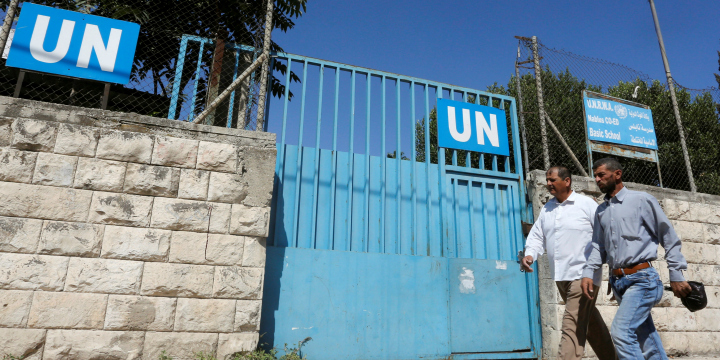
Palestinians pass by the gate of an UNRWA-run school in Nablus in the West Bank. Photo: Reuters/Abed Omar Qusini.
On July 30, the BBC News website published an uncredited report that was originally headlined “Six killed at Palestinian refugee camp in Lebanon.” Over the next day, that report was amended several times, and it is currently titled “Lebanon clashes: Thousands flee violence at Palestinian refugee camp.”
The final paragraph in all versions of that report — which is about the continuing violent clashes in and around the Ein el-Hilweh refugee camp — did not however undergo any changes and it reads as follows:
More than 479,000 refugees are registered with UNRWA in Lebanon, the agency says. About half live in the country’s 12 refugee camps, which have “dire” living conditions, it adds.
Most readers would be unlikely to click on that link, and so they would not be aware of the fact that “registered with UNRWA in Lebanon” does not necessarily mean living in Lebanon:
As of March 2023, the total number of UNRWA registered Palestine Refugees in Lebanon is 489,292 persons. In addition, UNRWA records show a total of 31,400 Palestine Refugees from Syria residing in Lebanon. However, registration with UNRWA is voluntary; deaths as well as emigration remain often unreported, and refugees can continue registering newborns as they move abroad through the UNRWA online registration system. In 2017, the Lebanese Palestinian Dialogue Committee together with the Palestine Central Bureau of Statistics carried out a census among Palestinians living in Lebanon and reported a total of 174,000 persons. A total of 45 per cent of Palestine Refugees are estimated to live in the country’s 12 refugee camps. About 200,000 Palestine Refugees access UNRWA services in Lebanon every year. The Agency’s current estimation is that no more than 250,000 Palestine Refugees currently reside in the country.
One presumes that whoever wrote this report accessed the UNRWA website to which he or she chose to link, but rather than inform BBC audiences that “no more than 250,000 Palestine Refugees currently reside in the country,” the uncredited BBC journalist elected to present a number that is nearly double UNRWA’s estimation.
Moreover, he or she went on to state that “about half” of that number “live in the country’s 12 refugee camps” — meaning that audiences would conclude that the number of people living in refugee camps is much higher than is actually the case.
As is so often the case in BBC reporting on the topic of Palestinian refugees in Lebanon, no effort is made to explain to readers why Palestinians have been kept in camps by Lebanon for generations. Audiences hear nothing at all about the Lebanese government’s long-running intentional discrimination against Palestinian refugees or the politics behind that policy.
Readers are also not given any explanation as to why Palestinian refugees have different criteria (including hereditary status) to refugees from the rest of the world and a separate UN agency that refrains from working towards their integration (even in territories run by Palestinians) and resettlement in host countries.
Hadar Sela is the co-editor of CAMERA UK – an affiliate of the Committee for Accuracy in Middle East Reporting and Analysis (CAMERA), where a version of this article first appeared.