 Pod Save America Hosts Call on Democrats to Cut All Israel Military Aid, No Longer Accept AIPAC Funding
 Jews, Israelis Targeted in Austria Amid Surge in Antisemitic Incidents; Local Jewish Community Calls for Action
 ‘All of Our Strength’: Over 1,000 Pro-Israel Activists Gather in DC for Solidarity Conference
 ‘Devastated’: Wesley LePatner, Killed in Manhattan Mass Shooting, Was a Jewish Communal, Philanthropic Leader
 Sen. Angus King Vows to No Longer Vote for Israel Military Aid Until Gaza Conditions Improve
 Europe Won’t Pressure Israel to ‘Commit Suicide’ Amid Gaza Backlash, Palestinian State Push, Says Israeli FM
 Israel’s National Soccer Coach Attacked in Athens Before Soccer Fans Chant ‘F–K Israel, Free Palestine’ at Match
 New York Judge Sentences Neo-Nazi to 5 Years for Livestreaming Bomb Threats Against Jewish Hospitals
 US Pressures Lebanon to Issue Cabinet Decision to Disarm Hezbollah Before Talks Continue
 UK Plans to Recognize Palestinian State in September Unless Israel Meets Conditions, Starmer Says


Media Re-airs Program That Whitewashes Palestinian Terror and Distorts Yasser Arafat’s Terror Record
Error: Contact form not found.
 by Hadar Sela

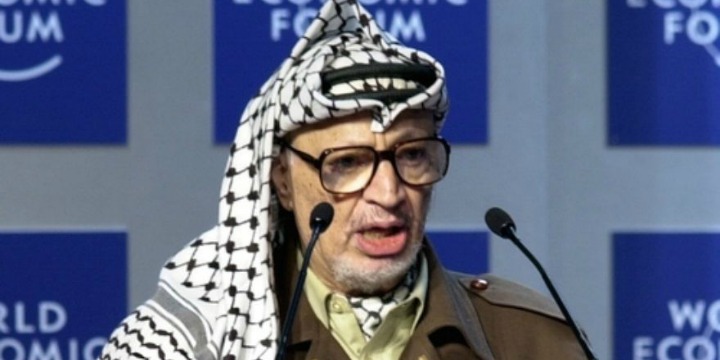
PLO leader leader Yasser Arafat. Photo: World Economic Forum.
On August 4, BBC Radio 4 saw fit to recycle an edition of its self-described “history programme” called Witness, which was originally aired in September 2012. In that episode — titled “Arafat goes to the United Nations” — presenter Louise Hidalgo interviewed Nabil Sha’ath.
The program’s synopsis states:
In the autumn of 1974 a young Palestinian was sent to New York to pave the way for Yasser Arafat to make a speech at the United Nations
His name was Nabil Sha’ath, and he was only given the mission because no other member of the Palestinian leadership agreed to go.
When Arafat arrived in America, he was greeted with noisy opposition – but his plea for an independent Palestinian state was to go down in history.” [emphasis added]
Nowhere in this program are listeners told that Arafat’s speech in fact demanded the erasure of the Jewish state and the so-called “right of return”:
I am a rebel and freedom is my cause. I know well that many of you present here today once stood in exactly the same resistance position as I now occupy and from which I must fight. You once had to convert dreams into reality by your struggle. Therefore you must now share my dream. I think this is exactly why I can ask you now to help, as together we bring out our dream into a bright reality, our common dream for a peaceful future in Palestine’s sacred land.
As he stood in an Israeli military court, the Jewish revolutionary, Ahud Adif [Ehud Adiv], said: “I am no terrorist; I believe that a democratic State should exist on this land.” Adif now languishes in a Zionist prison among his co-believers. To him and his colleagues I send my heartfelt good wishes.
…
Why therefore should I not dream and hope? For is not revolution the making real of dreams and hopes? So let us work together that my dream may be fulfilled, that I may return with my people out of exile, there in Palestine to live with this Jewish freedom-fighter and his partners, with this Arab priest and his brothers, in one democratic State where Christian, Jew and Muslim live in justice, equality and fraternity. [emphasis added]
Given that Sha’ath tells Hidalgo that he drafted that speech (along with others), Hidalgo’s avoidance of the topic of the Palestinian refusal to accept Israel’s existence is all the more glaring.
As one might expect, the BBC’s portrayal of Arafat whitewashes terrorism:
Hidalgo: “And he [Arafat] was deeply controversial: to Palestinians a guerilla fighter and national hero but to Israelis and others, a terrorist with the blood of innocents on his hands.”
Hidalgo’s use of the term “guerilla fighter” inaccurately implies that the targets of Arafat’s actions were military forces rather than civilians, as was so often the case. Nabil Sha’ath was then allowed to further whitewash terrorism:
Sha’ath: “During the war of ’73 Arafat has stood by the Arab unified command that Egypt led. Before that we had stood against the hijacking of planes and other terrorist acts and so his standing had become significantly better…”
Sha’ath’s claim that the PLO “had stood against the hijacking of planes” before October 1973 goes unchallenged by Hidalgo. In late January 1975 The New York Times reported that the PLO had declared that it would punish hijackers:
Article 125 of the so‐called penal code of the Palestine Liberation Organization, as translated into English by an interpreter, read:
“Capital sentences or lesser punishment are imposed on any person that has committed the crime of hijacking of a plane, ship or train and has restricted a person’s liberty in such places without order of the high command.”
“If a person is killed as result of such action there will be a capital sentence.” the interpreter read from the article.
He said that the code was adopted in 1974 by the Executive Committee of the P.L.O. and endorsed by Mr. Arafat.”
In other words, the claim that the PLO had “stood against” hijackings before October 1973 is unevidenced and misleading to audiences.
Hidalgo also fails to remind listeners that terrorists from a PLO member organization — the Popular Front for the Liberation of Palestine — carried out the Entebbe hijacking in June 1976.
As for the claim that the PLO was supposedly opposed to “other terrorist acts” before October 1973, listeners hear nothing about the 1975 Savoy Hotel attack or the 1978 Coastal Road massacre — both of which were carried out by Arafat’s own faction, Fatah, and planned by one of the people Sha’ath claims helped write Arafat’s 1974 UN speech.
Later in the program Hidalgo tells listeners that:
Hidalgo: “Just the year before Palestinian militants had killed eleven Israeli athletes at the Olympics in Munich. Although Arafat always insisted he’d had nothing to do with the killings, to the Israeli ambassador at the UN, he was a terrorist who had shot his way to a place at the podium.”
The Munich Olympics massacre took place in September 1972 — more than two years before Arafat’s November 1974 UN speech. Apparently no-one at the BBC had noticed that error in the 11 years since the program was first aired. Hidalgo’s uncritical portrayal of Arafat’s claims concerning that attack are not balanced by information concerning the PLO’s links to the perpetrators and Fatah’s glorification of that attack.
Towards the end of the program, Hidalgo tells listeners that Arafat’s UN speech paved the way to “the resolution that supported the right of the Palestinian people to self-determination and to a state of their own,” later adding: “38 years on, there is no Palestinian state.”
Once again listeners are told nothing of Arafat’s “one-state” intentions or of the multiple occasions on which the Palestinians refused peace offers which would have created a Palestinian state alongside the Jewish state.
Hadar Sela is the co-editor of CAMERA UK — an affiliate of the Committee for Accuracy in Middle East Reporting and Analysis (CAMERA), where a version of this article first appeared.