 Pod Save America Hosts Call on Democrats to Cut All Israel Military Aid, No Longer Accept AIPAC Funding
 Jews, Israelis Targeted in Austria Amid Surge in Antisemitic Incidents; Local Jewish Community Calls for Action
 ‘All of Our Strength’: Over 1,000 Pro-Israel Activists Gather in DC for Solidarity Conference
 ‘Devastated’: Wesley LePatner, Killed in Manhattan Mass Shooting, Was a Jewish Communal, Philanthropic Leader
 Sen. Angus King Vows to No Longer Vote for Israel Military Aid Until Gaza Conditions Improve
 Europe Won’t Pressure Israel to ‘Commit Suicide’ Amid Gaza Backlash, Palestinian State Push, Says Israeli FM
 Israel’s National Soccer Coach Attacked in Athens Before Soccer Fans Chant ‘F–K Israel, Free Palestine’ at Match
 New York Judge Sentences Neo-Nazi to 5 Years for Livestreaming Bomb Threats Against Jewish Hospitals
 US Pressures Lebanon to Issue Cabinet Decision to Disarm Hezbollah Before Talks Continue
 UK Plans to Recognize Palestinian State in September Unless Israel Meets Conditions, Starmer Says


The Jews of Samarkand: Remembering the Death of Stalin
Error: Contact form not found.
 by Hillel Zaltzman

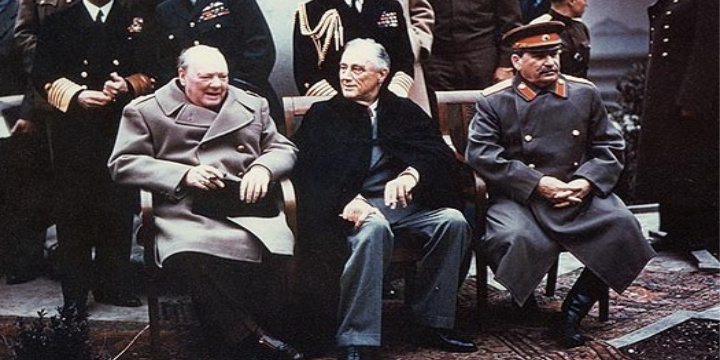
Winston Churchill, Franklin Roosevelt, and Joseph Stalin at the Yalta Summit in 1945. Photo: Wiki Commons.
“The Jewish Underground of Samarkand: How Faith Defied Soviet Rule” by Rabbi Hillel Zaltzman (Mandel Vilar Press, 2023)
“The Jewish Underground of Samarkand: How Faith Defied Soviet Rule” relates the largely unknown story of the Chassidic Jewish underground that operated in Samarkand under the watchful eyes of the KGB — a story of faith, courage, and resilience.
When the Nazis invaded Ukraine, throngs of Jews fled eastward to the Soviet provinces of Central Asia. Members of the Chabad stream of Chassidism settled in the cities of Samarkand and Tashkent in Uzbekistan, and Hillel Zaltzman’s family was among these refugees.
Yet despite the Soviet regime’s brutal repression against religion, the Chabad community continued to teach Torah, open an underground yeshiva, celebrate Jewish holidays, and observe their faith. In vivid detail, Zaltzman tells the story of this community.
Below is an edited excerpt from the book:
On March 4, 1953, the Soviet radio broadcaster took to the air. In a saddened voice, he announced that the mighty Stalin had fallen seriously ill and lost consciousness. This official announcement of Stalin’s illness was unusual for the Soviet Union, since the government always refrained from announcing any illness in their top echelons. We suspected that Stalin had died, and that the milder public announcement was to prepare the citizens of the country for the truth without causing any chaos. But this was only a suspicion, and his death was not yet confirmed.
All through the day, we sat fixed to the radio, listening raptly to every piece of news. We hoped against hope to finally hear the news we had been awaiting for the past 30 years.
Finally, the official announcement was made that Stalin, wicked enemy of the Jews, had died. The top government radio broadcaster, Yuri Levitan, himself a Jew, dramatically announced that a special news release would be broadcast shortly in all the radio stations throughout the Soviet Union. Levitan then addressed the nation solemnly: “On the fifth of March, at 9:50 p.m. Moscow Time, the heart of the First Secretary of the Communist Party of the Soviet Union, Chairman of the Supreme Soviet Council, the Generalissimo Iosif Vissarionovich Stalin, stopped beating.”
We immediately all rushed to the newsstands to purchase the latest paper. Indeed, on the front page was a photo of Stalin lying dead in a coffin. How precious this picture was to us! And how we wished to have seen this image sooner.
In the meantime, we were clueless of the events transpiring at 770 Eastern Parkway, in distant New York. We couldn’t have imagined how the Rebbe experienced and lived with our daily sacrifices for Torah and Judaism, but after we were freed from Russia, we came to realize that, in the words of the Purim Megillah, “Mordecai knew everything that had happened.” And like the righteous Mordecai in his day, the Rebbe worked to obliterate the evil decree facing Russian Jewry through otherworldly, heavenly channels.
Years later, in New York, I heard about a series of intriguing happenings that took place at the Rebbe’s farbrengens during those stormy winter days of 1953.
At a Shabbos farbrengen towards the end of 1952, the Rebbe suggested that the Chassidim present sing a somewhat unusual song. It was during one of the Chassidic melodies customarily sung between the Rebbe’s talks that he suddenly asked, “Does someone here know how to sing Ani Maamin?”
Ani Maamin was a soulful anthem dedicated to the ancient Jewish belief in the Moshiach. It had never before been sung at the Rebbe’s court, but one person present did know it. He began to sing, and was quickly joined by the rest of the participants. As soon as the melody began, the Rebbe’s expression changed and became very serious. He motioned with his hand for the room to sing more forcefully and he too joined in. The song certainly had considerable power: According to one well-known story, a group of Jews had defiantly sung it while being marched to their deaths during the Holocaust. But why sing it now? What could have prompted this impassioned expression of hope, and of anguished yearning?
In all probability, no one at the farbrengen could appreciate this sudden instruction to sing Ani Maamin. Of course, millions of Jews on the other side of the world were indeed facing a crisis of truly terrible proportions, but no one present had any way of knowing the severity of what was transpiring behind the scenes in Russia.
At the Purim farbrengen that spring, a large crowd had gathered to spend the conclusion of the festival with the Rebbe at 770 Eastern Parkway. Tens of attendees had left Russia just several years prior, some after having sat in jail for long periods of time, beaten and crushed by the force of Stalin’s iron arm. Though far away, they could not help but reflect upon their brothers still locked in captivity, trapped in the terrible danger that lay behind the Iron Curtain.
The farbrengen went on all night and towards morning the Rebbe told this story:
“During the Russian revolutionary period, the Rebbe Rashab told the Chassidim to participate in the elections that were to establish a Provisional Government. There was one Chassid who went to vote, but was so completely removed from matters of this world that he knew nothing of what was occurring in the country. He went to vote solely on the Rebbe’s say so. Naturally, he did so after immersing in a mikvah and fastening his gartel, as one does while fulfilling the Rebbe’s instructions. He followed the throngs of people making their way to vote, and after observing them for a short while, learned the proper voting procedure.
“After he had cast his vote, he noticed a noisy group of people gathered near the voting station. The crowd began to shout ‘Hurrah!’ repeatedly, so, still unaware why or for whom they were chanting, he stood there and joined the crowd. ‘Hurrah!’ sounded very much like the two Hebrew words hoo and ra, meaning ‘He is evil,’ so, along with the crowd, he too began to proclaim: ‘Hoo-ra! Hoo-ra! Hoo-ra!’”
The Rebbe then mimicked the Chassid. With a big smile on his face, he cupped his hands together and proclaimed “Hoo-ra!” three times.
When the Rebbe finished recounting the story, he turned to his right and repeated the story and once again put his hands together and said “Hoo-ra!” three times. Then he turned to his left and repeated it again, doing as the Chassid did.
The crowd of Chassidim at the farbrengen were completely taken aback. As astonished as they were by the peculiar scene playing before their eyes, they understood that they were witnessing something beyond their capacity to fathom. No one could explain the Rebbe’s actions, but it was clear that something heavenly had just transpired.
Rabbi Hillel Zaltzman is president of Chamah. He was born in Kharkov, Ukraine, in 1939. He was three years old when his parents fled from the invading Nazis and settled in Samarkand, Uzbekistan. At sixteen, he joined Chamah, an underground organization created to keep Judaism alive despite the Soviet government’s efforts to suppress it. In 1971, he received his exit visa and emigrated to Israel where he helped reestablish Chamah to help Russian Jews reclaim their Jewish heritage.