 Pod Save America Hosts Call on Democrats to Cut All Israel Military Aid, No Longer Accept AIPAC Funding
 Jews, Israelis Targeted in Austria Amid Surge in Antisemitic Incidents; Local Jewish Community Calls for Action
 ‘All of Our Strength’: Over 1,000 Pro-Israel Activists Gather in DC for Solidarity Conference
 ‘Devastated’: Wesley LePatner, Killed in Manhattan Mass Shooting, Was a Jewish Communal, Philanthropic Leader
 Sen. Angus King Vows to No Longer Vote for Israel Military Aid Until Gaza Conditions Improve
 Europe Won’t Pressure Israel to ‘Commit Suicide’ Amid Gaza Backlash, Palestinian State Push, Says Israeli FM
 Israel’s National Soccer Coach Attacked in Athens Before Soccer Fans Chant ‘F–K Israel, Free Palestine’ at Match
 New York Judge Sentences Neo-Nazi to 5 Years for Livestreaming Bomb Threats Against Jewish Hospitals
 US Pressures Lebanon to Issue Cabinet Decision to Disarm Hezbollah Before Talks Continue
 UK Plans to Recognize Palestinian State in September Unless Israel Meets Conditions, Starmer Says


The Reality of Holocaust Trauma
Error: Contact form not found.
 by Jeremy Rosen

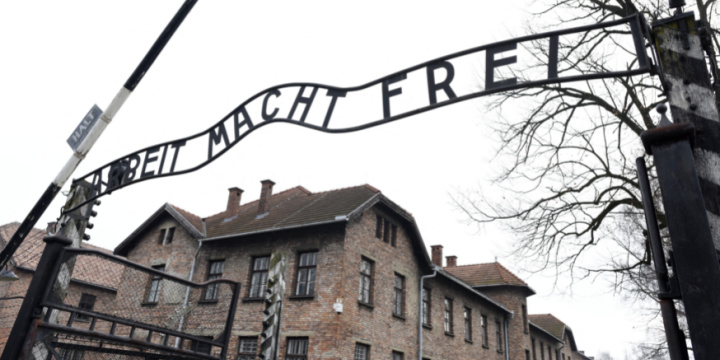
The sign “Arbeit macht frei” (“Work makes you free”) is pictured at the main gate of the former Nazi concentration and extermination camp Auschwitz in Oswiecim, Poland. Reuters/Pawel Ulatowski
We all experience traumas of different kinds. Some are obviously far more serious than others. Jews in particular have been subjected to constant horror and conflict. In the past 100 years, we have experienced the Holocaust and in Israel, the proportionately huge loss of life, much of it civilian, in defense of our homeland. This has caused far deeper psychological scars than many realize.
I have been fortunate not to have suffered anything like what other Jews have. I was, however, traumatized in a small way when I accidentally came across a book, as a child, exploring my father’s library.
It was a graphic and highly disturbing picture book published by The Daily Mail of photographs taken of liberated German concentration camps. I later learned that the publication had been almost immediately withdrawn as unseemly for public consumption. I was terribly upset and indeed, I recall how my father was deeply upset that I discovered it.
Some years later, a new book provided a visual history of German Nazi war crimes. The Scourge of the Swastika by Edward Russel featured horrifically graphic photographic evidence of the horrors of the Holocaust. Emaciated corpses piled high, bodies thrown into mass graves on top of each other, corpses suspended on wire electric fences either shot or who had killed themselves, and children’s bodies and body parts in crematoria.
The book quickly became an international bestseller and remained one for years. It has been referred to in several novels by Howard Jacobson, and it has been cited by numerous writers, dramatists, and directors, as having a profound influence on them.
What I find unforgivable is that the book’s publication resulted in an uproar that such pictures should not be shown to the public. Russell was even ordered by the government to withdraw the book’s publication. Rather than capitulate, he resigned his position of Assistant Judge Advocate General. Thankfully, the book was distributed, and Russel was eventually recognized and celebrated.
How does one explain officialdom’s desire to suppress the reality of what happened? And how does one explain why it was that almost all of the so-called civilized world tried so desperately to hide the evidence of collusion, let alone the refusal to provide refuge?
Was it guilt? Cowardice? Prejudice? The most popular excuse was that the Cold War led people to excuse the Germans because the West needed them to help fight the communists. So better not offend them?”
In Israel too, the establishment tried to hide the horrors or dismiss them as the sins of the Diaspora. Many survivors were berated for not standing up to the Nazis. It was not until the Eichmann trial in 1961 that the Israeli public acknowledged and began to come to terms with the catastrophe. So, it is hardly surprising that elsewhere they just wanted to forget the past and just get on with living.
The reality is that it took many years before the catastrophe came to be spoken about, memorialized, and recognized. Some even protested that it was being commercialized.
So why did those images I found in my father’s library shock me?
First of all, it was the clear realization that if Britain had lost the war, or if I had been born 50 miles eat, across the English Channel, that this would have been my fate too. And why? Why did people who did not know me hate me so much that they wanted to destroy me? What had I done to deserve it? Then there was my disgust at the hypocrisy of so many outwardly religious Christians and supposedly cultured civilized polite citizens of a modern world. The Archbishop of York was the only voice amongst the senior Anglo clergy who voted to allow children to be welcomed as refugees from Germany. Was this the sort of example I should follow? Of course, my brain also told me not everyone was bad — and the more I ventured out into the world, the more I discovered wonderful exceptional human beings.
But I was overwhelmed by a powerful determination that I would devote my life to ensuring Jewish survival as the only answer to such hatred. And that still animates me profoundly. I can still feel the trauma. The only way I can think of how to respond is that we must do whatever we can to strengthen ourselves and to survive, bear witness to evil, and be determined to adhere to the moral and spiritual values our people have committed to, no matter what others do.
The clichéd slogan “Never Again” continues to be ignored or betrayed by others. But we must teach our grandchildren not to forget. Rather as we say in the Shema, we must learn “to speak about it.”
The author is a writer and rabbi, currently based in New York.