 Pod Save America Hosts Call on Democrats to Cut All Israel Military Aid, No Longer Accept AIPAC Funding
 Jews, Israelis Targeted in Austria Amid Surge in Antisemitic Incidents; Local Jewish Community Calls for Action
 ‘All of Our Strength’: Over 1,000 Pro-Israel Activists Gather in DC for Solidarity Conference
 ‘Devastated’: Wesley LePatner, Killed in Manhattan Mass Shooting, Was a Jewish Communal, Philanthropic Leader
 Sen. Angus King Vows to No Longer Vote for Israel Military Aid Until Gaza Conditions Improve
 Europe Won’t Pressure Israel to ‘Commit Suicide’ Amid Gaza Backlash, Palestinian State Push, Says Israeli FM
 Israel’s National Soccer Coach Attacked in Athens Before Soccer Fans Chant ‘F–K Israel, Free Palestine’ at Match
 New York Judge Sentences Neo-Nazi to 5 Years for Livestreaming Bomb Threats Against Jewish Hospitals
 US Pressures Lebanon to Issue Cabinet Decision to Disarm Hezbollah Before Talks Continue
 UK Plans to Recognize Palestinian State in September Unless Israel Meets Conditions, Starmer Says


Why Does The Economist Accept False Palestinian Claim at Face Value?
Error: Contact form not found.
 by Adam Levick

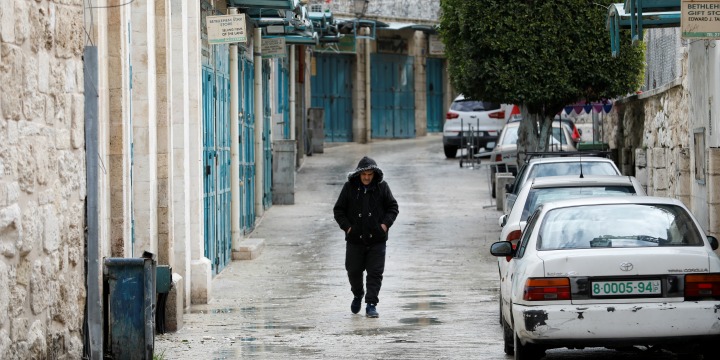
A man walks past closed shops as preventive measures are taken against the coronavirus, in the West Bank town of Bethlehem, March 6, 2020. Photo: Reuters / Mussa Qawasma.
An August 26 article in the print and online editions of The Economist (“The challenge of making Palestinian wine”) represents another example of how journalists often fail to fact check claims by Palestinians on the impact Israel’s occupation has on the disputed territories.
The piece focuses on a small winery in Bethlehem called Philokalia which is owned by Sari Khoury, a Palestinian who, readers are told, gave up his job as a Paris architect in 2014 “to return home to requite his passion for wine.” He now fills 10,000 bottles a year, made only from “indigenous grapes.”
The requisite anti-Israel hook begins in the fourth paragraph:
The business of wine-making is testing enough at the best of times. The headaches of production under military occupation are even more painful.
Mr Khoury is short of labourers because Palestinians can earn five times as much across the wall in Israel. And it is virtually impossible to get a permit from the Israeli authorities to expand his type of business physically. “I can’t even build a shed for my tools,” he explains. “I have to bring them with me in the car every time.” [emphasis added]
However, Bethlehem is in Area A of the West Bank, which means that the Palestinian Authority has completely administrative and military control of the area where Khoury’s winery is located — a fact that The Economist has acknowledged in previous reports. So, Israeli permits to expand his business in the city are not needed.
What’s especially puzzling about this error is that the three Economist correspondents covering Israel and the territories (Gregg Carlstrom, Nicolas Pelham, and Anshel Pfeffer) have decades of experience in the region. So, while normally we’d ask how such a basic error got past the outlet’s Middle East editor, it’s baffling how any one of the three journalists (The Economist has a policy of not identifying the writer of their articles) accepted Khoury’s claim at face value in the first place.
Adam Levick serves as co-editor of CAMERA UK – an affiliate of the Committee for Accuracy in Middle East Reporting and Analysis (CAMERA), where a version of this article first appeared.