 Pod Save America Hosts Call on Democrats to Cut All Israel Military Aid, No Longer Accept AIPAC Funding
 Jews, Israelis Targeted in Austria Amid Surge in Antisemitic Incidents; Local Jewish Community Calls for Action
 ‘All of Our Strength’: Over 1,000 Pro-Israel Activists Gather in DC for Solidarity Conference
 ‘Devastated’: Wesley LePatner, Killed in Manhattan Mass Shooting, Was a Jewish Communal, Philanthropic Leader
 Sen. Angus King Vows to No Longer Vote for Israel Military Aid Until Gaza Conditions Improve
 Europe Won’t Pressure Israel to ‘Commit Suicide’ Amid Gaza Backlash, Palestinian State Push, Says Israeli FM
 Israel’s National Soccer Coach Attacked in Athens Before Soccer Fans Chant ‘F–K Israel, Free Palestine’ at Match
 New York Judge Sentences Neo-Nazi to 5 Years for Livestreaming Bomb Threats Against Jewish Hospitals
 US Pressures Lebanon to Issue Cabinet Decision to Disarm Hezbollah Before Talks Continue
 UK Plans to Recognize Palestinian State in September Unless Israel Meets Conditions, Starmer Says


Christie’s Cancels Follow-Up Auction of Jewelry With Nazi Ties After Facing ‘Intense Scrutiny’
 by Shiryn Ghermezian

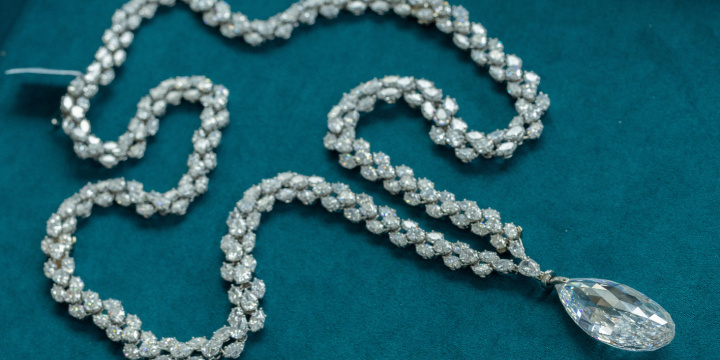
The 90 carat Briolette of India Diamond Necklace by Harry Winston is seen during a preview of the 700-piece jewelery collection of the late Austrian billionaire Heidi Horten at Christie’s before the auction sale in Geneva, Switzerland, May 8, 2023. Photo: REUTERS/Denis Balibouse
The auction house Christie’s canceled an upcoming auction of jewelry from an Austrian art collector after facing backlash over the source of her wealth, which was amassed by buying Jewish companies forcibly sold in Nazi Germany.
The majority of the 700-piece jewelry collection from the estate of Heidi Horten was auctioned off in May in a series of sales in Geneva and online. It garnering $202 million and set a new record for the world’s most valuable single collection of jewelry to be auctioned.
As per Horton’s request, all the proceeds will be donated to “a foundation that supports philanthropic causes, including medical research, children’s welfare, and access to the arts,” Christie’s noted on its website. The auction house also said in May it would make a “significant contribution” from the sale’s final proceeds to organizations that further Holocaust research and education.
Christie’s scheduled to have an additional, online auction for the remaining 300 pieces in the collection in November — but said on Thursday that it will not proceed with the sale.
“The sale of the Heidi Horten jewelry collection has provoked intense scrutiny, and the reaction to it has deeply affected us and many others, and we will continue to reflect on it,” Anthea Peers, Christie’s president of Europe, the Middle East, and Africa, told Artnet News in an emailed statement.
Horten’s late husband, German businessman Helmut Horten, built his retail empire in the 1930s by purchasing businesses — sometimes way below market prices — that Jews were forced to sell by the Nazis when Adolf Hitler was in power. Helmut was a member of the Nazi Party during World War II, and when he died in 1987, he left “a significant inheritance to Mrs. Horten,” Christie’s said. Heidi died last year at the age of 81.
Knowing the Horten family’s Nazi ties, many demanded that Christie’s call off the auction before it started, including the Simon Wiesenthal Center, the World Federation of Diamond Bourses, the American Jewish Committee, and the Holocaust Survivors Foundation USA. They called the auction “insulting” and “patently offensive,” said it “unquestionably trivializes the Holocaust,” and accused Christie’s of “perpetuating a disgraceful pattern of whitewashing Holocaust profiteers.”
The Tel Aviv Museum of Art even decided to withdraw as hosts of a conference on art restitution organized by Christie’s after the auction house faced criticism for selling the jewelry collection. Most Jewish institutions that promote Holocaust education and research also reportedly refused to accept a donation of the proceeds from Christie’s because of Helmut’s Nazi ties, including Yad Vashem.
The Holocaust Survivor Foundation USA welcomed news of the auction’s cancellation this week.