 Pod Save America Hosts Call on Democrats to Cut All Israel Military Aid, No Longer Accept AIPAC Funding
 Jews, Israelis Targeted in Austria Amid Surge in Antisemitic Incidents; Local Jewish Community Calls for Action
 ‘All of Our Strength’: Over 1,000 Pro-Israel Activists Gather in DC for Solidarity Conference
 ‘Devastated’: Wesley LePatner, Killed in Manhattan Mass Shooting, Was a Jewish Communal, Philanthropic Leader
 Sen. Angus King Vows to No Longer Vote for Israel Military Aid Until Gaza Conditions Improve
 Europe Won’t Pressure Israel to ‘Commit Suicide’ Amid Gaza Backlash, Palestinian State Push, Says Israeli FM
 Israel’s National Soccer Coach Attacked in Athens Before Soccer Fans Chant ‘F–K Israel, Free Palestine’ at Match
 New York Judge Sentences Neo-Nazi to 5 Years for Livestreaming Bomb Threats Against Jewish Hospitals
 US Pressures Lebanon to Issue Cabinet Decision to Disarm Hezbollah Before Talks Continue
 UK Plans to Recognize Palestinian State in September Unless Israel Meets Conditions, Starmer Says


Headlines Omit Violent Nature, Palestinian Affiliation of Terrorists in Recent Attacks
Error: Contact form not found.
 by Chaim Lax

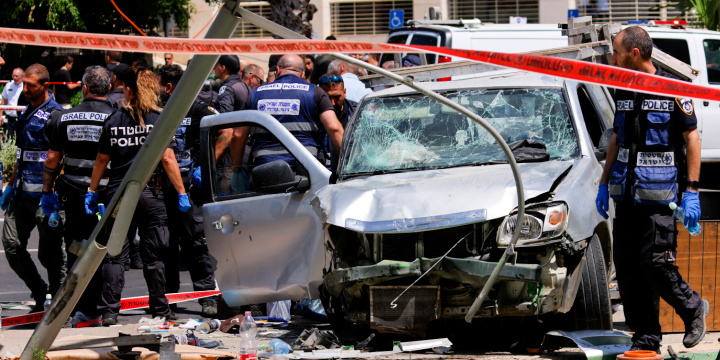
Illustrative: Israeli police at the scene of a terror attack in Tel Aviv. Photo: Reuters/Amir Cohen
Within the span of 12 hours, one Israeli was killed and at least six others were wounded in two separate Palestinian terror attacks.
The first attack occurred on the evening of August 30, when a Palestinian teen from eastern Jerusalem stabbed a 25-year-old Israeli in the back at the Shivtei Yisrael light rail station. The victim managed to escape before an off-duty Border Police officer shot the terrorist multiple times, ultimately killing him.
Approximately 12 hours later, a Palestinian terrorist rammed a truck into a group of off-duty soldiers walking along the highway near a checkpoint, hit a nearby car and then drove away. Israeli security forces were able to kill the terrorist before he could commit another ramming attack.
In their coverage of these two terror attacks, several news outlets provided vague headlines that left readers with hazy information as to the nature of these attacks.
In the headlines for their reports on the Jerusalem light rail stabbing attack, both the Associated Press (AP) and Agence France-Presse (AFP) wire services focused on the fate of the terrorist, while obscuring the identity of his victim and the nature of his attack.
The AP headline highlighted the death of a “Palestinian teen assailant” at the hands of the Israeli police, but failed to provide its readers with any context as to what the “assailant” had done and who he had attacked.
It appears that for this esteemed news service, the fate of the terrorist is more newsworthy than either his actions or his victim.
An Israeli civilian is stabbed but @AP‘s headline also focuses instead on the death of the terrorist responsible. https://t.co/yzNNq73kuk pic.twitter.com/yVc7qfzEvT
— HonestReporting (@HonestReporting) August 31, 2023
The AFP headline was even more vague, focusing solely on the fate of the terrorist while omitting the fact that the “teenage attacker” was a Palestinian, that his victim was Israeli, or that the attack was of a nationalistic character.
Hey @AFP,
? Why focus solely on the perpetrator?
? Who is the attacker?
? Who is his victim?
? What is a “Jerusalem stabbing”?#HeadlineFailhttps://t.co/IaHpbDD1LL pic.twitter.com/KSKpjddWTJ— HonestReporting (@HonestReporting) August 31, 2023
Perhaps the most egregious (but unsurprising) headline on the Jerusalem attack came from Al Jazeera, which omitted the fact that an innocent Israeli had been stabbed in the back, and left out any mention of an attack altogether.
For anyone reading the Al Jazeera headline, it would appear as if a random Palestinian teenager was killed by the Israel Police for no reason. This is the perfect example of how the Qatar-funded news organization conceals reality in order to promote its anti-Israel narrative.

Similar to its report on the Jerusalem light rail stabbing attack, AFP’s initial headline on the truck ramming attack was equally vague and uninformative.
The news service merely reported that three people were injured in a truck ramming attack, omitting the fact that the terrorist was a Palestinian or that the victims were Israeli.
Even the first paragraph of this report was hazy with the details, merely referring to the attack being committed by a “truck driver” and that “three people” had been injured.
In its headline, The Guardian not only omitted the fact that the victims were Israelis, but even attempted to minimize the nature of the attack by describing it as “Palestinian motorist drives car into pedestrians.”
For the average reader, this looks like a simple road accident — not the deliberate mowing down of Israelis by a terrorist bent on killing them.
Hey @guardian, we fixed your headline for you.https://t.co/gYY4DsvgGF pic.twitter.com/DL8G53GlOb
— HonestReporting (@HonestReporting) August 31, 2023
If all the information is eventually provided further down in the reports, why is it so important for the headlines to be both accurate and informative?
As studies have shown, a large percentage of news consumers just read the headline and not the entire article.
When media organizations omit vital information from their headlines, they are leaving their readers misinformed and without a proper understanding of the event in question.
The author is a contributor to HonestReporting, a Jerusalem-based media watchdog with a focus on antisemitism and anti-Israel bias — where a version of this article first appeared.