 Pod Save America Hosts Call on Democrats to Cut All Israel Military Aid, No Longer Accept AIPAC Funding
 Jews, Israelis Targeted in Austria Amid Surge in Antisemitic Incidents; Local Jewish Community Calls for Action
 ‘All of Our Strength’: Over 1,000 Pro-Israel Activists Gather in DC for Solidarity Conference
 ‘Devastated’: Wesley LePatner, Killed in Manhattan Mass Shooting, Was a Jewish Communal, Philanthropic Leader
 Sen. Angus King Vows to No Longer Vote for Israel Military Aid Until Gaza Conditions Improve
 Europe Won’t Pressure Israel to ‘Commit Suicide’ Amid Gaza Backlash, Palestinian State Push, Says Israeli FM
 Israel’s National Soccer Coach Attacked in Athens Before Soccer Fans Chant ‘F–K Israel, Free Palestine’ at Match
 New York Judge Sentences Neo-Nazi to 5 Years for Livestreaming Bomb Threats Against Jewish Hospitals
 US Pressures Lebanon to Issue Cabinet Decision to Disarm Hezbollah Before Talks Continue
 UK Plans to Recognize Palestinian State in September Unless Israel Meets Conditions, Starmer Says


Tel Aviv Riot: How Intra-Communal Eritrean Violence Was Used To Malign Israel
Error: Contact form not found.
 by Chaim Lax

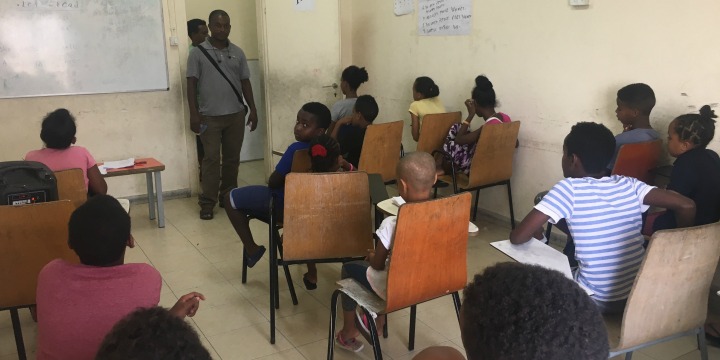
A class in progress at the Abugida Eritrean Community School in Tel Aviv, Israel, Sept. 25, 2018. Photo: Thomson Reuters Foundation / Inna Lazareva.
On September 2, 2023, the streets of south Tel Aviv were turned into a battle zone as rival groups of Eritrean expats fought amongst themselves and then, later, with the Israeli police, who were attempting to disperse the melee.
The riot began when Eritreans opposed to the dictatorial regime in their home country confronted a group of Eritreans celebrating the African country’s independence. The confrontation quickly turned into a full-blown scene of violence, with members of both the pro-government and opposition camps attacking each other with pieces of lumber, metal, rocks, and at least one axe.
Ultimately, the Israeli police were forced to use a variety of riot dispersal methods, including tear gas, stun grenades, and live ammunition fired in the air, to quell the riot and return calm to the area. With roughly 150 people injured, the brawl garnered a significant amount of international media attention.
While most of the media accurately portrayed the riot, several news outlets disproportionately focused on the police response, creating the false impression that the tumult was essentially a dispute between Eritrean refugees and the Israeli police.
Several commentators on social media also used the police response as an opportunity to malign the Jewish state.
Several international news outlets played down the violent clash between the two groups of Eritreans, and instead focused heavily on the Israeli police’s response.
For example, the BBC’s initial headline reported it as “Police clash with Eritrean asylum seekers.” Even though the headline was later updated, the article continued to dedicate several paragraphs to the police response, while only briefly referring to the violent confrontation between the Eritrean groups in two paragraphs.
The BBC report even went so far as to implicitly blame Israel for the rampage, claiming that it “was sparked after activists opposed to the Eritrean government said they asked Israeli authorities to cancel an embassy event on Saturday.”
Similarly, The Guardian’s report, under the headline “Eritrean asylum seekers and police injured in clashes in Israel,” dedicated the majority of its coverage to the skirmish between the police and the Eritrean rioters.
When referencing the initial clashes that pre-empted the police response, The Guardian only mentioned a “demonstration” that “turned violent,” as well as “clashes … between supporters and opponents of the Eritrean regime.”
This is a far cry from its coverage of a similar riot in early August in Sweden. In that instance, nearly the entire piece was dedicated to describing the intra-communal fighting and not the police’s response.
This false portrayal of the riot as primarily a clash between the police and Eritrean refugees was also evident in Sky News’ headline, “More than 140 injured in clashes between Eritrean asylum seekers and Israeli police.”
Voice of America’s one-minute video, “Eritrean Asylum-Seekers Clash With Israeli Police,” predominantly featured images of the police response and almost no coverage of the violent skirmishes that precipitated the response.
The story was not newsworthy for The New York Times until 24 hours later, when the Israeli government began discussing a plan to deport those who had engaged in the violence, contributing to a false and misleading media narrative that portrays the Israeli police and government as the aggressors and victimizers of Eritrean refugees.
Some anti-Israel social media personalities took their hate to the extreme by erasing any mention of the clash between the two Eritrean groups, and portraying the Israeli police as using deadly force without provocation.
The British rapper Lowkey claimed that “Israeli police opened fire with live ammunition on a protest of Eritrean refugees in Tel Aviv,” while pro-Palestinian activist Heather Alexandra was more blunt in her revolting message by tweeting that “Israeli police fired live bullets at black people in Tel Aviv today.”
Independent journalist Rafael Shimunov claimed that “There are images of corpses of Eritrean refugees who were murdered by Israeli police in a playground” (even though there were no reported deaths from the riot at the time of his tweet), and that “Their ‘crime’ was protesting an event by the Eritrean embassy. Rather than deescalate…they used bullets and will now smear the dead.”
Palestinian journalist Mariam Barghouti tweeted that “Israeli police are brutally cracking down on Eritrean refugees in Tel Aviv,” adding that this signified the “essence and core of Israeli supremacy. A single ethnoreligious state for White Jewish people.”
Barghouti clearly doesn’t account for the fact that the majority of Israeli citizens are of non-European descent.
Various skirmishes have occurred around the world between expatriate Eritrean supporters and opponents of its government. However, only the melee that occurred in Israel seems to have resulted in a change of narrative to turn an intra-Eritrean conflict into one between the police and Eritrean expats.