 Pod Save America Hosts Call on Democrats to Cut All Israel Military Aid, No Longer Accept AIPAC Funding
 Jews, Israelis Targeted in Austria Amid Surge in Antisemitic Incidents; Local Jewish Community Calls for Action
 ‘All of Our Strength’: Over 1,000 Pro-Israel Activists Gather in DC for Solidarity Conference
 ‘Devastated’: Wesley LePatner, Killed in Manhattan Mass Shooting, Was a Jewish Communal, Philanthropic Leader
 Sen. Angus King Vows to No Longer Vote for Israel Military Aid Until Gaza Conditions Improve
 Europe Won’t Pressure Israel to ‘Commit Suicide’ Amid Gaza Backlash, Palestinian State Push, Says Israeli FM
 Israel’s National Soccer Coach Attacked in Athens Before Soccer Fans Chant ‘F–K Israel, Free Palestine’ at Match
 New York Judge Sentences Neo-Nazi to 5 Years for Livestreaming Bomb Threats Against Jewish Hospitals
 US Pressures Lebanon to Issue Cabinet Decision to Disarm Hezbollah Before Talks Continue
 UK Plans to Recognize Palestinian State in September Unless Israel Meets Conditions, Starmer Says


Undeterred by Russian Attacks, Jews in Ukrainian City of Odesa Prepare for a Second Rosh Hashanah at War
Error: Contact form not found.
 by Ben Cohen

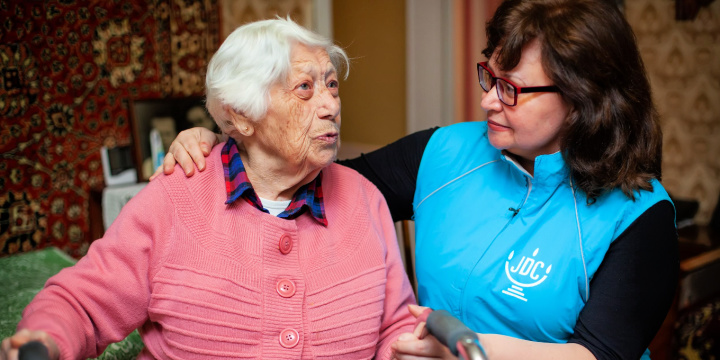
Inna Vdovichenko of JDC’s operation in Odesa is seen on a home visit with Rosa Ushakova, one of thousands of vulnerable Jews in the city. Photo: Konstantin Gerasimenko
For the second year running, Jews in the Ukrainian city of Odesa will mark Rosh Hashanah — the Jewish New Year — on Friday night under the threat of Russian missile attacks.
The exact number of Jews currently living there has not been determined. “We didn’t have the exact number before [the Russian invasion of] Feb. 2022 just as we didn’t have it afterwards,” Inna Vdovichenko — the director of the American Jewish Joint Distribution Committee’s (JDC) operations in the city — told The Algemeiner this week. “We always estimated it at about 40,000 people.”
A key European center of Jewish intellectual and cultural life from the nineteenth century onwards, Odesa today is tightly focused on survival. The Black Sea port has been frequently targeted over the course of this year, with one Russian attack on a grain storage facility on July 23 resulting in the destruction of at least 50 buildings, including four kindergartens and five schools, according to the UN. A few days later, another Russian missile struck the offices of Hillel International, a Jewish student organization, in the city. Dozens of civilians have been killed and hundreds more wounded in the near constant pounding by Russian forces, which intensified dramatically after Russian President Vladimir Putin’s regime announced on July 17 that it was unilaterally canceling its participation in a deal to export grain from Ukraine.
The parameters of Vdovichenko’s work over the previous 18 months have been determined by, on the one hand, arranging evacuations from the city and, on the other, providing a range of services to those who remain, from deliveries of food packages to online celebrations of Shabbat. Her efforts, like those of her colleagues, are buoyed by the extensive presence of JDC — a humanitarian agency that first arrived in the region in the wake of the Bolshevik revolution more than a century ago — across Ukraine, with its network of “cheseds,” or community centers, providing thousands of needy Jews with a tangible link to their community and their heritage.
In the first days following the Russian invasion, “we were working on evacuations all the time,” Vdovichenko said. Initially, up to 15 buses were departing daily, spiriting evacuees over the border into Moldova. “Now, there is only one bus, and sometimes only one or two people are on the bus,” she noted. While the number of evacuees on any given day depends on the situation on the ground — during bursts of Russian attacks there are more evacuees, and during quieter periods there are less, Vdovichenko observed — the overall trend is to stay put.
The onset of the war meant that “we had to assume new roles, in addition to doing our regular work in a different environment during a blackout,” Vdovichenko said. “We worked as a humanitarian hub distribution center, and Odesa was a transit point. We rented a warehouse, and the trucks pick up foodstuffs and take them to other locations.”
Vdovichenko pointed out with quiet amusement that the number of people accessing JDC’s services has actually increased since the invasion, thanks to the influx of displaced persons from nearby cities and towns, such as Mykolaiv — which endured a punishing Russian onslaught in the first months of the war — into Odesa, as well as evacuees who decided to return despite the obvious dangers in the city. “[The chesed] used to serve about 5,000 people; now it’s 7,000,” she said.
There are many reasons why Ukrainians return to cities under fire, but the desire to be with their families is a powerful one, Vdovichenko explained. “People want to be back with their families,” she said. “Ukrainian men aged between 18 and 60 cannot leave the country and can be conscripted at any moment, which means that mothers and children are separated from husbands and fathers.” Vdovichenko related the experience of Tamara, a women in her early 70s who traveled on one of the first buses of evacuees to safety in Germany in 2022. “She came back, saying, ‘My son is here, I want to be near him,'” she recalled.
Those providing the aid are not immune from the heavy toll exacted by the war as they battle to maintain their morale. “We’re just human beings, and behind all of us there is a story,” Vdovichenko, who has worked for JDC for the past 25 years, reflected. “But JDC saves me. I know that I am needed, and there are people who need my help.”
The agency has established seven trauma centers across Ukraine, Vdovichenko said, whose psychologists and counselors are available to JDC’s pressured staff as well. JDC aid workers have also maintained their visits to homebound clients, despite the dangers of moving around Odesa. On many occasions, the agency’s staff members have stayed overnight with those whom they are visiting, or have even taken them into their own homes. Sometimes the terrible circumstances in which the city’s residents are thrown together yields unexpected positive results. Vdovichenko told the story of two elderly women who were displaced from the city of Kherson, where both were regular visitors to the local chesed. “They are now living together; one is 76 and the other is 86,” Vdovichenko said. “Their names are Lyubova, which means ‘love,’ and Nadezhda, which means ‘hope.'”
Despite the emphasis on war aid, JDC has not lost sight of the importance of providing its clients with deeper, spiritually comforting hope. “I was at the chesed when they had a choir rehearsal,” Vdovichenko said. “One Holocaust survivor who was there said to me, ‘Everything is perfect, but without the choir I would die.'”
The chesed in Odesa still stages a variety of online and in-person events, such as Shabbat dinners, singing lessons, and lectures on Judaism, art and, other subjects. Those attending range from young students to elderly people. “It’s incredible that this level of activity continues, supporting people of different ages,” Vdovichenko remarked.
Going forward, she is adamant that JDC will continue to thrive in adversity. “This has always been a city where people help each other and love each other,” Vdovichenko stressed. “Most of the time, if someone asks you, ‘How are you?’ you just say, ‘I’m fine,’ but here it means, ‘Are you hungry?’ ‘Are you cold?’ ‘Do you need somewhere to live?'”
Jewish life in the city “is going on,” Vdovichenko underlined. “All our efforts are centered on Jewish values. These values help us implement our work, and that’s what we’ll continue doing.”