 Pod Save America Hosts Call on Democrats to Cut All Israel Military Aid, No Longer Accept AIPAC Funding
 Jews, Israelis Targeted in Austria Amid Surge in Antisemitic Incidents; Local Jewish Community Calls for Action
 ‘All of Our Strength’: Over 1,000 Pro-Israel Activists Gather in DC for Solidarity Conference
 ‘Devastated’: Wesley LePatner, Killed in Manhattan Mass Shooting, Was a Jewish Communal, Philanthropic Leader
 Sen. Angus King Vows to No Longer Vote for Israel Military Aid Until Gaza Conditions Improve
 Europe Won’t Pressure Israel to ‘Commit Suicide’ Amid Gaza Backlash, Palestinian State Push, Says Israeli FM
 Israel’s National Soccer Coach Attacked in Athens Before Soccer Fans Chant ‘F–K Israel, Free Palestine’ at Match
 New York Judge Sentences Neo-Nazi to 5 Years for Livestreaming Bomb Threats Against Jewish Hospitals
 US Pressures Lebanon to Issue Cabinet Decision to Disarm Hezbollah Before Talks Continue
 UK Plans to Recognize Palestinian State in September Unless Israel Meets Conditions, Starmer Says


A Sukkot Guide for the Perplexed, 2023
Error: Contact form not found.
 by Yoram Ettinger

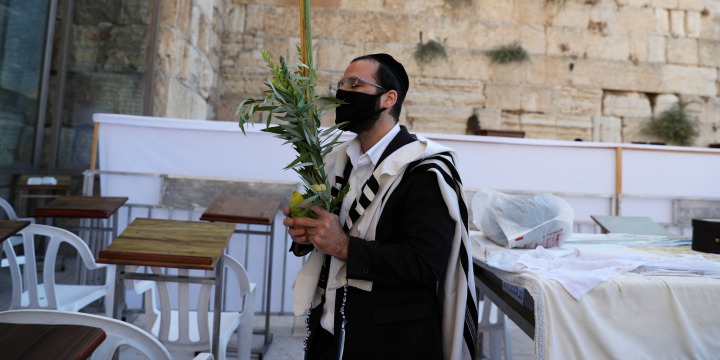
A Jewish worshipper holds the Four Species, used in rituals on the holiday of Sukkot, as he takes part in the priestly blessing at the Western Wall, Judaism’s holiest prayer site, amid Israel’s second-wave coronavirus disease (COVID-19) lockdown, in Jerusalem’s Old City, Oct. 5, 2020. Photo: Reuters / Ronen Zvulun.
Ahead of Sukkot, which begins on Friday, here are some interesting facts about the holiday:
1. Sukkot, the Feast of Tabernacles, derives its name from the first stop of the Exodus — the town of Sukkot — as documented in Exodus 13:20-22 and Numbers 33:3-5. Sukkot was also the name of Jacob’s first stop west of the Jordan River, upon returning to the Land of Israel from his 20 years of work for Laban in Aram (Genesis 33:17).
2. Sukkot is a Jewish national liberation holiday, commemorating the Biblical Exodus, and the transition of the Jewish people from bondage in Egypt to liberty. It also celebrates the ongoing Jewish in-gathering in the Land of Israel. The Exodus from Egypt inspired the US Founding Fathers and also the abolitionist movement.
3. The construction of the Holy Tabernacle, during the Exodus, was launched on the first day of Sukkot (full moon).
4. Sukkot underscores the gradual transition from the spiritual state-of-mind during Rosh Hashanah and Yom Kippur to the mundane of the rest of the year, and from religious tenets of Judaism to the formation of the national, historic and geographical Jewish identity.
5. The seven days of Sukkot — a holiday celebrated in the seventh Jewish month, Tishrei — are dedicated to seven supreme guests-in-spirit and notable care-takers: Abraham, Isaac, Jacob, Joseph, Moses, Aaron, and David. They were endowed with faith, reality-based-optimism, humility, magnanimity, principle-driven leadership, compassion, tenacity in the face of daunting odds, and the mentality of peace-through-strength.
6. Sukkot features the following four species (Leviticus 23:39-41): one citron (representing King David, the author of Psalms), one palm branch (representing Joseph), three myrtle branches (representing the three Patriarchs), and two willow branches (representing Moses and Aharon, the role models of humility), which are bonded together, representing unity-through-diversity and strength-through-unity.
They embody four leadership prerequisites: a solid backbone (palm branch), humility (willow), a compassionate heart (citron), and penetrating eyes (myrtle). These species also represent the agricultural regions of the Land of Israel: the southern Negev and Arava (palm); the slopes of the northern Golan Heights, Upper Galilee, and Mt. Carmel (myrtle); the streams of the central mountains of Judea and Samaria, including Jerusalem (willow); and the western coastal plain (citron).
7. Traditionally, Sukkot is dedicated to the study of the Biblical Scroll of Ecclesiastes, written by King Solomon, which highlights humility, morality, patience, learning from past mistakes, commemoration and historical perspective, family, friendship, long-term thinking, proper timing, realism, and knowledge.
8. During the holiday of Sukkot, it is customary to highlight humility by experiencing a seven-day-relocation from one’s permanent dwelling to the temporary, humble, wooden booth (Sukkah in Hebrew), which sheltered the people of Israel during the Exodus.
The author is a commentator and former Israeli ambassador.