 Pod Save America Hosts Call on Democrats to Cut All Israel Military Aid, No Longer Accept AIPAC Funding
 Jews, Israelis Targeted in Austria Amid Surge in Antisemitic Incidents; Local Jewish Community Calls for Action
 ‘All of Our Strength’: Over 1,000 Pro-Israel Activists Gather in DC for Solidarity Conference
 ‘Devastated’: Wesley LePatner, Killed in Manhattan Mass Shooting, Was a Jewish Communal, Philanthropic Leader
 Sen. Angus King Vows to No Longer Vote for Israel Military Aid Until Gaza Conditions Improve
 Europe Won’t Pressure Israel to ‘Commit Suicide’ Amid Gaza Backlash, Palestinian State Push, Says Israeli FM
 Israel’s National Soccer Coach Attacked in Athens Before Soccer Fans Chant ‘F–K Israel, Free Palestine’ at Match
 New York Judge Sentences Neo-Nazi to 5 Years for Livestreaming Bomb Threats Against Jewish Hospitals
 US Pressures Lebanon to Issue Cabinet Decision to Disarm Hezbollah Before Talks Continue
 UK Plans to Recognize Palestinian State in September Unless Israel Meets Conditions, Starmer Says


Hamas’ Massacre Shows That Terrorist Groups Can’t Be ‘Managed’
Error: Contact form not found.
 by Shoshana Bryen and Stephen Bryen

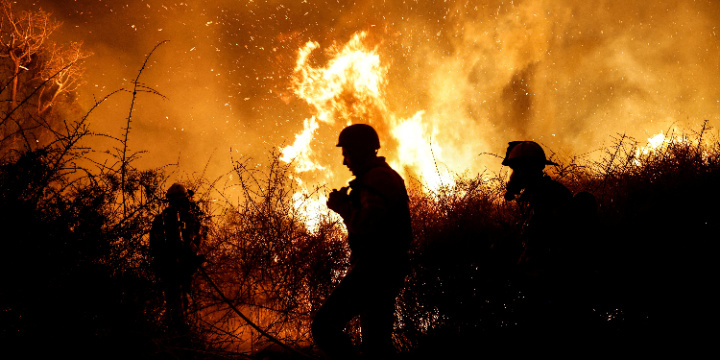
Firefighters work to put out a fire in an open field, following a mass-infiltration by Hamas gunmen from the Gaza Strip, near a hospital in Ashkelon, southern Israel, Oct. 7, 2023. Photo: REUTERS/Amir Cohen
The main lesson for Israel from the hideous Hamas attacks suffered over the weekend is a simple one: Terrorists can’t be managed.
For decades, Israel worked with Hamas and the Palestinian Authority (PA) by combining incentives on the one hand, with controlled military responses on the other. Major attacks, including rockets from Gaza last May, prompted retaliation, usually with air power, and a subsequent cease-fire, often brokered by Egypt.
When Iranian-sponsored militias set up weaponry in the West Bank, the Israel Defense Forces (IDF) conducted on-the-ground operations in Jenin and Nablus.
In the case of Hezbollah, Israel allowed the US to broker a maritime border semi-deal last year that allows Lebanon to pump natural gas and receive the financial benefit, which will accrue to Hezbollah and allow them to run the government in Beirut.
All this has been done in the name of tamping down fires that could ignite the big blaze.
The policy derived from several elements. The first is “world opinion,” specifically American government opinion, that could turn against Israel unless it responded to terrorism in a manner congruent with pronounced Western standards. Israel believed that any military response had to happen quickly to avoid blowback from allies and friends, as much as from enemies.
Israel has also always believed that someday, somehow there would be a political solution. Israeli leaders would get angry with Palestinian leadership — Hamas or the PA — but they also talked to them, subsidized them, looked the other way at language that veered into Nazi tropes, and even invited them to lunch.
The corollary was not to hammer too hard in response to terror and to go after individual terrorists, not the leadership, as much as possible — always leaving the door open to more talks.
Israel also thought it could use its long-range capabilities, especially airpower, to destroy enemy assets. While this sometimes worked as a form of retaliation, it never stopped the massive accumulation of Iranian-supplied and financed missiles, rockets and other weapons.
Hamas just demonstrated that fact by sending thousands of missiles into Israel, and overwhelming Israeli air defenses less than six months after last Spring’s “rocket wars.”
Israel understood, too, that billions of dollars flowed to the Palestinians not only from Iran and its partners like Qatar, but also from the US and Europe; much of it directly and indirectly fueled terrorism and hatred.
Israel itself provides gas and clean water as well as food aid and Israeli work permits to Palestinians. Before the weekend, 18,000 Gaza Palestinians entered Israel daily, sending $2 million per day into Gaza. To some extent, it was to help the people. To another, it aimed to moderate or placate Hamas.
This was no closer to true than the US financial support for Iran offered by the Obama and Biden administrations, which it hoped would placate or moderate the mullah regime in Tehran.
One deeply-experienced Israeli expert writing about the intelligence failure that allowed preparations for the Hamas attack to go undetected noted, “Israelis have grown accustomed to missile attacks from Gaza.”
In short, Israel built up some defenses, retaliated, and otherwise figured it was controlling the situation, when in fact it was losing the larger war.
Carrots and sticks failed; there is now no going back. The more media coverage shows the shocking depravity of Hamas terrorists when they found Israeli and even foreign civilians to rape and murder– people burned alive and babies decapitated — the more necessary it becomes for Israel to revise its battle plan.
Because of internal political conflict in Israel, many citizens have lost faith in their democratic institutions. The Gaza war has temporarily created some unity — and soldier loyalty to the IDF is clear — but that won’t suffice.
Israel needs a new security strategy and an internal political solution. A unity government could be a big step forward.
Prime Minister Benjamin Netanyahu says he intends to “crush Gaza.” But what does that mean? Israel will send in the army and try to free as many hostages held in Gaza as possible. Then Israel will go after as many Hamas leaders as it can find, but many will likely try to cross the border into Egypt.
If and when Hamas is ousted it will leave the problem of who will run the Gaza Strip? Israel could, in theory, reoccupy it, but the burden will be huge and threats from inside lethal. It also risks blowback from Israel’s usual allies and friends — a political matter with security implications.
There aren’t many rays of hope in the situation. However, the fact that the UN constructed an international military coalition to manage Haiti temporarily in the absence of a national Haitian government and in the face of brutal rule by gangs, leaves some slim hope for an international solution until new Palestinian leadership emerges.
If that is possible.
Stephen Bryen served as Staff Director of the Near East Subcommittee of the Senate Foreign Relations Committee and as a Deputy Under Secretary of Defense for Policy. Shoshana Bryen is Senior Director of The Jewish Policy Center and Editor of inFOCUS Quarterly. A version of this article was originally published in the Asia Times.