 Pod Save America Hosts Call on Democrats to Cut All Israel Military Aid, No Longer Accept AIPAC Funding
 Jews, Israelis Targeted in Austria Amid Surge in Antisemitic Incidents; Local Jewish Community Calls for Action
 ‘All of Our Strength’: Over 1,000 Pro-Israel Activists Gather in DC for Solidarity Conference
 ‘Devastated’: Wesley LePatner, Killed in Manhattan Mass Shooting, Was a Jewish Communal, Philanthropic Leader
 Sen. Angus King Vows to No Longer Vote for Israel Military Aid Until Gaza Conditions Improve
 Europe Won’t Pressure Israel to ‘Commit Suicide’ Amid Gaza Backlash, Palestinian State Push, Says Israeli FM
 Israel’s National Soccer Coach Attacked in Athens Before Soccer Fans Chant ‘F–K Israel, Free Palestine’ at Match
 New York Judge Sentences Neo-Nazi to 5 Years for Livestreaming Bomb Threats Against Jewish Hospitals
 US Pressures Lebanon to Issue Cabinet Decision to Disarm Hezbollah Before Talks Continue
 UK Plans to Recognize Palestinian State in September Unless Israel Meets Conditions, Starmer Says


An Open Letter to the Queen of Jordan
Error: Contact form not found.
 by Alex Safian

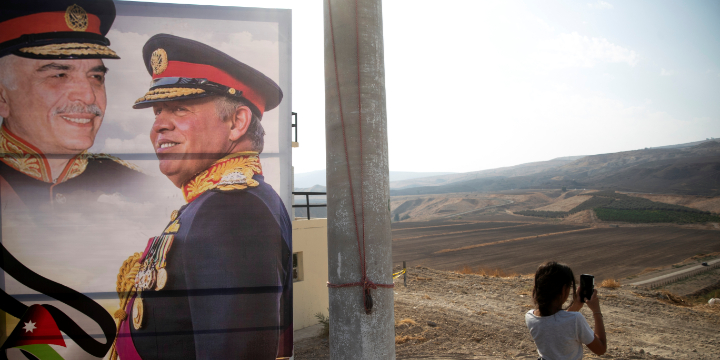
A picture of Jordanian King Abdullah and his father, the late King Hussein, is seen as a girl visits the ‘Island of Peace’ in an area known as Naharayim in Hebrew and Baquora in Arabic, on the Jordanian side of the border with Israel, Nov. 9, 2019. Photo: Reuters / Ronen Zvulun.
Her Majesty Queen Rania Al Abdullah
Raghadan Palace
Hashemite Kingdom of Jordan
Queen Abdullah,
I watched with great interest your interview on October 25 with Christiane Amanpour of CNN in which you stated:
Are we being told that it is wrong to kill a family, an entire family, at gunpoint, but it’s OK to shell them to death? I mean, there is a glaring double standard here. It is just shocking to the Arab world …
Essentially they’re given a choice between expulsion or extermination, between ethnic cleansing and genocide. And no people should be given, [should] have to face, that kind of choice. The people of Palestine should not, [the people] of Gaza should not, be forced to be moved again …
This is a 75-year-old story, a story of overwhelming death and displacement to the Palestinian people. It is a story of an occupation under apartheid regime, that occupies lands, that demolishes houses, confiscates lands, military incursions, night raids.
Of course, the apartheid and related charges are entirely baseless.
But judging by your earlier comments, especially regarding your use of the terms “shell” and “expulsion,” it is perhaps possible you might not be fully aware of the so-called Black September crisis — really civil war — which took place in Jordan in 1970, when your country’s existence was threatened by the Palestine Liberation Organization (PLO).
I therefore hope you do not mind my offering a brief outline of the terrible events of those days, including the actions your late father-in-law King Hussein had to take to defeat the PLO, and to expel them from Jordan.
I would be happy to supply more details and references upon Your Majesty’s request, but here is the short version:
The Palestine Liberation Organization had been firmly entrenched in Jordan, with its large Palestinian population, since the organization was founded in the 1960s. As the PLO’s military power grew, it became a state within a state, challenging King Hussein’s rule and clashing repeatedly with the Jordanian army and security forces.
King Hussein blamed Yasir Arafat and the PLO for their attacks on Israel that provoked damaging retaliation. His attempts to prevent such PLO attacks were met by a number of assassination attempts.
Finally, in September 1970, a PLO group hijacked three Western airliners to Jordan and blew them up after evacuating the passengers. On September 15, seemingly not in control of his country or his capital, which was dotted with PLO checkpoints, King Hussein appointed an emergency cabinet composed of loyal generals and declared martial law. The stage was set for a showdown with Yasir Arafat and the PLO (Jordan’s Palestinian Challenge, 1948-1983, Clinton Bailey; Israel: the Embattled Ally, Nadav Safran).
The next day the Jordanian army:
… trained its artillery on fedayeen headquarters and other targets in the al-Wahdat and Husayni refugee camps adjacent to the capital. On the next day, ruthless mop-up operations began in Amman itself to dislodge Palestinian fighters from bunkers and rooftops. These operations, which lasted for ten days, were heavy-handed, causing great loss of life and damage to property. The two refugee camps were almost razed to the ground and buildings were destroyed on top of their occupants. In Amman, most buildings harboring fedayeen nests were summarily shelled. (Bailey, p 57)
The Palestinian death toll in 11 days of fighting was estimated at 3,400, though Arafat claimed that 20,000 had been killed (Bailey, p 59; The Making of a War: The Middle East from 1967 to 1973, John Bulloch, p 67).
After a cease fire lasting until July 1971, fighting resumed and the remaining PLO forces were defeated and expelled from Jordan. Some 200 fedayeen, seeing their comrades butchered by Hussein’s troops, fled across the Jordan River to Israel.
So, with all respect Your Majesty, my question to you is whether you think Israel should simply follow the example of your late father-in-law King Hussein, by directly firing tank shells and artillery shells into Palestinian refugee camps and flattening them? Or should they continue to put the lives of their own soldiers at risk by warning Palestinian civilians to leave dangerous areas before attacking?
Your faithful servant,
Alex Safian, PhD
The author is the Associate Director and Research Director at CAMERA, where a version of this article first appeared.