 Pod Save America Hosts Call on Democrats to Cut All Israel Military Aid, No Longer Accept AIPAC Funding
 Jews, Israelis Targeted in Austria Amid Surge in Antisemitic Incidents; Local Jewish Community Calls for Action
 ‘All of Our Strength’: Over 1,000 Pro-Israel Activists Gather in DC for Solidarity Conference
 ‘Devastated’: Wesley LePatner, Killed in Manhattan Mass Shooting, Was a Jewish Communal, Philanthropic Leader
 Sen. Angus King Vows to No Longer Vote for Israel Military Aid Until Gaza Conditions Improve
 Europe Won’t Pressure Israel to ‘Commit Suicide’ Amid Gaza Backlash, Palestinian State Push, Says Israeli FM
 Israel’s National Soccer Coach Attacked in Athens Before Soccer Fans Chant ‘F–K Israel, Free Palestine’ at Match
 New York Judge Sentences Neo-Nazi to 5 Years for Livestreaming Bomb Threats Against Jewish Hospitals
 US Pressures Lebanon to Issue Cabinet Decision to Disarm Hezbollah Before Talks Continue
 UK Plans to Recognize Palestinian State in September Unless Israel Meets Conditions, Starmer Says


Here’s Everything You Need to Know About What’s Happening in Gaza
Error: Contact form not found.
 by Eado Hecht

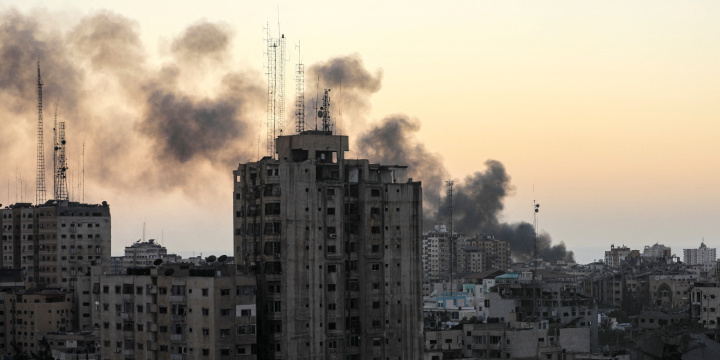
Smoke rises following Israeli strikes, amid the ongoing conflict between Israel and the Palestinian terrorist group Hamas, in Gaza City, Nov. 7, 2023. Photo: REUTERS/Mohammed Al-Masri
“We cannot always prevent the murder of workers in an orchard or sleeping families, but we can set a high price for our blood. A price too high for the Arab settlement, the Arab army and the Arab government to pay. … [Retaliation operations] are not for vengeance. It is an act of punishment and warning, that if that state does not control its population and does not prevent them attacking us – the Israeli forces will cause havoc in its land.”
IDF Chief of Staff Moshe Dayan, Lecture to IDF officers: “Retaliation Operations as a Means of Ensuring Peace”, July 1955
Here’s what has happened in the Israel-Hamas conflict from November 3-6.
Gaza:
Over the past four days, Israeli forces have gradually tightened the noose around Gaza City and have begun to conduct raids into the outskirts. These raids are directed at known strongpoints of Hamas.
Meanwhile, Hamas forces are attempting to exploit the hidden tunnel exits in the open ground outside the city to attack the Israeli forces deployed there. They have been publishing quite a number of short video clips of their raids on Israeli troops and positions. These clips purport to show their successes. They have had some successes, but many of the clips are cut before the actual result of the attack is shown.
Thus, for instance, they claim to have destroyed 27 IDF tanks, armored personnel carriers, and bulldozers, and to have “eliminated dozens of Israeli soldiers” over the past two days. A few armored vehicles have indeed been damaged including one or two destroyed, but in most cases, these attacks failed. The clip shows the anti-tank rocket exploding, but is then cut before showing that the explosion did not in fact damage the target, usually because it was intercepted by the Israeli active protection system. After each raid the Hamas attackers rush back to their tunnel exits. The IDF troops follow them to locate the tunnels and employ various means to destroy them.
Hamas fighters have suffered heavy casualties as Israeli troops discover their hideouts and destroy them. In a number of cases, entire tunnel sections were destroyed with a barrage of ground-penetrating bombs that killed large numbers of Hamas personnel hiding in them. The ability to do this requires an accurate trace of the tunnel. In these cases, tunnels were located by capturing documents in Hamas headquarters the IDF had raided. The IDF has also been hunting Hamas commanders and has killed quite a few of them.
Top photograph: Hamas rocket launchers discovered in a Boy Scouts den. They are permanently emplaced in an open section of the wall to shoot from inside the building.
Bottom photograph: Half-buried rocket launchers in the yard next to a mosque.
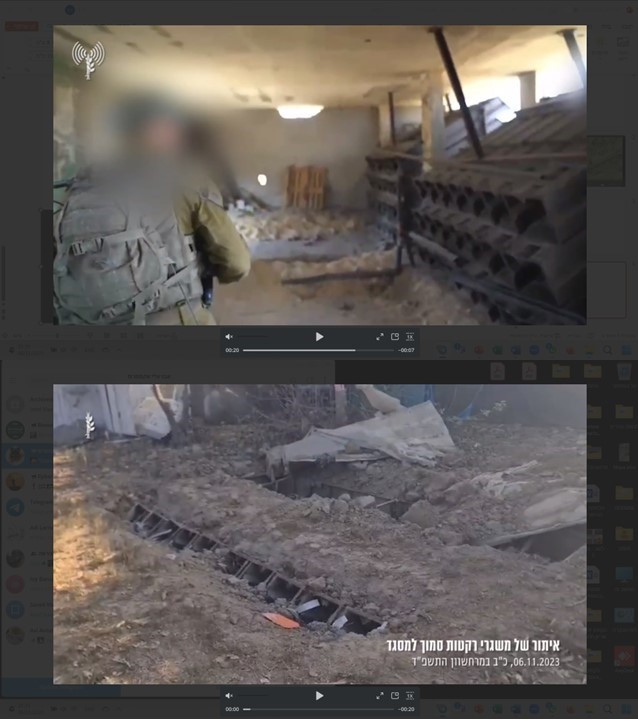
The IDF has not published an estimate of Hamas casualties, except to claim that the majority of the Palestinian fatalities are combatants and not civilians. They number in the thousands.
A couple of days ago, the IDF finally released its own casualty figures so far. As of today, they amount to approximately 300 injured and 31 killed.
Hamas continues to fire rockets into Israel, though the daily average has lessened. The total to date is approximately 9,000, of which approximately 1,000 fell inside Gaza. Also, for the first time, they fired two rockets with a range of more than 100 kilometers. The claimed range was 250 kilometers, but the actual distance to the targets was less than half that. Neither hit its target.
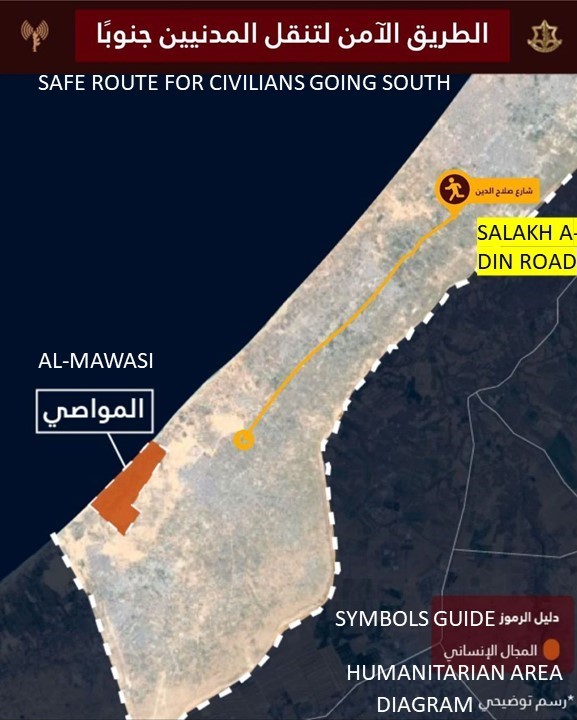
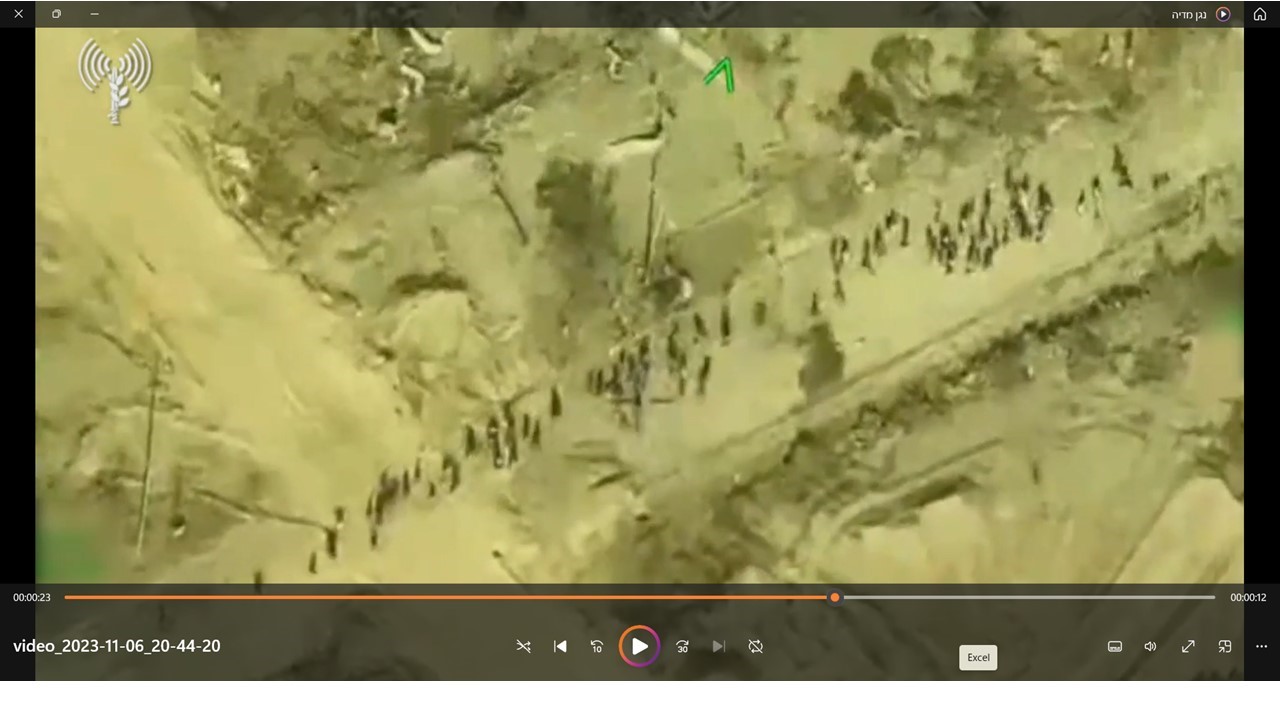
The IDF has repeatedly called on civilians still in Gaza City to evacuate to the south of the Gaza Strip. All roads going south are now controlled by IDF units, so each day the IDF declares specific hours for travel along one of the roads. A checkpoint has been set up to check the identity of those passing through in order to catch Hamas personnel trying to escape with the civilians. On the first day the road was opened, Hamas troops fired at the area of the checkpoint, threatening the lives of the Gazan civilians themselves.
One of the flyers dropped by Israeli aircraft with an explanation for the population on which route to use to evacuate:
Screen shot from an IDF drone video feed of Gazan civilians walking south.
A topic that Hamas has been harping on for over a week is that the hospitals are running out of fuel and are losing electrical power critical to providing care. However, every photograph or video from inside the hospitals they claim are affected shows the electricity still working. The IDF published a conversation that proves that there are hundreds of thousands of liters of petrol in Hamas stores, including in underground stores beneath the hospitals.
Hamas also claims Israel has attacked ambulances. The IDF responded that the only ambulances attacked were those being used to drive Hamas combat personnel on their missions (i.e., NOT wounded). Given that Hamas combat personnel are often wearing civilian clothes, they are discovered through intensive intelligence work.
Israel allowed the Jordanian air force to parachute medical supplies in Gaza. To reach Gaza the Jordanian military transport aircraft had to fly through Israel.
Meanwhile, new information on the initial Hamas attack into Israel has shown that a number of the participants in the attack were Gazans who were allowed to work inside Israel (a total of almost 20,000 such permits were granted). Others who did not participate in the actual attack did serve as collectors of intelligence on the Israeli defenses they passed along the border and worked in the Israeli agricultural villages.
The family of a Bedouin Arab who was murdered by Hamas during the October 7 attack has declared a blood feud and is offering US $1,000,000 for information on the killers’ identities. According to the family, the entire tribe organized a donation drive and raised the money to enable the execution of the feud. In such cases the usual process is that the family of the murdered person kills the killer/killers or a third party mediates compensation depending on the case. If not mediated successfully, such feuds can last generations.
Lebanon:
On Friday, November 3, Hassan Nasrallah, the chief of Hezbollah, gave a speech that had received heavy build-up as it was expected to dictate Hezbollah’s policy with regard to the current war. I listened to it — it was boring. Nasrallah opened by hailing the Hamas success on October 7, but then explained at length why Hezbollah is not doing more to assist it by joining in the war at full strength, much to the disappointment of the Palestinians.
A new trend in Hezbollah attacks has begun, however. It is using larger rockets with much heavier warheads, but maintaining more or less the same targets. The Israeli response was also much more powerful, and Hezbollah fatalities are now at 63. In addition to attacking the Hezbollah units conducting the attacks, the IDF has apparently been attacking Hezbollah sites throughout southern Lebanon to a distance of at least 10 kilometers from the border.
In addition to Hezbollah, Palestinian groups have participated in the fighting in Lebanon and have suffered nine killed.
On November 6, Hamas forces in Lebanon fired some 30 rockets into Israel. There were no casualties. Such a large barrage would not have been possible without Hamas permission.
Syria:
On the Syrian border there have been only a few incidents so far — rocket launches, etc. These were responded to via tank fire, artillery, and air strikes.
Judea and Samaria:
In Judea and Samaria, Palestinian attacks on Israelis have increased somewhat, but despite calls from the Hamas leadership to escalate, they have not surged. Israeli security forces have responded with raids to arrest terrorists. So far approximately 1,350 have been arrested, and approximately 160 have been killed either attempting to attack Israelis or resisting arrest with firearms. The majority are Hamas personnel, but there are also Palestinian Islamic Jihad and Fatah personnel. On November 6, a high-ranking Hamas military commander was killed in an Israeli raid in Tulkarem. Also killed was a commander in a Fatah-affiliated terrorist group, whose father is a brigadier general in the official Palestinian Authority security forces.
A 16-year-old Palestinian walking by two Israeli police personnel in Jerusalem suddenly attacked them with a knife, killing the policewoman and wounding the policeman. Other police personnel at the scene shot and killed the attacker. This brings the number of Israelis killed in Judea and Samaria to three.
There has also been a slight increase in the number of violent altercations between Palestinian civilians and Israeli civilians over agricultural property rights (field boundaries, grazing rights).
Yemen:
The Houthis have continued to launch missiles and long-range explosive drones towards Israel. The rate of fire has gone down from the first few days, and none has succeeded in hitting Israel (though they claim to have succeeded).
Attacks on US Forces in Iraq and Syria:
Pro-Iranian Iraqi Shiite militias continued to attack American bases in Iraq and Syria with rockets and exploding drones. The total number of such attacks since the beginning of the current Israel-Hamas war is more than 30 so far. The number of American casualties is one killed (apparently from cardiac arrest caused by an attack) and approximately 30 wounded.
Attempts to Attack Israelis Abroad:
According to a high-ranking Israeli security official, over the past few months (i.e., including a number of months prior to the current war), a few dozen attempts to attack Israelis and Jews abroad have been thwarted. The Office for Counter Terrorism has issued a strong warning to Israelis to delay all travel abroad.
Israeli Casualties:
There are still a number of people unaccounted for, but it seems that all or nearly all the bodies of Israelis killed in the initial attack inside Israel have been found. Currently there are still a few hundred bodies that have not been definitely identified because they are so badly damaged (in some cases there are problems identifying the bodies even with DNA tests). Also, some of the missing have been confirmed to be among the kidnapped Israelis in Gaza.
The current count of Israelis killed is more than 1,400 (of whom approximately 400 are soldiers, police, and firefighters) with more than 6,900 wounded. This includes the Israelis killed or wounded in the fighting that followed the initial Hamas attack, but almost all were killed or wounded on the first day. Also, the current count of hostages confirmed kidnapped to Gaza is 241 (one less, after the identification of another dead person who former information had suggested was in Gaza). It is not known how many of the hostages are still alive.
The number of Israelis who have been forced to leave their homes in 64 villages and towns along the borders with Gaza and Lebanon has reached approximately 250,000.
Palestinian Casualties:
The Gaza Health Ministry, which is controlled by Hamas in its role as the government of Gaza, claims that so far approximately 10,050 Gazans have been killed and approximately 24,000 wounded. They do not differentiate between personnel of Hamas and other terrorist organizations and civilians. They also claim that this number includes more than 4,000 children. Apart from the fact that all the numbers are propaganda-based and not verifiable or credible, the children include anyone up to the age of 18. Since Hamas actively employs teens as combatants, in fact this includes quite a number of terrorists. This is true also of women and elderly people who often serve in Hamas, often as scouts or suicide-bombers. There is a history of supposedly innocent Palestinians of both sexes and all ages approaching IDF soldiers to ask for help and actually carrying suicide bomb-vests under their clothes, or trying to lead IDF soldiers into explosive booby traps or ambushes. The IDF spokesperson claims that the majority of the casualties are Hamas personnel or personnel of other armed groups, but has not elaborated.
The claim of 32,000 wounded published on November 2 was apparently a typographical error in the Gaza Health Ministry report. The next day they reduced it to 23,000.
The latest report on displaced Palestinians gives the number at approximately 1 million. This includes the vast majority of the population of northern Gaza who were told by the IDF to leave and head south. When providing this number to the UN, a Hamas spokesperson tried to claim that there are 900,000 of 1.1 million Palestinians still in northern Gaza and that this proves the IDF attempt to move the population south has failed. This is one more example of the contradictions in Hamas rhetoric.
What Next?
Following Nasrallah’s mellow speech, the tension, though not the fighting (as described above), has been reduced. However, this does not mean Hezbollah will not change their minds later. Iran too seems (publicly) more interested in stopping Israel’s offensive on Hamas than widening the fighting to new fronts. However, it must be taken into consideration that this might be an attempt to get Israel to lower its guard before a sudden escalation once they have completed their preparations, which will require them to move more forces into Syria and Lebanon. Therefore, Israel is still holding its forces in high readiness along the borders with these two states and retaliating aggressively to every attack.
Since there is more civilian traffic evacuating Gaza City and the IDF seems intent on allowing it while maintaining pressure on Hamas, the next few days will probably see only a gradual advance into the city. But as I wrote previously, it seems the IDF intends to gradually comb the city itself, street by street, house by house and tunnel entrance by tunnel entrance in order to find, kill or capture Hamas personnel. If so, this will be a long arduous process and casualties on both sides will definitely increase greatly.
Hamas seems to be planning to maintain its presence in Gaza, though a few of its personnel were captured by the IDF trying to leave Gaza among the civilians as mentioned above. Hamas claims to have stored enough food, water, and equipment to continue fighting a long time — hopefully until Israel’s allies stop supporting it and demand an Israeli withdrawal from Gaza because of the civilian casualties inflicted during the fighting. In the meantime, it hopes to inflict many casualties on Israeli troops by raiding and ambushing them through popping up out of the tunnels or the many above-ground hiding places it has prepared among the tens of thousands of buildings in Gaza.
Hamas seems to still be hoping to incite a major escalation in Judea and Samaria (the West Bank), but so far this does not seem to be working. This is due in part to Israel’s escalated counter-actions and the general shock of the populace at unfolding events, but also to the fact that the ruling Palestinian faction in Judea and Samaria, Fatah, sees Hamas as an enemy and is quite happy to see it decimated. (Of the approximately 1,500 people arrested or killed by the IDF in its counter-terrorist operations in Judea and Samaria, more than 60% are Hamas personnel).
However, when asked if Fatah would be willing to return to rule Gaza after the war, a high-ranking Fatah official declared that it would not, because the group would be deemed to have “ridden to power on the tanks and aircraft of the IDF.”
The majority of the Arab states are making public declarations in favor of the Palestinians but in fact are doing little to nothing (depending on the state) to help them. Even humanitarian aid from the Arab states has been minimal, and public demonstrations in favor of the Palestinians in the Arab states are generally fewer and smaller than those in Europe and America.
ADDITIONAL TOPICS
Deep-Fake Propaganda:
Since the outbreak of the war, the amount of false information and fake content on the internet has reached new heights. Much of this content is created using deep-fake applications based on artificial intelligence. The fact that any internet user is now able to create synthetic content has made the issue of public diplomacy especially complex. It is vital, therefore, that there be a deep understanding both of the phenomenon and ways to confront the challenges it poses. You can read more evidence about that here.
Proportionality:
One of the topics that many anti-Israel commentators use is the principle of “proportionality” in international law. Supposedly, because Hamas killed “only” 1,400 Israelis, Israel’s response, which has killed more, is disproportional.
This is a distortion of that legal concept. Proportionality in international law does not mean that if someone slaps my face I am only allowed to respond by slapping his. It means that my action must be proportionate to the need to prevent that person from slapping me again. If a counter-slap is sufficient, then that is proportionate. If kicking him is required because a slap won’t stop him from doing it again, then that is proportionate.
The following was written for me by a legal expert:
Israel’s right to self-defense under international law following the attack by Hamas on October 7 is beyond question, but many take a mistaken view of the limits placed on that right by the principle of proportionality in the international law of armed conflict.
Proportionality in this context does not mean, as many suppose, that defensive military action must be limited so as to cause “only” proportionate harm to the enemy. Thus, the number of casualties or the damage caused to non-military targets is not in itself an indication of disproportionality.
What the principle does require is that the military action, when targeting a particular military target, should not proceed if the information available indicates that the probable collateral damage to civilians and non-military targets would be excessive in relation to the military advantage expected from the military action.
This is therefore a more nuanced and fact-sensitive equation than is commonly understood.
Thus, for example, the warnings to residents in Gaza to remove themselves to the south are highly relevant given the need and legal right to target and destroy Hamas assets which have been embedded in residential and civilian environments.
Application of the correct definition of proportionality in international law is therefore of the utmost importance in assessing the legality, and indeed the morality, of current Israeli military action and any further action that is undertaken in the future.
Dr. Eado Hecht is a military analyst focusing mainly on the relationship between military theory, doctrine, and practice. He teaches courses on military theory and military history at Bar-Ilan University, Haifa University, and Reichman University and in a variety of courses in the Israel Defense Forces. A version of this article was originally published by The BESA Center.