 Pod Save America Hosts Call on Democrats to Cut All Israel Military Aid, No Longer Accept AIPAC Funding
 Jews, Israelis Targeted in Austria Amid Surge in Antisemitic Incidents; Local Jewish Community Calls for Action
 ‘All of Our Strength’: Over 1,000 Pro-Israel Activists Gather in DC for Solidarity Conference
 ‘Devastated’: Wesley LePatner, Killed in Manhattan Mass Shooting, Was a Jewish Communal, Philanthropic Leader
 Sen. Angus King Vows to No Longer Vote for Israel Military Aid Until Gaza Conditions Improve
 Europe Won’t Pressure Israel to ‘Commit Suicide’ Amid Gaza Backlash, Palestinian State Push, Says Israeli FM
 Israel’s National Soccer Coach Attacked in Athens Before Soccer Fans Chant ‘F–K Israel, Free Palestine’ at Match
 New York Judge Sentences Neo-Nazi to 5 Years for Livestreaming Bomb Threats Against Jewish Hospitals
 US Pressures Lebanon to Issue Cabinet Decision to Disarm Hezbollah Before Talks Continue
 UK Plans to Recognize Palestinian State in September Unless Israel Meets Conditions, Starmer Says


Arthur Szyk in Connecticut: A New Look at a 20th Century Master
Error: Contact form not found.
 by Algemeiner Staff

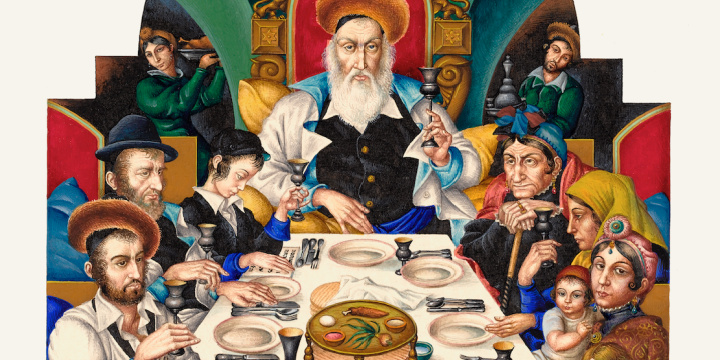
An image from “Family at the Seder,” from the 1935 Haggadah by artist Arthur Szyk (b. 1894, Lodz, Poland—d. 1951, New Canaan, CT). Photo: Courtesy of Irvin Ungar
The work of Polish-Jewish painter Arthur Szyk, a miniaturist who savaged Nazis and championed values of human dignity through his lavishly detailed works, is having its largest exhibition in over half a century at the Fairfield University Art Museum in Connecticut.
The exhibit is organized around the theme of human rights and features dozens of works by the famed artist.
Szyk’s political cartoons placed Nazi genocide, tyranny, and antisemitism on the covers of America’s most popular magazines during World War II. Today, his morally-minded graphic storytelling, deeply conversant in the themes and examples of graphic storytelling, have renewed relevance, according to Irvin Ungar, curator emeritus of the Arthur Szyk Society.
“Arthur Szyk continues to speak to us as a human being and as a Jew,” Ungar said. “His paintings reflect his belief in the fundamental dignity of every human being.”
Ungar, a former pulpit rabbi and antiquarian bookseller who has devoted 25 years to scholarship on the Jewish artist Arthur Szyk, has become one the foremost experts on Szyk’s life and work.
The exhibition, organized by the University of California, Berkeley, The Magnes Collection of Jewish Art and Life, and curated by Francesco Spagnolo, is divided into six sections — including Human Rights and their Collapse, and The Rights of Nationhood — which reflect the diversity of Szyk’s artistic and ethical commitments.
As a self-described “soldier in art,” Szyk’s work was acclaimed by First Lady Eleanor Roosevelt as a potent weapon “against Hitlerism.”
Born in 1894 Lodz, in what is now Poland, Szyk grew up in an upper-middle class Jewish family of textile manufacturers, thought to be descended from a great Talmudic scholar. As a young boy, Szyk witnessed an uprising by Polish peasants — after which his father, blinded by acid thrown in his face at a factory skirmish, would never be able to see his son’s colorful artworks.
Hailing from a diverse city that was one-third Jewish, Szyk was raised with both a universalist sense of common humanity and a particularist devotion to the Jewish community. In 1940, he immigrated to America, where he went on to become the leading anti-Nazi artist of the day, ultimately casting himself as a “spokesperson for the Jewish people,” according to Ungar.
The exhibition is coordinated by Philip Eliasoph, a professor of art history and visual culture at Fairfield University, and is co-sponsored by the Bennett Center for Judaic Studies, the Center for Jewish History, NY, and the Jewish Federation of Greater Fairfield County. It runs from Sept. 29 to Dec. 16. More information can be found here.