 Pod Save America Hosts Call on Democrats to Cut All Israel Military Aid, No Longer Accept AIPAC Funding
 Jews, Israelis Targeted in Austria Amid Surge in Antisemitic Incidents; Local Jewish Community Calls for Action
 ‘All of Our Strength’: Over 1,000 Pro-Israel Activists Gather in DC for Solidarity Conference
 ‘Devastated’: Wesley LePatner, Killed in Manhattan Mass Shooting, Was a Jewish Communal, Philanthropic Leader
 Sen. Angus King Vows to No Longer Vote for Israel Military Aid Until Gaza Conditions Improve
 Europe Won’t Pressure Israel to ‘Commit Suicide’ Amid Gaza Backlash, Palestinian State Push, Says Israeli FM
 Israel’s National Soccer Coach Attacked in Athens Before Soccer Fans Chant ‘F–K Israel, Free Palestine’ at Match
 New York Judge Sentences Neo-Nazi to 5 Years for Livestreaming Bomb Threats Against Jewish Hospitals
 US Pressures Lebanon to Issue Cabinet Decision to Disarm Hezbollah Before Talks Continue
 UK Plans to Recognize Palestinian State in September Unless Israel Meets Conditions, Starmer Says


Meet the Scientist Helping to Identify Israel’s Oct. 7 Victims
Error: Contact form not found.
 by Troy O. Fritzhand

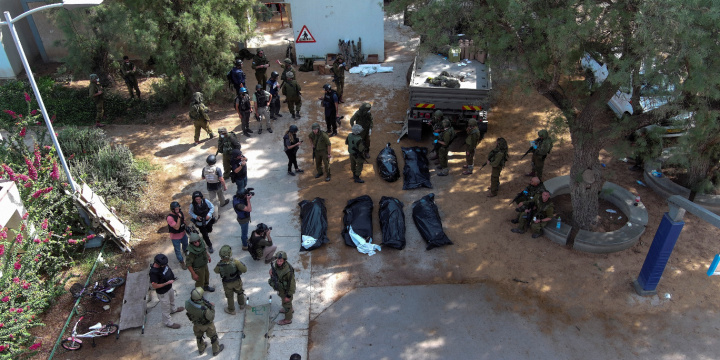
An aerial view shows the bodies of victims of an attack following a mass infiltration by Hamas gunmen from the Gaza Strip lying on the ground in Kibbutz Kfar Aza, in southern Israel, Oct. 10, 2023. Photo: REUTERS/Ilan Rosenberg
The process of identifying the bodies of the more than 1,200 people, mostly civilians, killed by Hamas terrorists across southern Israel on Oct. 7 has been grueling and required innovative techniques to bring closure to families. Due to the fact that many of the victims were burned or mutilated beyond recognition, forensic experts and scientists have worked nonstop since the massacre to identify bodies.
Prof. Gila Kahila Bar-Gal from the Faculty of Agriculture, Food, and Environment at the Hebrew University of Jerusalem is a world-renowned expert on wildlife and ancient DNA analysis. She told The Algemeiner about how she got involved in assisting with identifying the dead from Oct. 7.
In the aftermath of the attack, she said, “you had a lot of missing people and we needed to determine if they were kidnapped or killed.”
Thanks to her expertise in DNA analysis, Bar-Gal was able to volunteer herself. Her work at the National Center of Forensic Medicine (known as Abu Kabir) has been focused on “extracting DNA from burnt bones, many of which are from carcasses that are not intact.”
The scientist said that in her regular day-to-day life she has been working with museum and archeological samples that are primarily animal-based. Her skills in DNA extraction made the transition possible. “I am using the same techniques [as with animals],” Bar-Gal said, adding that she also studied anatomy, which helped with her ability to recognize parts of the human body.
Of course, the work can be emotionally draining, and she has only taken off one day during the war — and even that one day was to get things in order for her normal job.
Bar-Gal said the task has not been easy. But “when I decided to volunteer, I looked for where I could make an impact,” she explained. “You get there and understand you can’t think about the stories behind the samples,” because “having emotion will not help.”
The emotional toll of the job has been made slightly more manageable due to the fact that she works with numbers, instead of names. However, the professor said once there are positive matches and families are identified, she often looks at the stories of the fallen.
The work at Abu Kabir is not done, as there are a number of bone samples that still need to be analyzed. Bar-Gal said she plans on remaining at the forensic center after the war on a part-time basis. She has also started to train people at Abu Kabir in her methods.
The professor avoided praise when asked about the impact she is making by allowing families to know the fate of their loved ones.
“If you look around Israel, everyone is trying to volunteer, and people with different skills are trying to make their impact where they can,” she said. “I have to do what I have to do, and I’m in the place where I’m needed.”
“I am happy to have the opportunity and to give some of the families [closure],” Bar-Gal added. “This is what drives me.”