 Pod Save America Hosts Call on Democrats to Cut All Israel Military Aid, No Longer Accept AIPAC Funding
 Jews, Israelis Targeted in Austria Amid Surge in Antisemitic Incidents; Local Jewish Community Calls for Action
 ‘All of Our Strength’: Over 1,000 Pro-Israel Activists Gather in DC for Solidarity Conference
 ‘Devastated’: Wesley LePatner, Killed in Manhattan Mass Shooting, Was a Jewish Communal, Philanthropic Leader
 Sen. Angus King Vows to No Longer Vote for Israel Military Aid Until Gaza Conditions Improve
 Europe Won’t Pressure Israel to ‘Commit Suicide’ Amid Gaza Backlash, Palestinian State Push, Says Israeli FM
 Israel’s National Soccer Coach Attacked in Athens Before Soccer Fans Chant ‘F–K Israel, Free Palestine’ at Match
 New York Judge Sentences Neo-Nazi to 5 Years for Livestreaming Bomb Threats Against Jewish Hospitals
 US Pressures Lebanon to Issue Cabinet Decision to Disarm Hezbollah Before Talks Continue
 UK Plans to Recognize Palestinian State in September Unless Israel Meets Conditions, Starmer Says


The Thin Line Between Antisemitism and Anti-Zionism: Unraveling the Protests
Error: Contact form not found.
 by Asher Stern

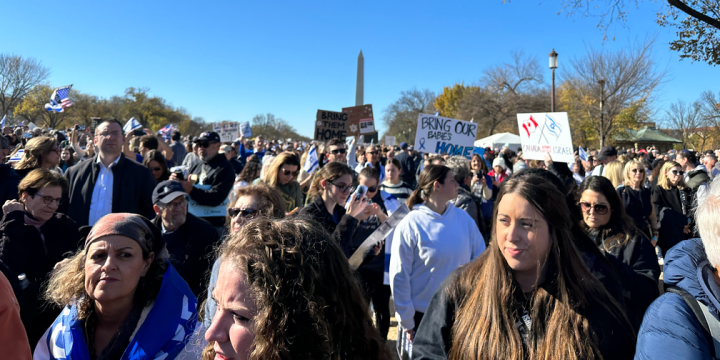
Jewish Americans and supporters of Israel gather at the National Mall in Washington, DC on Nov. 14, 2023 for the “March for Israel” rally. Photo: Dion J. Pierre/The Algemeiner
The world has witnessed a disturbing surge in antisemitic, violent protests that contrast sharply with the peaceful demonstrations in support of Israel. The juxtaposition of these demonstrations has stirred controversy and raises important questions about the so-called line between antisemitism and anti-Zionism — a line that is increasingly blurred in these troubling times.
Anti-Zionism is not merely a disagreement with Israeli policies, but an insidious form of prejudice that extends beyond geopolitical boundaries. While it is crucial to acknowledge that criticism of Israeli policies is not inherently antisemitic, there are members of various protests who have not been criticizing, but rather demonizing, the Jewish State. They are not voicing peaceful expressions of discontent or legitimate criticism; instead, they are promoting hatred and calls for violence. Large groups of protestors have called for the destruction of Israel; they also promote violence against Jews, and share antisemitic imagery.
These protestors profess anti-Zionism while practicing antisemitism; advocate for a ceasefire while remaining silent on hostage release; declare support for Palestinians without condemning Hamas; and express a desire for peace while resorting to violence.
These violent protestors are using what should be peaceful demonstrations as a cover for expressing deep-seated hatred, which is a tactic that mirrors the reprehensible strategies employed by Hamas. Just as Hamas members embed themselves in civilian populations to make Israel’s attempts at finding them more difficult (while putting innocent civilians at risk), these vicious protestors do the same, manipulating public perception by using seemingly peaceful demonstrations to mask their underlying agenda.
Not all demonstrators necessarily harbor antisemitic sentiments. Some may be misinformed, misguided, or are critical for a legitimate reason. However, even if they do not espouse antisemitism, their culpability lies in their neglect and disregard for the issue at hand. Standing by while their peers propagate inflammatory rhetoric, tear down signs of innocent hostages, and brandish flags of designated terrorist organizations like Hamas and ISIS, renders them complicit by association.
It also highlights an inherent ignorance of the situation in Israel. The ongoing conflict is not a war against the Palestinian people, but rather a response to neutralize the Hamas terror organization. While it is true that innocent Palestinians are being caught in the crossfire, both Israel and the US have offered considerable proof that Hamas is to blame for those deaths, hiding among civilians, misfiring rockets within Gaza, denying humanitarian aid, and committing further atrocities that force Israel to remove the terror group. By openly supporting Hamas at these rallies, these protesters are not actually supporting Palestinians, but rather their Hamas oppressors, and doing so with antisemitic rhetoric and vitriol.
By contrast, pro-Israel demonstrations, exemplified by the peaceful gathering in Washington, D.C., that took place on November 14, with over 290,000 in attendance, by and large advocate for hope, for shared values with the US, and a nuanced understanding of the Israeli-Palestinian conflict.
These rallies focus on supporting the right of Israel to exist and defend itself against external threats, particularly from entities like Hamas, providing a counter-narrative to the violent demonstrations.
The stark contrast between the two types of protests underscores the importance of distinguishing between criticism of policies and the promotion of hatred. While violent protesters may try to hide behind the veil of anti-Zionism, now more than ever, the world must realize, that anti-Zionism is antisemitism.
Edmund Burke said, “The only thing necessary for the triumph of evil is for good men to do nothing.” This statement resonates profoundly in the current context, urging us to confront antisemitism, hatred, and terror head-on.
Asher Stern, Head of Operations, International Legal Forum — an Israel-based global network of lawyers and activists around the world, standing up for Israel, and combating antisemitism in the international legal arena — holds a BA in Government, Strategy, and Diplomacy from the IDC, and an MA in International Relations from the Hebrew University.