 Pod Save America Hosts Call on Democrats to Cut All Israel Military Aid, No Longer Accept AIPAC Funding
 Jews, Israelis Targeted in Austria Amid Surge in Antisemitic Incidents; Local Jewish Community Calls for Action
 ‘All of Our Strength’: Over 1,000 Pro-Israel Activists Gather in DC for Solidarity Conference
 ‘Devastated’: Wesley LePatner, Killed in Manhattan Mass Shooting, Was a Jewish Communal, Philanthropic Leader
 Sen. Angus King Vows to No Longer Vote for Israel Military Aid Until Gaza Conditions Improve
 Europe Won’t Pressure Israel to ‘Commit Suicide’ Amid Gaza Backlash, Palestinian State Push, Says Israeli FM
 Israel’s National Soccer Coach Attacked in Athens Before Soccer Fans Chant ‘F–K Israel, Free Palestine’ at Match
 New York Judge Sentences Neo-Nazi to 5 Years for Livestreaming Bomb Threats Against Jewish Hospitals
 US Pressures Lebanon to Issue Cabinet Decision to Disarm Hezbollah Before Talks Continue
 UK Plans to Recognize Palestinian State in September Unless Israel Meets Conditions, Starmer Says


Iran Ramps Up Enrichment of Uranium to Near Weapons-Grade After Temporary Slowdown
Error: Contact form not found.
 by Reuters and Algemeiner Staff

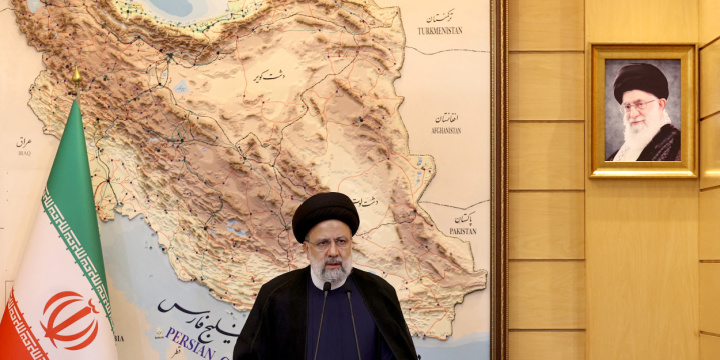
Iranian President Ebrahim Raisi speaks during the official farewell ceremony for his trip to New York, at Mehrabad Airport in Tehran, Iran, September 17, 2023. Photo: Iran’s Presidency/WANA (West Asia News Agency)/Handout via REUTERS
Iran has reversed a months-long slowdown in the rate at which it is enriching uranium to up to 60 percent purity, close to weapons grade, the UN nuclear watchdog said on Tuesday.
Many diplomats believed the slowdown, which had begun by June, was the result of secret talks between the United States and Iran that led to the release of US citizens held in Iran earlier this year.
Iran already has enough uranium enriched to up to 60 percent, if enriched further, to make three nuclear bombs, according to the International Atomic Energy Agency’s theoretical definition, and more at lower enrichment levels. Iran denies seeking nuclear weapons.
Iran has “increased its production of highly enriched uranium, reversing a previous output reduction from mid-2023,” the IAEA said in a statement summarizing a confidential report to member states seen by Reuters that was sent minutes earlier.
Iran is enriching to up to 60 percent, close to the roughly 90 percent that is weapons grade, at its Pilot Fuel Enrichment Plant (PFEP) in its sprawling Natanz complex and at its Fordow Fuel Enrichment Plant (FFEP), which is dug into a mountain.
Since the slowdown, those plants had been enriching uranium to up to 60 percent at a rate of about 3 kg a month, the IAEA said.
“The agency confirms that, since the end of Nov. 2023, the rate at which Iran has been producing uranium enriched up to 60 percent U-235 at these two facilities combined has increased to approximately 9 kg per month,” the report to member states said.
By the IAEA’s theoretical definition, around 42 kg of uranium enriched to 60 percent is the amount at which making a nuclear bomb with it cannot be excluded.
IAEA inspectors first observed a change in production at Fordow on Nov. 25, after which Iran said the change was made on Nov. 22, and that the rate of production was returning to the pre-slowdown level there, the report said.
Inspectors observed an increase in the production rate at Natanz on Nov. 27, it added. The IAEA then verified the amount being produced at Natanz on Dec. 19 and Fordow on Dec. 24, it said. The IAEA did not formally notify its member states of the slowdown until Tuesday’s report.