 Pod Save America Hosts Call on Democrats to Cut All Israel Military Aid, No Longer Accept AIPAC Funding
 Jews, Israelis Targeted in Austria Amid Surge in Antisemitic Incidents; Local Jewish Community Calls for Action
 ‘All of Our Strength’: Over 1,000 Pro-Israel Activists Gather in DC for Solidarity Conference
 ‘Devastated’: Wesley LePatner, Killed in Manhattan Mass Shooting, Was a Jewish Communal, Philanthropic Leader
 Sen. Angus King Vows to No Longer Vote for Israel Military Aid Until Gaza Conditions Improve
 Europe Won’t Pressure Israel to ‘Commit Suicide’ Amid Gaza Backlash, Palestinian State Push, Says Israeli FM
 Israel’s National Soccer Coach Attacked in Athens Before Soccer Fans Chant ‘F–K Israel, Free Palestine’ at Match
 New York Judge Sentences Neo-Nazi to 5 Years for Livestreaming Bomb Threats Against Jewish Hospitals
 US Pressures Lebanon to Issue Cabinet Decision to Disarm Hezbollah Before Talks Continue
 UK Plans to Recognize Palestinian State in September Unless Israel Meets Conditions, Starmer Says


Media Ignore Anti-Israel Rocket Attack, Focus on Israel’s Military Response
Error: Contact form not found.
 by Chaim Lax

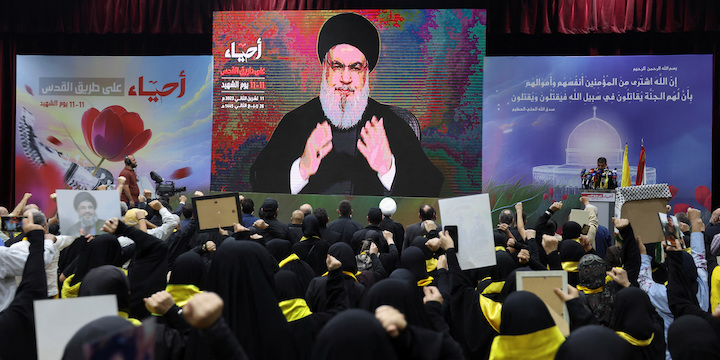
Lebanon’s Hezbollah leader Sayyed Hassan Nasrallah addresses his supporters through a screen during a rally commemorating the annual Hezbollah Martyrs’ Day, in Beirut’s southern suburbs. Photo: Reuters/Aziz Taher
On the morning of February 14, northern Israel was subjected to a barrage of indiscriminate rocket fire from Lebanon. Rockets reportedly landed in the city of Safed and an Israeli military base, killing a female soldier and wounding eight others.
In response to this attack, the Israeli air force undertook a “widespread” bombing campaign against Hezbollah targets in southern Lebanon, killing several terror operatives as well as a number of Lebanese civilians.
This rocket barrage was the latest escalation in Hezbollah’s campaign against Israel, which it undertook in the wake of Hamas’ October 7 massacre in southern Israel. Due to the threat posed by the Iran-backed terror group, tens of thousands of Israeli civilians from the north have evacuated to other parts of the country.
💣 No Quiet on Israel’s Northern Front
With all eyes on Israel’s war against Hamas in Gaza, Hezbollah has been increasingly raising tensions along Israel’s northern border. We teamed up with @Eve_Barlow to take a closer look at what’s going on at Israel’s northern front. pic.twitter.com/U4F4nPGmHV
— HonestReporting (@HonestReporting) February 7, 2024
Despite this latest violence stemming from the rocket barrage directed at Israel, several news outlets chose to frame the story in such a way as to portray Israel as the aggressor.
While some news outlets (like the BBC and Fox News) did properly convey the necessary information in their headlines, explaining that Israel’s airstrikes came in response to the rocket barrage earlier that day, several media organizations failed in this regard, with their headlines leaving out the vital context and turning Israel’s defensive campaign into one of aggression.
For example, The Washington Post‘s headline only mentioned Israel’s strikes in Lebanon, informing its readers that Israel was responding to a rocket barrage only in the report’s third paragraph.

As did CBS News‘ headline, which only mentioned Israel’s strikes in Lebanon. Further, their report indicated that Israel’s strikes were “raising fears of a war” between Israel and Lebanon. It would appear that only Israel’s response raises fears of war, not attacks from Hezbollah against Israel.

Reuters‘ headline only mentioned Hezbollah’s vow that Israel will “pay price” for the “deadly day.”
It took 12 paragraphs for Reuters to even mention at all that Israel’s strikes in Lebanon were in response to a rocket attack.

For its part, two Sky News headlines failed to inform its readers that Israel was bombing Lebanon in response to an earlier rocket attack.
The first read: “Israel launches wave of deadly attacks on Lebanon — as Hezbollah vows revenge” while the second headline read: “Children among 11 people killed in Israeli strikes on Lebanon, say security sources.”
While the sub-header for the second article did mention that Israel was responding to an earlier attack, it also used different language for each country’s casualties, claiming that Lebanese were “killed” by Israel’s strikes while an Israeli had passively “died.”
Earlier today, Hezbollah launched a barrage of rockets at the northern Israeli city of Safed, killing one & wounding 8 more.
But as far as @SkyNews is concerned, Israel is the aggressor & Lebanon the victim. pic.twitter.com/JBaYmj7B9X
— HonestReporting (@HonestReporting) February 14, 2024
Several video reports also left out vital information, portraying Israel as the aggressor in the region.
For example, France 24 titled its report “Fears of escalation as Israel strikes hit southern Lebanon.”
Similarly, 9 News Australia’s video report was titled “Israel launches wave of air strikes in Lebanon as tensions escalate.”
The title for AFP’s clip of a State Department briefing on the clashes over Israel’s northern border not only failed to mention the initial anti-Israel rocket attack, but the barrage was also entirely missing from the video’s accompanying text.

For some news outlets, it was not the headline that was the issue as much as the content of the report itself.
For example, The Guardian‘s coverage (under the headline “Seven civilians killed in Israeli strikes on south Lebanon”) mentioned both the rocket attack from Lebanon and Israel’s strikes in Lebanon. However, it failed to inform its readers as to which occurred first, leaving them with the impression that both Israel and Hezbollah are equally to blame for tensions and violence along the border.
In its report, news agency UPI described Israel’s targeted air strikes as a “barrage of rockets,” while the indiscriminate fire directed against Israel from Lebanon was described as an “attack” and a “strike.”
Perhaps the most egregious report was filed by The Times of London, which reported two paragraphs on Israel’s strikes in Lebanon, but not a single word about the earlier barrage against Israel or the fact that an Israeli soldier had been killed in that attack.
Hey, @thetimes, how can you possibly include these paragraphs without referencing the Hezbollah rocket barrage that killed an Israeli & wounded 8 more that preceded the Israeli response?
Stop falsely portraying Israel as the initiator of the violence.https://t.co/XKbvkLXOfR pic.twitter.com/sfcYnMeLqz
— HonestReporting (@HonestReporting) February 15, 2024
By leaving out vital information and context from their headlines and reports, these news outlets are not only failing to inform their respective audiences properly, but they are also helping to contribute to a false narrative that leaves Hezbollah’s belligerency out of the picture and portrays Israel as the primary aggressor along its northern border.
The author is a contributor to HonestReporting, a Jerusalem-based media watchdog with a focus on antisemitism and anti-Israel bias — where a version of this article first appeared.