 Pod Save America Hosts Call on Democrats to Cut All Israel Military Aid, No Longer Accept AIPAC Funding
 Jews, Israelis Targeted in Austria Amid Surge in Antisemitic Incidents; Local Jewish Community Calls for Action
 ‘All of Our Strength’: Over 1,000 Pro-Israel Activists Gather in DC for Solidarity Conference
 ‘Devastated’: Wesley LePatner, Killed in Manhattan Mass Shooting, Was a Jewish Communal, Philanthropic Leader
 Sen. Angus King Vows to No Longer Vote for Israel Military Aid Until Gaza Conditions Improve
 Europe Won’t Pressure Israel to ‘Commit Suicide’ Amid Gaza Backlash, Palestinian State Push, Says Israeli FM
 Israel’s National Soccer Coach Attacked in Athens Before Soccer Fans Chant ‘F–K Israel, Free Palestine’ at Match
 New York Judge Sentences Neo-Nazi to 5 Years for Livestreaming Bomb Threats Against Jewish Hospitals
 US Pressures Lebanon to Issue Cabinet Decision to Disarm Hezbollah Before Talks Continue
 UK Plans to Recognize Palestinian State in September Unless Israel Meets Conditions, Starmer Says


What Hostages? Media Ignore Hamas’ Captives, Oct. 7 Massacre
Error: Contact form not found.
 by Rinat Harash


Posters on a wall in Tel Aviv highlighting the plight of Israeli hostages seized by Hamas. Photo: Reuters/Dylan Martinez
For the past five months, Israel has repeatedly stated its aims in the war against Hamas: destroy the terrorist organization, and secure the release of the hostages abducted during its deadly October 7 attack on the Jewish state.
But as these goals are supposedly within reach — pending an Israeli incursion into Gaza’s southernmost city of Rafah — international media outlets seem to have suddenly caught amnesia regarding the remaining 134 Israeli hostages and the barbaric Hamas massacre that sparked the war.
With coverage focused almost entirely on the plight of Gazans sheltering in Rafah — coupled with apocalyptic prophecies on their eternally imminent doom — the result of such omissions is a moral inversion that robs Israel of its right to self defense: Israel has become the aggressor in a war that has been forced upon it, and justice has turned into injustice.
As shown in the following examples, this inversion is achieved by using simple yet subtle reporting tactics — media outlets either omit Israel’s war aims altogether or mention only the destruction of Hamas without referring to the hostages. And there is no detailing of what happened on October 7, when Hamas terrorists brutally slaughtered 1,200 people in Israel and kidnapped some 240 others into Gaza.
No Hamas, No Hostages
TIME Magazine and Reuters took the simple route: they totally omitted the hostages and Israel’s justification for the Rafah operation from their recent reports.
Israeli Prime Minister Benjamin Netanyahu has been widely quoted explaining why it was necessary to operate in Rafah in order to eliminate Hamas and release the remaining hostages.
But, disturbingly, instead of reporting it, TIME made it look like Israel was fighting against America, not Hamas:
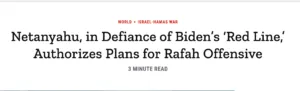
By approving plans for the offensive, which the Israeli military says involve moving civilians to designated “humanitarian islands” elsewhere in the Strip, Netanyahu has signaled his intent to cross that red line.
In fact, the word “Hamas” is mentioned only once in TIME’s report, in the very last paragraph. And there is no mention of the October 7 massacre and the hostages.
The same problems plague Reuters’ report: it fails to mention the hostages and Hamas’ October 7 attack, and ignores Israel’s reasoning for a ground operation in Rafah.
What Reuters does include is a paragraph that creates the impression that Israel is arbitrarily planning to endanger more than a million Gazans in the cramped city:
Prime Minister Benjamin Netanyahu reaffirmed to a cabinet meeting on Sunday that Israeli forces would thrust into Rafah, the last relatively safe place in the tiny, crowded Gaza enclave after more than five months of war, despite international pressure for Israel to avoid civilian casualties.
And to top it off, the word “Hamas” isn’t mentioned at all in the Reuters report.
Undermining Israel’s Justification
AP and The New York Times took a more subtle approach.
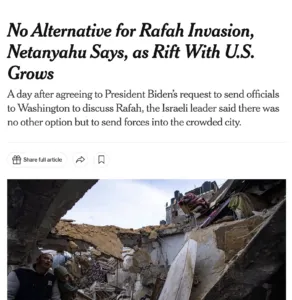
They quoted Netanyahu on the need to enter Rafah to eliminate Hamas, but omitted his reference to the hostages and glossed over October 7 without elaboration.
So uninformed readers are left to wonder what exactly had Hamas done to warrant such a reaction from Israel. After all, not every “attack,” as it is dryly described by The New York Times, justifies such a military campaign.
And these omissions are all the more mind-boggling judging from the articles’ headlines, which seem to promise a full explanation as to why the Rafah operation is necessary for Israel:
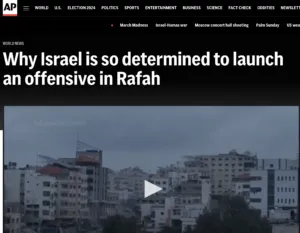
How, @AP, can you attempt to explain “Why Israel is so determined to launch an offensive in Rafah” and fail to mention the 134 Israeli hostages still being held by Hamas in Gaza?https://t.co/MFsRMls8qg pic.twitter.com/y7pkpw9gop
— HonestReporting (@HonestReporting) March 21, 2024
Ignoring the existence of hostages and Hamas’ massacre that ignited the war, while focusing instead on the suffering of displaced Palestinians, is bad journalism. But it’s worse than that.
The media’s decision to omit Hamas is tantamount to undermining Israel’s right to respond to a genocidal threat.
By doing so, the media paints a picture that actively serves Hamas’ agenda.
The author is a contributor to HonestReporting, a Jerusalem-based media watchdog with a focus on antisemitism and anti-Israel bias — where a version of this article first appeared.