 Pod Save America Hosts Call on Democrats to Cut All Israel Military Aid, No Longer Accept AIPAC Funding
 Jews, Israelis Targeted in Austria Amid Surge in Antisemitic Incidents; Local Jewish Community Calls for Action
 ‘All of Our Strength’: Over 1,000 Pro-Israel Activists Gather in DC for Solidarity Conference
 ‘Devastated’: Wesley LePatner, Killed in Manhattan Mass Shooting, Was a Jewish Communal, Philanthropic Leader
 Sen. Angus King Vows to No Longer Vote for Israel Military Aid Until Gaza Conditions Improve
 Europe Won’t Pressure Israel to ‘Commit Suicide’ Amid Gaza Backlash, Palestinian State Push, Says Israeli FM
 Israel’s National Soccer Coach Attacked in Athens Before Soccer Fans Chant ‘F–K Israel, Free Palestine’ at Match
 New York Judge Sentences Neo-Nazi to 5 Years for Livestreaming Bomb Threats Against Jewish Hospitals
 US Pressures Lebanon to Issue Cabinet Decision to Disarm Hezbollah Before Talks Continue
 UK Plans to Recognize Palestinian State in September Unless Israel Meets Conditions, Starmer Says


To Be Holy Is to Live Morally and Treat Others With Respect
Error: Contact form not found.
 by Jeremy Rosen

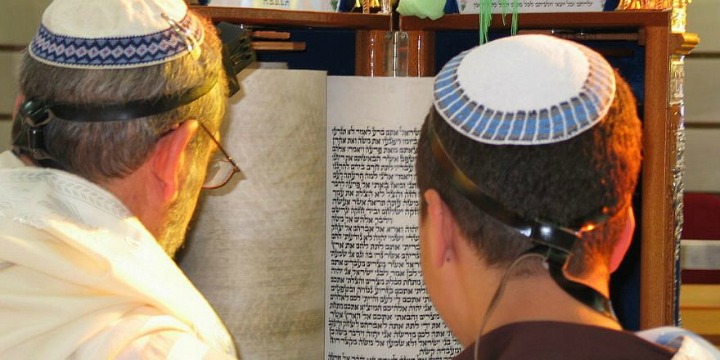
Reading from a Torah scroll in accordance with Sephardi tradition. Photo: Sagie Maoz via Wikimedia Commons.
Chapter 19 of Leviticus, known as Kedoshim, includes a range of laws that concern ethical standards that were relevant back then and today.
It starts with respecting one’s parents and then goes on to talk about the importance of giving charity and helping the poor and the indigent. It also includes such basic ethical rules as don’t steal, don’t deceive, don’t lie, don’t oppress your neighbor, etc. ( Leviticus 19:2-18).
However, interspersed in this collection are ritual laws, and the repeated refrain “Be Holy because I am holy,” “I am your God,” or “ I am your God who took you out of Egypt.”
To the modern skeptical mind, they seem out of place. We are so used to thinking of morality and ethics as being divorced from concepts of God, that these ritual-based commands seem to be irrelevant to many people. Yet the Bible is based upon the principle that humans are fallible, changeable, and unreliable, and are often not the best judges of good and bad. Greek philosophical culture, on the other hand, thought that logic alone could determine what was right or wrong. The Torah established the concept of Divine Authority as a safeguard against overweening human arrogance.
The anthropologist Margaret Mead discovered that there is a universal pattern that explains all this strange connection between morality and ritual. The ancient world was concerned with order. Each culture was regulated in its own way. The Torah, too, is concerned with order, a holistic approach to life that includes the spiritual as well as the physical. It is a template of the complete life, in which one finds room for a way of life that connects with God through ritual and behavior.
In our case, the universal sacrificial system that once dominated our ritual life soon fell away. Instead, we have focused on the laws that make up what is called halacha — how we behave day-to-day and how all our actions should be predicated on forethought, consideration, and a value system.
An ethical system predicated on a ritual one, however irksome, adds a level of spirituality to our daily lives. If religious behavior does not improve one’s morality or behavior towards others, it is failing. Holiness in the Torah means being better — not automatically through birth, but rather what we do, and how we behave.
When we say be holy because God is holy, we’re not describing God. We may disagree as to what is good and what is bad, what is fair and what is not, and whether there is a God and to what extent God controls our lives. But, in the end, we should live a life of consideration and respect for ourselves as well as for the rest of humanity.
The author is a writer and rabbi, currently based in New York.