 Pod Save America Hosts Call on Democrats to Cut All Israel Military Aid, No Longer Accept AIPAC Funding
 Jews, Israelis Targeted in Austria Amid Surge in Antisemitic Incidents; Local Jewish Community Calls for Action
 ‘All of Our Strength’: Over 1,000 Pro-Israel Activists Gather in DC for Solidarity Conference
 ‘Devastated’: Wesley LePatner, Killed in Manhattan Mass Shooting, Was a Jewish Communal, Philanthropic Leader
 Sen. Angus King Vows to No Longer Vote for Israel Military Aid Until Gaza Conditions Improve
 Europe Won’t Pressure Israel to ‘Commit Suicide’ Amid Gaza Backlash, Palestinian State Push, Says Israeli FM
 Israel’s National Soccer Coach Attacked in Athens Before Soccer Fans Chant ‘F–K Israel, Free Palestine’ at Match
 New York Judge Sentences Neo-Nazi to 5 Years for Livestreaming Bomb Threats Against Jewish Hospitals
 US Pressures Lebanon to Issue Cabinet Decision to Disarm Hezbollah Before Talks Continue
 UK Plans to Recognize Palestinian State in September Unless Israel Meets Conditions, Starmer Says


Israel Needs a Large Army — Not Just Advanced Technology (PART TWO)
Error: Contact form not found.
 by Eado Hecht and Eitan Shamir

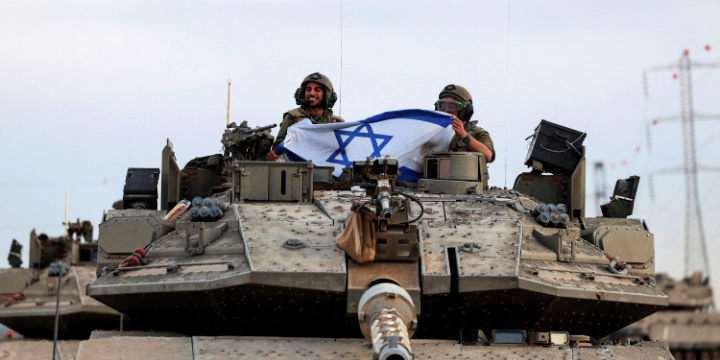
Israeli soldiers drape their country’s flag over an IDF tank near the border with Gaza after the October 7 Hamas massacre. Photo: Reuters/Ronen Zvulun
For Part One of this article, click here.
The offensive fighting in Gaza has drawn the bulk of the IDF’s effort. Meanwhile, approximately 100,000 Israeli citizens cannot return to their homes on the Lebanese border, and no one is able to commit to a date for dealing with this problem. Again, there are several reasons for this, but the most influential is the lack of sufficient forces. The IDF was unable to simultaneously conduct major ground offensives in both Gaza and Lebanon. Although the IDF’s achievements in the ongoing war of attrition on the Lebanese front have been good, they are far from sufficient to achieve Israel’s political goal: the removal of Hezbollah forces from the border to allow our citizens to return home.
Consider the lessons of the Yom Kippur War. After that war, the IDF increased its standing forces to deal with the threat of another multi-front surprise, but it also increased its reserve forces to enable victory to be achieved faster. Over the past few decades, the IDF has drastically reduced both its standing and reserve forces (about 170,000 soldiers were dismissed from the reserves due to a decision by IDF leadership that they were no longer required). The current war has demonstrated that this reduction of the reserve forces was a mistake in every possible respect. Not only were they reduced numerically, but most of those not cancelled had their training budgets drastically reduced. It is no coincidence that it took almost three weeks of retraining before the IDF was able to go on the attack in the current war. In the Yom Kippur War, reserve forces were fighting in large numbers within a single day on the Syrian front and within two and a half days on the Egyptian front.
The IDF has always depended on the reserve forces to complete its combat power on the battlefield – in fact, the reserves were considered the main force. However, the mobilization of reserves dictates short wars. Israel is also committed to short wars because of the intense political pressure it is invariably under to stop fighting before it has reached the achievements required to guarantee its security.
This is not a new situation. But the need for short wars returns us to the issue of the size of the force, and this war created a chain reaction: the inability to attack the whole Gaza Strip simultaneously led to the prolongation of the fighting, which led in turn to the release of reserves before the mission was completed. The continuation of the war also led to the loss of patience of countries that had supported Israel, which ratcheted up the pressure on Israel and led to the partial stagnation that now prevails in Gaza.
The fact is that after over six months of war, despite all the operational achievements of the IDF, politically and strategically the State of Israel is still in the basic state of defeat it suffered on October 7. Israelis remain expelled from their homes with no possibility of defining a clear time limit on their status as internal refugees, and this is because the full sovereignty of the State of Israel has not yet been restored to all its territories.
The military technology used by IDF forces, for all its sophistication, cannot change this strategic reality. Over the past two decades, some of the most advanced technologies in the world have been acquired by the IDF. Much has been said about the use of computer network warfare technologies, precision weaponry and remotely operated means to replace old and supposedly obsolete means that are no longer needed. This concept failed in the war in Ukraine, and it failed once again in the war in Gaza.
The most efficient and useful tools turned out to be the “unnecessary” ones that had been reduced in number and were not sufficiently available for the forces – tanks, bulldozers, mortars, etc. This does not mean the new technologies have no value; they add additional performance, but do not obviate the need for the old means. In the war in Ukraine, the leading powers in the field of cyber warfare did not achieve a single achievement of strategic significance. Also, despite the use of many varieties of precision weaponry and remotely operated aircraft, battles are decided by “outdated” statistical artillery and mass. If the IDF had had two or three additional divisions available, even equipped with less advanced technology, Israel’s strategic situation would have improved considerably.
Advanced technology is important, but the question is which technology and at what level of investment and equipment. Most of us have phones and computers with many tools and options we don’t use or need, but we pay a lot for the latest models anyway. The IDF has spent huge amounts on advanced technologies whose overall contribution to the results on the battlefield is less than their alternative cost. Interception systems for the defense of the home front are a necessary technology; systems such as the “Trophy” (which has saved hundreds of fighters) are necessary; but many other technologies, while scientifically amazing, cost more than they are worth.
For example, a basic Merkava 4 costs 150% more than a Merkava 3. An advanced Merkava 4 costs even more. But some of the additions and upgrades it contains do not provide sufficient tactical value to justify the additional cost. The lack of sufficient tanks was due not only to the perception that they are unnecessary but also to their increasingly high price. Among other things, the steep price led to a reduction in training in a way that diminished the competence of commanders and crews. Cheaper tanks in greater quantity, with advanced technology limited to specific tactically important capabilities rather than the best that can be created whatever the cost, would have enabled maintaining larger and better-trained tank forces — forces that were lacking during this war.
Another example is drones. The cost of professional military drones is much higher than that of commercial civilian drones. Military UAVs have important capabilities that civilian models do not, and a certain number of them is required — but, as was proven in the war in Ukraine and again in athe current war in Gaza, cheap civilian UAVs and drones of all kinds are able to provide most of the required capabilities at a negligible cost. It is possible to distribute them widely in the army, not only to a small number of specialist units, and thus better exploit their unique tactical contribution.
In conclusion, the IDF needs more ground forces than it currently has at its disposal. It is important not to exaggerate and increase forces to dimensions the State of Israel cannot sustain without intolerable financial cost. Technology is an important component of war-fighting too – but again, it is important not to exaggerate. Operational experience, not only from the current war but also from Israel’s previous wars and the wars of others, shows that not every technological innovation is beneficial. Sometimes their costs cause more damage than the added capability they provide because acquiring them reduces the ability to acquire other no-less necessary capabilities.
In our opinion, considering the existing and emerging threats surrounding the State of Israel, the IDF needs at least two more armored/mechanized divisions, and preferably three. It is desirable for Israel to have technological superiority over its enemies, but the benefit of this superiority is not equal in every field. There are areas in which it would be advantageous for the IDF to equip with the most modern technology available, provided it is able to purchase a reasonable amount — a “critical mass” — and still have a budget that enables the training of operators and the purchase of quantities of older tools. Inadequate skill levels due to a sharp cut in the depth and quality of training over many years led to Israel’s paying a price in casualties and insufficient performance, despite the very advanced technologies the forces had at their disposal.
In most cases, an improved technology that is “good enough” in large quantities is many times better than an excellent technology, even the most advanced that exists, but in a tiny quantity. There are, of course, exceptions to this rule that must be identified and invested in.
One area where a particularly large shortage was discovered is ammunition. The ammunition shortage is not unique to Israel. Russia and Ukraine have also discovered that they do not have either enough stocks or sufficient capacity to produce new ammunition, and this shortage has severely limited their ability to conduct operations. The NATO countries are behind Ukraine, but all of them put together are unable to meet the needs of the Ukrainians. Russia’s situation is a little better, and this gap is greatly affecting the results of the fighting. Although there is a huge effort by many countries to increase production, there are also shortages in raw materials, production machines and skilled workers, slowing down the industrial build-up to increase production. To this must be added fear of an escalation of conflict in East Asia over the issue of Taiwan or other possible flashpoints, which, if it occurs, will create an even greater shortage. Therefore, Israel should do as much as it can to increase its independent production capacities and accumulate stocks much bigger than the ones with which it started the current war.
Dr. Eado Hecht is a researcher at the Begin-Sadat Center for Strategic Studies and a lecturer in the master’s degree program in Security Studies at Bar-Ilan University. Prof. Eitan Shamir is Director of the Begin-Sadat Center for Strategic Studies. A version of this article was originally published by The BESA Center.





