 Pod Save America Hosts Call on Democrats to Cut All Israel Military Aid, No Longer Accept AIPAC Funding
 Jews, Israelis Targeted in Austria Amid Surge in Antisemitic Incidents; Local Jewish Community Calls for Action
 ‘All of Our Strength’: Over 1,000 Pro-Israel Activists Gather in DC for Solidarity Conference
 ‘Devastated’: Wesley LePatner, Killed in Manhattan Mass Shooting, Was a Jewish Communal, Philanthropic Leader
 Sen. Angus King Vows to No Longer Vote for Israel Military Aid Until Gaza Conditions Improve
 Europe Won’t Pressure Israel to ‘Commit Suicide’ Amid Gaza Backlash, Palestinian State Push, Says Israeli FM
 Israel’s National Soccer Coach Attacked in Athens Before Soccer Fans Chant ‘F–K Israel, Free Palestine’ at Match
 New York Judge Sentences Neo-Nazi to 5 Years for Livestreaming Bomb Threats Against Jewish Hospitals
 US Pressures Lebanon to Issue Cabinet Decision to Disarm Hezbollah Before Talks Continue
 UK Plans to Recognize Palestinian State in September Unless Israel Meets Conditions, Starmer Says


Amid Escalating Threats, Here’s What’s Been Happening in Gaza
Error: Contact form not found.
 by Eado Hecht

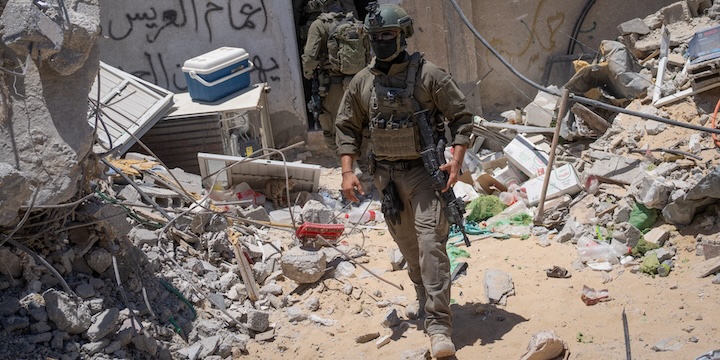
Israeli soldiers operate during a ground operation in the southern Gaza Strip, amid the Israel-Hamas conflict, July 3, 2024. Photo: Ohad Zwigenberg/Pool via REUTERS
Over the past few weeks, fighting in the Gaza Strip has continued at the same reduced pace, and with the same methods on both sides.
The IDF is slowly combing through the Rafah area against pinprick ambushes and raids by Hamas and other groups. Apparently, most of the Palestinian terrorists fled along with the civilians when the IDF provided evacuation notices to the latter, and are now trickling back to fight. Preventing the flight of terrorists with the civilians would have required the IDF to first conduct a rapid attack through the area north of Rafah to cut off access between it and Khan Yunis and the designated safe haven, but that would have increased civilian casualties and so was not viable.
The latest IDF raid into eastern Khan Yunis lasted two weeks. During that raid, IDF soldiers found the bodies of five more Israelis who were killed on October 7, and then had their bodies abducted. They were hidden inside a tunnel behind a false wall. According to one report, the information enabling their recovery was acquired from a captured Hamas terrorist. The IDF reported that during this raid, 150 terrorists were killed. The population that had been evacuated from the area of the raid prior to its start was allowed to return.
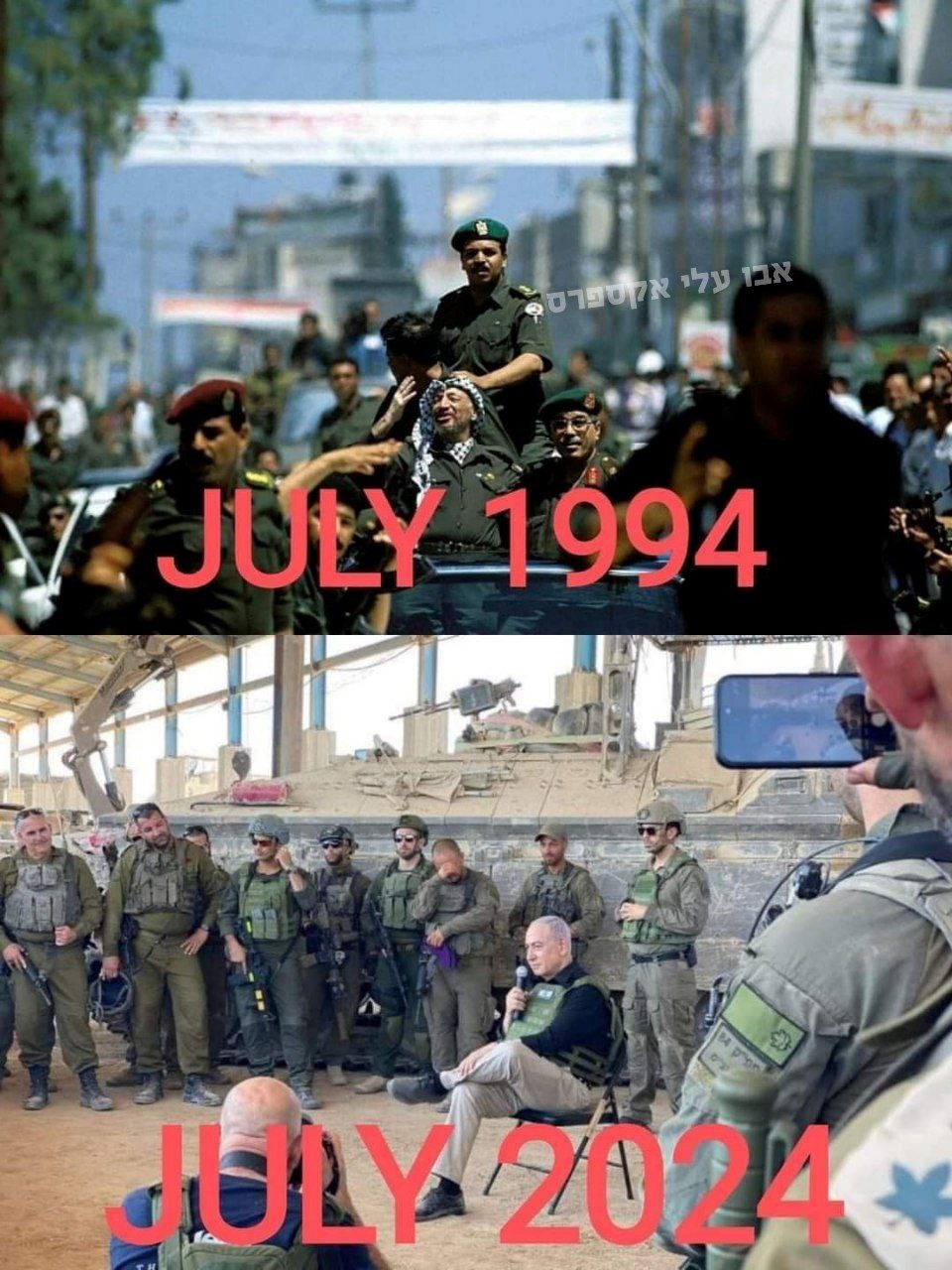
Below is a piece of Fatah propaganda against Hamas (provided by Israeli blogger Abu Ali Express from Palestinian social media): It says that in July 1994 Arafat entered Gaza following the Oslo Accords; In July 2024 Israeli Prime Minister Netanyahu entered Gaza. The message: We, Fatah, liberated Gaza, and you, Hamas, destroyed it.
The population of the northern area of Nusayrat and Burayj (south of the IDF cordon separating northern Gaza from the rest of the Gaza Strip) was told to evacuate, and airstrikes and small raids have been conducted there.
The IDF conducts airstrikes in areas where its ground troops are not operating. These strikes are based on intelligence, and last-minute evacuation orders are provided to civilians living in or very near the target. Hamas and the other groups have been using UNRWA facilities, schools, and other “sensitive” locations to protect their personnel; the IDF locates them, monitors them, and then strikes them. Each time this occurs, Hamas claims that all the casualties incurred were civilians. The IDF provides information that they were mostly terrorists, though unfortunately some civilians have been hit too.
Hamas fired rockets from inside the safe haven area, so a portion of it was declared a combat zone and the population there told to evacuate. Some of the rockets fell inside Gaza, including on an UNWRA school in Khan Yunis, causing Palestinian casualties.
During the fighting in Gaza, three Israeli soldiers have been killed since my last update and a few dozen wounded (a few severely but most of them only lightly).
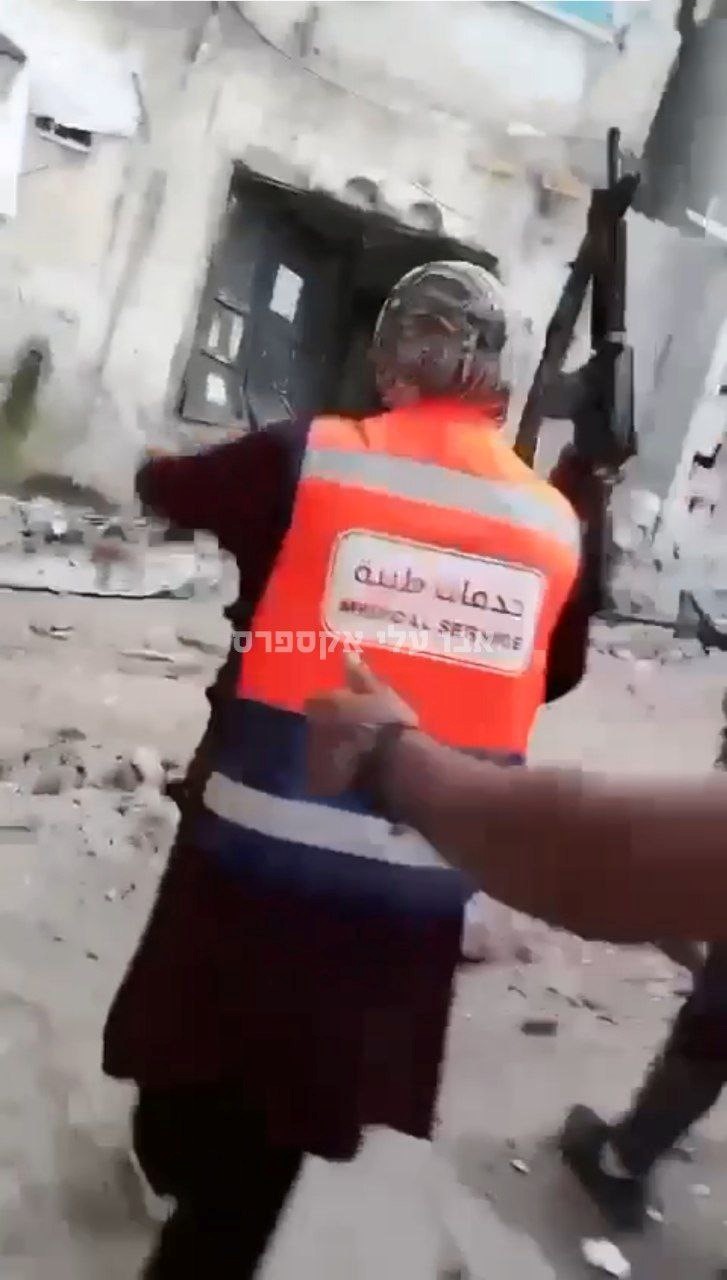
Below is a Palestinian “civilian” medic in action, also from a video posted on Palestinian social media, provided by Abu Ali Express.
Judea and Samaria:
The fighting in Judea and Samaria continues. Each IDF entry into Palestinian towns faces varying intensities of resistance, including bombs dug under roads (cleared by having bulldozers tear up the asphalt), rifles, machine guns, grenades, and improvised hand-thrown bombs as well as petrol bombs.
Since my last report there have been a couple of hundred more Palestinian attacks in or emanating from Judea and Samaria, bringing the total number of Palestinian attacks since October 7, 2023, to approximately 4,000. Several Israeli civilians and soldiers were wounded but none killed.
The Palestinians claim that more than 9,855 people have been arrested, but the official Israeli number is approximately 4,250 (no official update since my last report, but partial reporting adds a few dozen arrested all told) of whom approximately 50% belong to Hamas and the others to other groups. The discrepancy is apparently explained by the fact that the Palestinians count anyone who was detained, even if they were released after questioning.
Occasional skirmishes continue between the Palestinian Authority’s security forces and Hamas and Palestinian Islamic Jihad cells. In at least two cases, these have included the detonating of bombs targeting Palestinian Authority security patrols inside the Authority’s sovereign controlled territory. At least one security officer was wounded. In another case, Palestinian Authority security personnel entered a hospital in Tulkarem to arrest a Palestinian Islamic Jihad commander wounded in a skirmish with Palestinian Authority security forces (a bomb he tried to hurl at them exploded prematurely), but he managed to escape with the help of civilians in the hospital and other armed members of his faction. His escape was afterwards feted by a street celebration. This suggests the relative popularity among the local population of Fatah, which dominates the Palestinian Authority, and its rivals.
During their skirmishes, the factions often cooperate to attack Israelis. Symbolic of this occasional cooperation is that during the funeral of a killed terrorist, his body was draped in the flags of Fatah-affiliated organizations while being carried to the grave and then in Palestinian Islamic Jihad flags at the grave itself.
Dr. Eado Hecht, a senior research fellow at the BESA Center, is a military analyst focusing mainly on the relationship between military theory, military doctrine, and military practice. He teaches courses on military theory and military history at Bar-Ilan University, Haifa University, and Reichman University and in a variety of courses in the Israel Defense Forces. A version of this article was originally published by The BESA Center.