 Pod Save America Hosts Call on Democrats to Cut All Israel Military Aid, No Longer Accept AIPAC Funding
 Jews, Israelis Targeted in Austria Amid Surge in Antisemitic Incidents; Local Jewish Community Calls for Action
 ‘All of Our Strength’: Over 1,000 Pro-Israel Activists Gather in DC for Solidarity Conference
 ‘Devastated’: Wesley LePatner, Killed in Manhattan Mass Shooting, Was a Jewish Communal, Philanthropic Leader
 Sen. Angus King Vows to No Longer Vote for Israel Military Aid Until Gaza Conditions Improve
 Europe Won’t Pressure Israel to ‘Commit Suicide’ Amid Gaza Backlash, Palestinian State Push, Says Israeli FM
 Israel’s National Soccer Coach Attacked in Athens Before Soccer Fans Chant ‘F–K Israel, Free Palestine’ at Match
 New York Judge Sentences Neo-Nazi to 5 Years for Livestreaming Bomb Threats Against Jewish Hospitals
 US Pressures Lebanon to Issue Cabinet Decision to Disarm Hezbollah Before Talks Continue
 UK Plans to Recognize Palestinian State in September Unless Israel Meets Conditions, Starmer Says


Columbia University Interim President Issued Delayed, Neutral Statements About Hamas Oct. 7 Attack, Campus Antisemitism
Error: Contact form not found.
 by Corey Walker

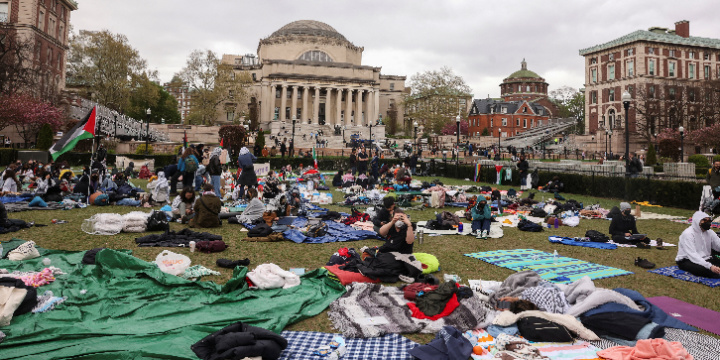
The “Gaza Solidarity Encampment” at Columbia University, located in the Manhattan borough of New York City, on April 25, 2024. Photo: Reuters Connect
Columbia University Interim President Katrina Armstrong has exhibited a neutral and waffling stance on the Israel-Hamas war and campus antisemitism in her public statements, raising questions about whether she will forcefully defend Jewish students as classes begin in the coming weeks.
The Ivy League university announced on Wednesday that Armstrong would replace embattled former President Minouche Shafik. Armstrong’s ascension to the presidency comes amid withering criticism from Jewish students and alumni, as well as US lawmakers, over the campus climate in the months following Hamas’ Oct. 7 onslaught across southern Israel.
While serving as the Dean of the Vagelos College of Physicians and Surgeons at Columbia, Armstrong waited two days to address the Hamas atrocities of Oct. 7, which included rampant sexual violence against Israelis and the biggest single-day massacre of Jews since the Holocaust.
In a letter titled “Regarding the crisis in Israel,” Armstrong lamented the “terrible violence and loss of life” in the Jewish state. The letter did not mention Hamas, which rules Gaza, nor did it mention the some 25 hostages kidnapped or 1,200 people slaughtered at the hands of the Palestinian terrorist group.
“The scale of the conflict engulfing Israel and Gaza and the impact on innocent civilians are horrifying,” the Oct. 9 letter read. “Those of us with friends, loved ones, or colleagues in the region are worrying about their safety and feel this especially acutely. This is a time for us to come together and to embrace each other with compassion and empathy.”
Armstrong published a statement on Dec. 22 referring to simmering campus tensions over the ensuing Israel-Hamas war as a “complicated moment.” In contrast to her first statement, Armstrong mentioned Hamas’ murders and hostages. She also acknowledged the growing problem of campus antisemitism at the New York City-based university.
“The Oct. 7 Hamas terrorist attack and the hostages remaining in captivity weigh very heavily on many in our community. And I have heard personal stories from other student leaders about the heartrending situation in Gaza where the civilian death toll continues to climb and military strikes go on,” Armstrong wrote.
In April, Armstrong penned a statement in response to the anti-Israel encampments on Columbia’s campus. She urged students to maintain focus on their academic work while they navigate the “immensely difficult issues that are roiling” the university.
“Every member of our community holds personal opinions of the events of the last week, and past months. Though your views and personal journeys are many, the distress and pain we feel is experienced by all,” Armstrong wrote.
Armstrong continued, emphatically denouncing “hateful language, calls for violence, and the targeting of any individuals or groups based on their beliefs, ancestry, religion, gender identity, or any other identity or affiliation.”
Columbia’s campus descended into chaos last spring. Anti-Israel campus activists held raucous rallies, chanting slogans such as “Burn Tel Aviv to the ground!” and “go back to Poland!” Jewish students reported heading home early to avoid the hostile campus atmosphere.
Since Oct. 7, Columbia University has become a hub of rising antisemitism and anti-Israel activism on American college campuses. In the immediate aftermath of Hamas’ attacks, numerous Columbia student groups issued statements blaming Israel for the massacre. Several campus groups categorically banned “Zionist” students from membership. Jewish students reported antisemitic bias and discrimination from Columbia faculty and staff.
The US Congress initiated an investigation into antisemitism at the Ivy League campus. Three Columbia deans stepped down from their positions after the House Committee on Education and the Workforce released a trove of text message exchanges among the administrators. In the texts, the university leaders exhibited a dismissive attitude toward the experiences of Jewish students on campus.
In the immediate aftermath of Minouche’s resignation, the Columbia chapter of the Students for Justice in Palestine (SJP campus group released a statement vowing to continue their demonstrations. The group warned Armstrong to acquiesce to their demands or face consequences.
“After months of chanting ‘Minouche Shafik you can’t hide’ she finally got the memo. To be clear, any future president who does not pay heed to the Columbia student body’s overwhelming demand for divestment [from Israel] will end up exactly as President Shafik did,” the group wrote on X/Twitter.
Columbia’s SJP chapter publicly endorsed Hamas in May.





