 Pod Save America Hosts Call on Democrats to Cut All Israel Military Aid, No Longer Accept AIPAC Funding
 Jews, Israelis Targeted in Austria Amid Surge in Antisemitic Incidents; Local Jewish Community Calls for Action
 ‘All of Our Strength’: Over 1,000 Pro-Israel Activists Gather in DC for Solidarity Conference
 ‘Devastated’: Wesley LePatner, Killed in Manhattan Mass Shooting, Was a Jewish Communal, Philanthropic Leader
 Sen. Angus King Vows to No Longer Vote for Israel Military Aid Until Gaza Conditions Improve
 Europe Won’t Pressure Israel to ‘Commit Suicide’ Amid Gaza Backlash, Palestinian State Push, Says Israeli FM
 Israel’s National Soccer Coach Attacked in Athens Before Soccer Fans Chant ‘F–K Israel, Free Palestine’ at Match
 New York Judge Sentences Neo-Nazi to 5 Years for Livestreaming Bomb Threats Against Jewish Hospitals
 US Pressures Lebanon to Issue Cabinet Decision to Disarm Hezbollah Before Talks Continue
 UK Plans to Recognize Palestinian State in September Unless Israel Meets Conditions, Starmer Says


Sickening: Why Did Western Media Outlets Praise Hassan Nasrallah?
Error: Contact form not found.
 by Channa Rifkin

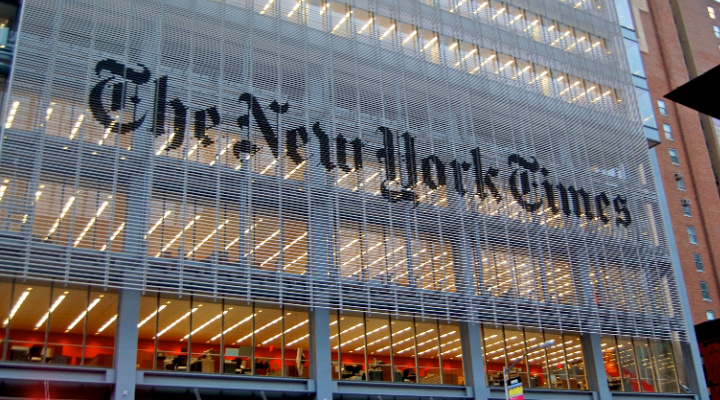
The New York Times building in New York City. Photo: Wikimedia Commons
“Charismatic.” “Revered.” A grandfatherly figure?
According to many media outlets, Hezbollah’s former leader, Hassan Nasrallah, was all “live, laugh, and love.”
But let’s not get it twisted. Nasrallah was an evil terrorist with blood on his hands — and not just of Jews.
Major media outlets are describing Hezbollah leader Hassan Nasrallah as “charismatic” and “shrewd,” even using smiling photos to soften his image. But Nasrallah’s real legacy? Deadly bombings, rocket attacks, and civilian deaths—including the U.S. Embassy bombing and the Buenos… pic.twitter.com/YH1tleNo5P
— HonestReporting (@HonestReporting) September 28, 2024
Despite his track record of killing Americans, Israelis, Lebanese (including the country’s former president), Sky News chose to memorialize the butcher of Syria’s Sunni population with a sweet, smiling picture of him:
Hey, @SkyNews, do you always use stock images of terrorist leaders that make them look like benign grandfatherly figures? Or is it only when they’ve been eliminated by Israel? pic.twitter.com/VFEhakqlkB
— HonestReporting (@HonestReporting) September 28, 2024
The same thing happened with the media’s coverage of Hamas leader Ismail Haniyeh’s assassination.
Some of the world’s most evil and oppressive figures are receiving moments of silence and fawning obituaries in commemoration of their lifetime achievements — and it’s being done by the biggest media outlets in the world.
Distortion of facts and truth is a common thread:
Hezbollah has been committing terrorist attacks against Americans and the west for decades. The “region” launched a genocidal war against Israel 12 months ago.
Fighting back doesn’t create a “region full of people who hate them.” The mere existence of Israel does. https://t.co/0R4Js4aBun
— HonestReporting (@HonestReporting) September 28, 2024
Needless to say, reactions across the social platform X (formerly Twitter) called out this complete distortion of the truth.
The Associated Press has since changed its headline, but not before it was exposed:
.@AP I’m sorry for your loss.
“Charismatic and shrewd…. an astute strategist… considered a pragmatist… idolized by his Lebanese Shiite followers… respected by millions across the Arab and Islamic world… ” https://t.co/bezopcUSTe
Maybe next time, speak to his victims. pic.twitter.com/qUb3EbRMri
— Hillel Neuer (@HillelNeuer) September 28, 2024
The Guardian did not hold back either. This tweet sums up how we all feel while reading this sentence:
Also the @guardian: “Adolf Hitler was a gifted painter, compelling public speaker and competent organizer.” pic.twitter.com/tcDrMF5HA3
— Arsen Ostrovsky 🎗️ (@Ostrov_A) September 28, 2024
This profile on Nasrallah by The New York Times, may as well be a love letter. Since its publication, words have been changed to appear vague, but are still rather favorable towards a killer:
He often referred to Israel as “the Zionist entity” and maintained that Jewish people who arrived from other countries over decades should return to their nations of origin, and said that Israel should be replaced by the state of Palestine, with equality for all residents.
The writer was caught portraying Nasrallah as a believer in coexistence for one state for Jews, Christians, and Muslims in “Palestine,” and framed as a responsible leader concerned with the needs of his people:
Are you kidding me, @nytimes? pic.twitter.com/XL08ksucoD
— Eitan Fischberger (@EFischberger) September 29, 2024
Unfortunately, the bizarre obituary did not stop there. It is filled with respectful descriptions of Nasrallah and his popularity amongst the suffering Shiite Lebanese population. Almost as if he was progressive:
He came across as less dour than most Shiite clerics, partly because of his roly-poly figure, a slight lisp and a propensity to crack jokes. He never pushed hard-line Islamic rules, like veils for women in the neighborhoods that Hezbollah controls. Analysts attributed that to his exposure in his youth to many of Lebanon’s 17 religious sects and his desire not to isolate Lebanese outside of Hezbollah’s religious Shiite base.
And publications like Le Monde came out with an obituary describing his features almost lovingly, and accentuating his “heroic” nature. It almost seems cool to be Israel’s biggest adversary, and the Middle East’s “object of fascination.”
With his black turban, reserved for descendants of the Prophet, thin glasses and thick salt-and-pepper beard, Hassan Nasrallah has been the face of Hezbollah for over three decades. At the head of this militia dedicated to armed struggle against Israel, which has become a state above the Lebanese state, the Shiite leader has held the fate of the country in his hands, in war and in peace.
But quite frankly, it’s embarrassing to read.
Nasrallah, an evil murderer, was granted obituaries he didn’t deserve. While he may have been seen as a heroic and revered figure by his followers, why should this matter when he has so much blood on his hands over the course of decades?
The author is a contributor to HonestReporting, a Jerusalem-based media watchdog with a focus on antisemitism and anti-Israel bias — where a version of this article first appeared.