 Pod Save America Hosts Call on Democrats to Cut All Israel Military Aid, No Longer Accept AIPAC Funding
 Jews, Israelis Targeted in Austria Amid Surge in Antisemitic Incidents; Local Jewish Community Calls for Action
 ‘All of Our Strength’: Over 1,000 Pro-Israel Activists Gather in DC for Solidarity Conference
 ‘Devastated’: Wesley LePatner, Killed in Manhattan Mass Shooting, Was a Jewish Communal, Philanthropic Leader
 Sen. Angus King Vows to No Longer Vote for Israel Military Aid Until Gaza Conditions Improve
 Europe Won’t Pressure Israel to ‘Commit Suicide’ Amid Gaza Backlash, Palestinian State Push, Says Israeli FM
 Israel’s National Soccer Coach Attacked in Athens Before Soccer Fans Chant ‘F–K Israel, Free Palestine’ at Match
 New York Judge Sentences Neo-Nazi to 5 Years for Livestreaming Bomb Threats Against Jewish Hospitals
 US Pressures Lebanon to Issue Cabinet Decision to Disarm Hezbollah Before Talks Continue
 UK Plans to Recognize Palestinian State in September Unless Israel Meets Conditions, Starmer Says


The 2024 High Holidays: Should God Atone, Too?
Error: Contact form not found.
 by Jeremy Rosen

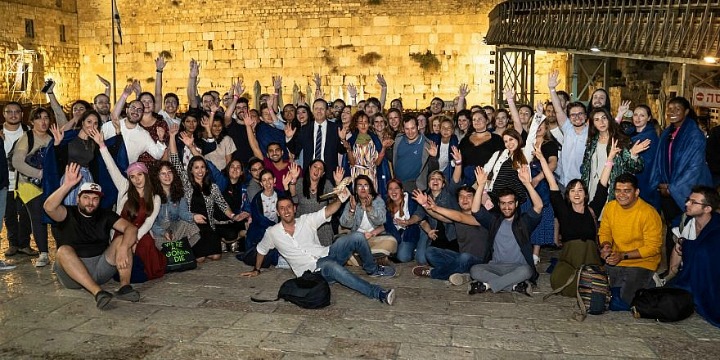
New immigrants experience their first High Holidays in Jerusalem as official residents of Israel, Oct. 6, 2019. Photo: The Jewish Agency for Israel.
We are approaching a period of atonement. And sometimes I wonder who should be atoning. It may sound blasphemous, but perhaps God should be atoning (metaphorically of course), as much as we atone to God for our shortcomings.
The rabbis envisaged God suffering with us in exile. And the Talmud has God praying to Himself that his quality of mercy should override that of justice.
Yet it is God (or as some might say, the universe) who made us with all our faults and capacities for evil — just as much as for good. As the Talmud says, humans were not created to be angels.
If you take the position that God controls everything on earth, then if we are suffering, what is God doing about it?
Of course, we understand that God is not a human being, and therefore ascribing human characteristics to God simply doesn’t make sense. When we look at the physical world, we see this constant turmoil and conflict between good and evil, and the struggle to deal with it.
But when we think of God in spiritual terms, we think of a relationship — between us and life, and a way of dealing with it, however best we can.
We know that life is going to bring us pain and ultimately death. That there will be happy and sad moments, and that we have to navigate these rapids while still preserving a sense of goodness.
But it is hard for the Jewish people, when we seem destined to suffer out of all proportion to the rest of the world, time and time again. Have we been chosen to suffer? And each time we think we may have transcended hatred, it comes back to bite us, harder and harder.
Can we — should we — challenge God? After all, the Biblical Book of Job is a critique of God and how God allows bad things to happen to good people.
This time last year, we had no idea what we were about to suffer — both in Israel and the Diaspora. When I think of all those mothers bereaved of sons, those who lost husbands, children now orphans, I can’t imagine the pain they’re going through.
Somehow or other, most of them will survive — and they will need our help both financially and emotionally. We have carried on our lives, for better or for worse, as if nothing was going to change. Yet I certainly have not lived through a year as painful and sometimes depressing, not just because of the evil perpetrated and the loss of life, but because of the ongoing crescendo of hate from supposedly moral, educated people.
Yet I should not be surprised. Very little has changed over thousands of years, either in terms of violence, hatred, or our capacity for self-destruction.
We should not be surprised that some 80 years after the Holocaust, irrational hatred has returned. Yet we should be grateful for the fact that we have more tools to defend ourselves now than we ever did before.
I can derive both pain and comfort from the great prophets. But the agony, the question, is: how have we deserved this?
We are living in a world without trust. We don’t trust governments; we don’t trust institutions. I have no idea where this is going to lead.
But the one thing I do know is that for all the crises before October the 7th and since, the one common and remarkable factor that binds us is a shared solidarity when the crisis strikes.
The Jewish community has shown that we can pull together. The root of this solidarity is loyalty. Either you’re for our survival or you’re against us.
That doesn’t mean to say that we can’t criticize or complain about corruption, dishonesty, failed policies, and missed opportunities, wherever they come from.
It’s no different than a parent dealing with a difficult child, and trying to bring about change. But in the end, you have to be there in a supportive role and let that child make its own mistakes and hope that in the end, something good will come out of it.
The world goes on according to its own system and rules, says the Talmud. But there is hope and faith.
We have survived because however much we’ve failed, our traditions give us purpose and a mission.
We cannot speak for God. The idea of God is essentially the realization that there is some other force, energy, or reason for what happens on earth, and that much of what happens is beyond ourselves.
God works as God works. What we know is that we must speak and atone for ourselves, and find solace where we can. Many of us will pray and hope with extra motivation and passion this year, to ourselves, and that the Almighty will be kinder in 5785.
The author is a writer and rabbi, currently based in New York.