 Pod Save America Hosts Call on Democrats to Cut All Israel Military Aid, No Longer Accept AIPAC Funding
 Jews, Israelis Targeted in Austria Amid Surge in Antisemitic Incidents; Local Jewish Community Calls for Action
 ‘All of Our Strength’: Over 1,000 Pro-Israel Activists Gather in DC for Solidarity Conference
 ‘Devastated’: Wesley LePatner, Killed in Manhattan Mass Shooting, Was a Jewish Communal, Philanthropic Leader
 Sen. Angus King Vows to No Longer Vote for Israel Military Aid Until Gaza Conditions Improve
 Europe Won’t Pressure Israel to ‘Commit Suicide’ Amid Gaza Backlash, Palestinian State Push, Says Israeli FM
 Israel’s National Soccer Coach Attacked in Athens Before Soccer Fans Chant ‘F–K Israel, Free Palestine’ at Match
 New York Judge Sentences Neo-Nazi to 5 Years for Livestreaming Bomb Threats Against Jewish Hospitals
 US Pressures Lebanon to Issue Cabinet Decision to Disarm Hezbollah Before Talks Continue
 UK Plans to Recognize Palestinian State in September Unless Israel Meets Conditions, Starmer Says
‘Shiva: Poems of October 7’ Contains 59 Poems That Will Make You Cry
Error: Contact form not found.
 by Alan Zeitlin

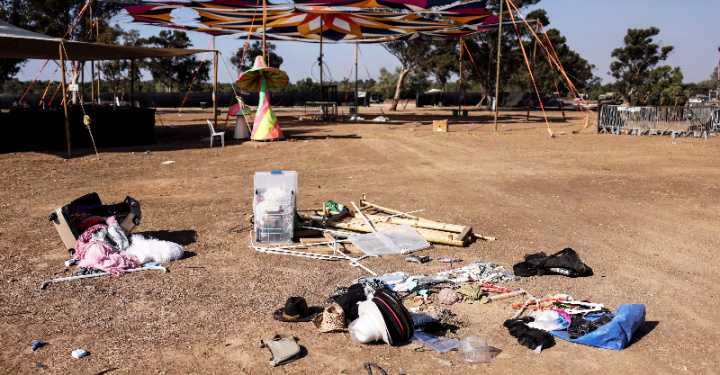
The personal belongings of festival-goers are seen at the site of an attack on the Nova Festival by Hamas terrorists from Gaza, near Israel’s border with the Gaza Strip, in southern Israel, Oct. 12, 2023. Photo: REUTERS/Ronen Zvulun
The introduction to the anthology Shiva: Poems of October 7, notes that the most common response to the Hamas attack of October 7 was “ain milim” — “there are no words.”
Rachel Korazim, Michael Bohnen, and Heather Silverman are the editors of the book, which contain numerous powerful poems that represent feelings of heartache all Israelis and Jews experienced on October 7.
Korazim, 78, said her time teaching poetry in English for many years at the Shalom Hartman Institute, Hebrew University, and online, has given her a wealth of experiences with students.
During the Covid pandemic, she grew a community of hundreds of poetry students.
“When October 7 hit, I realized I could not continue what I planned to teach, and I started collecting works [about what happened] on October 10,” Korazim told me in an interview.
She said that rabbis approached her to create a class, and one advised her to make an anthology. The editors refined and edited translations, and the book is now printed in Israel and available at Amazon.
People often assume that poetry can help people deal with issues emotionally, as a catharsis from trauma.
“I don’t read poetry as being anything but poetry,” Korazim said. “For some people, it is a catharsis. For other people, it’s just a way to express themselves. You didn’t have a tsunami of poetry after 9/11 in America. But we did have it now in Israel. Throughout our history, we have put high value on poetry. If you look at Jewish history and Israeli history, you will see waves of poetry in regular times but also after catastrophe.”
A portion of Ran Shayit’s “A Landscape Sketch Without Entering Into Graphic Details,” hits hard:
There are no words for this
A strong smell of suffocation from the depths of a well
Like The palms of a dead man
Holding onto the foundation of a house…”
Many recognize Rachel Goldberg-Polin for her pleas and media appearances as she advocated for her son Hersh, who was taken hostage. He was murdered by Hamas, and his body was recovered at the end of August.
Her poem, “One Tiny Seed,” includes:
There is a Yiddish lullaby that says “Your mother will cry a
Thousand tears before you grow to be a man.”
I have cried a million tears in the last 67 days. …
Our sea of tears
They all taste the same.
Can we take them gather them up, and remove the salt,
And then pour them over our desert of despair …
And plant one tiny seed
A seed wrapped in pain, trauma, fear and hope?
Osnat Eldar’s poem, “Sea Fragments,” begins with Psalm 93 and is dedicated to Romi Suissa, a six-year-old girl whose parents were murdered by Hamas.
Romi hid in the backseat, and was eventually rescued by a police officer in a now famous recording where she asks the man who saved her and her sister: “Are you Israeli?”
In another of Eldar’s poems, she writes:
Mothers
If only they could change places with the boy or the girl
Ready for captivity or death.
In “A Good Day,” Tal Shavit writes:
I want to turn myself into bulletproof vests
For all the fighters,
Become iron domes
Over the heads of all the girls,
Each and every one.
One of the most powerful images is depicted in Dael Rodrigues Garcia’s “A Fallen Soldier”:
A soldier is falling
Like a coin into a tzedakah box
He bumps into the copper coins
Secretly, he falls anonymously,
He saves from death
He rattles with his brothers
He kisses their faces
Crusted with the sweat of battle
And his father and mother stretch out their hands
Begging me to bring him back
Through the narrow
Slit.
Garcia explained that the poem was written before October 7, but having lived in Israel, he recognizes that, “the deep act of kindness done for you by others who protect you, which is often hidden, is the greatest act of charity.”
There are different ways that the human mind processes horror. This book is a gut-wrenching assessment of the fragility, vulnerability, and undeniability that despite the trauma we’ve experienced, those who are alive continue to live. Net proceeds of sales of the book will be donated to the Israel Trauma Coalition, which works with victims of October 7.
The author is a writer based in New York.
Share this Story:


Let your voice be heard!
Join the Algemeiner