 Pod Save America Hosts Call on Democrats to Cut All Israel Military Aid, No Longer Accept AIPAC Funding
 Jews, Israelis Targeted in Austria Amid Surge in Antisemitic Incidents; Local Jewish Community Calls for Action
 ‘All of Our Strength’: Over 1,000 Pro-Israel Activists Gather in DC for Solidarity Conference
 ‘Devastated’: Wesley LePatner, Killed in Manhattan Mass Shooting, Was a Jewish Communal, Philanthropic Leader
 Sen. Angus King Vows to No Longer Vote for Israel Military Aid Until Gaza Conditions Improve
 Europe Won’t Pressure Israel to ‘Commit Suicide’ Amid Gaza Backlash, Palestinian State Push, Says Israeli FM
 Israel’s National Soccer Coach Attacked in Athens Before Soccer Fans Chant ‘F–K Israel, Free Palestine’ at Match
 New York Judge Sentences Neo-Nazi to 5 Years for Livestreaming Bomb Threats Against Jewish Hospitals
 US Pressures Lebanon to Issue Cabinet Decision to Disarm Hezbollah Before Talks Continue
 UK Plans to Recognize Palestinian State in September Unless Israel Meets Conditions, Starmer Says


Revolting: How the Media Used Oct. 7 Anniversary to Focus on Hamas-Instigated War in Gaza
Error: Contact form not found.
 by Chaim Lax

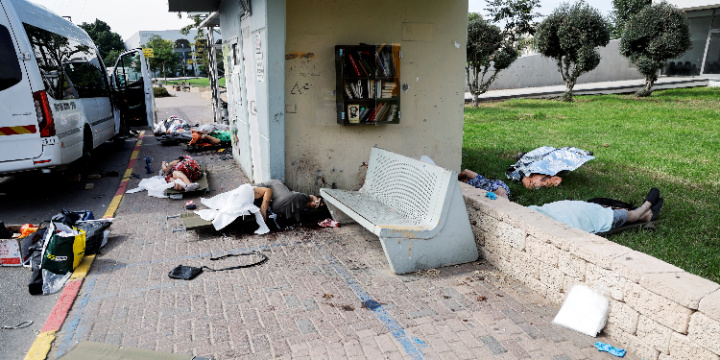
The bodies of people, some of them elderly, lie on a street after they were killed during a mass-infiltration by Hamas gunmen from the Gaza Strip, in Sderot, southern Israel, Oct. 7, 2023. Photo: REUTERS/Ammar Awad
October 7, 2024 marked one year since Hamas’ murderous rampage through southern Israel. As Israelis commemorated the deadliest day for the Jewish people since the Holocaust, how did the international media cover this somber anniversary?
By and large, the media coverage was both empathetic and nuanced, with news organizations dedicating much of their coverage to the effect that October 7 has had on Israel and interviewing survivors, family members of the 1,200 who were murdered during the atrocities, and family members of hostages still being held in Gaza.
However, both online and in print, some media outlets chose to use the anniversary to spotlight the cost of Israel’s war against Hamas in Gaza, despite the fact that October 7 is not the key anniversary of the war.
In effect, they chose Israel’s national day of sorrow as the springboard through which to criticize Israel’s defensive military operations and to subtly move the spotlight away from the atrocities committed by Hamas and other Palestinians on that fateful day.
For example, on its Instagram page, TIME Magazine highlighted the work of a Palestinian photographer, who had first spoken to the American magazine early in the war and was now speaking to it again after a year of documenting the fighting and destruction in Gaza.
However, as TIME noted, October 7 was not the anniversary of the first time this Palestinian photographer spoke with the magazine, it was a couple of weeks later.
So, why did the magazine choose to feature his story on October 7, and not on the actual anniversary of its first conversation with the Gaza-based photographer?
View this post on Instagram
Similarly, on October 7, Reuters’ photos account on X (formerly Twitter) posted an award-winning image of a Gazan woman cradling a dead child’s body, captioning it “A picture of her grief gripped the world. A year on, Gaza woman haunted by memories.”
However, this image is from October 17.
Why did the esteemed wire service choose to post this image on October 7 and not on the actual anniversary of when it was taken?
A picture of her grief gripped the world. A year on, Gaza woman haunted by memories 📷 Mohammed Salem pic.twitter.com/LgiGxu7ty2
— Reuters Pictures (@reuterspictures) October 7, 2024
On its Instagram page, Vanity Fair’s sole post on October 7 paid lip service to the atrocities before turning its attention to the war with a post entitled “The Sorrow of Gaza, One Year After the October 7 Attacks.”
The accompanying quote by war correspondent Janine di Giovanni not only created a moral equivalence between those killed in Gaza during the Israel-Hamas War (which includes killed Hamas terrorists) and Israeli civilians that were intentionally massacred on October 7, but also implicitly drew a connection between the war in Gaza and the Holocaust and the African & Balkan genocides of the 1990s.
View this post on Instagram
On its X page, Sky News chose to commemorate October 7 by publishing an in-depth look at the destruction in Gaza, deeming it “a year since the war in Gaza began.”
In this long thread, only a passing reference was made to Hamas and several posts were specifically designed to paint Israel’s defensive campaign in the coastal enclave as some kind of cruel and unusual operation that falls outside the bounds of normative warfare.
No, it’s not a year since the war in Gaza began, @SkyNews.
Today is a year since Hamas launched its brutal attack on Israel, murdering 1,200 & taking some 250 hostages.
If you are going to look back at what has been lost, maybe start with that. https://t.co/N5WRqkO7Es
— HonestReporting (@HonestReporting) October 7, 2024
Along with social media posts, there were several front pages of printed newspapers that also moved the spotlight away from the atrocities of October 7.
For example, The Independent’s front page, headlined “365 days of horror since October 7,” was a mashup of different numbers related to the war in Gaza, but only featured one number related to the Israeli victims of Hamas.
This is how the @Independent marked October 7: by editing the jihadis out of the story. The word “Hamas” doesn’t appear once. pic.twitter.com/V4yZMQ15vf
— Jake Wallis Simons (@JakeWSimons) October 7, 2024
For other newspapers, it wasn’t the replacement of coverage of Hamas’ atrocities with coverage of the war in Gaza that was the issue, it was the lack of substantial coverage altogether.
For example, The Chicago Tribune’s front page for October 7 featured two Israel-related articles — one AP copy about present fighting in Gaza and an article about how the war’s effects on the Chicago city council’s sentiments.
Compared to the front pages of other newspapers, which dedicated a substantial portion of the page to a reminder of what occurred on October 7, The Chicago Tribune’s coverage was clearly lacking.

And it wasn’t only news coverage that was an issue with some media outlets, but also opinion pieces.
On the eve of October 7, The Guardian saw fit to publish a grotesque op-ed by Naomi Klein, which accused Israel of turning the trauma of October 7 into a weapon.
Grotesque: Israel can’t even mourn its dead from Oct. 7 without @guardian platforming Naomi Klein to accuse the country of weaponizing its trauma.
If you can’t sympathize with innocent civilians butchered by terrorists, then you are the problem.https://t.co/ONhRmJ3pac pic.twitter.com/1emgTKzxa6
— HonestReporting (@HonestReporting) October 6, 2024
Similarly, on October 8, The Los Angeles Times published an op-ed by Daoud Kuttab which seemed to both minimize the horrors of October 7 while also implicitly justifying them.
This is beyond disgusting. @latimes published an opinion piece that tries to justify Hamas butchering civilians https://t.co/HzyNkYDMEC pic.twitter.com/S0r2Gr6sgA
— HonestReporting (@HonestReporting) October 8, 2024
As we pass a year since the October 7 atrocities and the subsequent beginning of the Israel-Hamas war, it is reasonable for media organizations to place extra focus on the toll that the war has wrought on the Gaza Strip and its Palestinian residents.
However, what is not reasonable is using the anniversary to take focus away from the atrocities and massacres that were committed by Hamas and its allies in southern Israel and instead use the opportunity to place a spotlight on what is occurring in the Gaza Strip.
By using October 7 to focus on Gaza (especially when commemorating an event that took place after October 7), these media organizations are helping to create a false narrative that seeks to diminish what occurred on October 7 or to create a moral equivalence between those atrocities and the situation in the Gaza Strip due to the ongoing war.
The author is a contributor to HonestReporting, a Jerusalem-based media watchdog with a focus on antisemitism and anti-Israel bias — where a version of this article first appeared.