 Pod Save America Hosts Call on Democrats to Cut All Israel Military Aid, No Longer Accept AIPAC Funding
 Jews, Israelis Targeted in Austria Amid Surge in Antisemitic Incidents; Local Jewish Community Calls for Action
 ‘All of Our Strength’: Over 1,000 Pro-Israel Activists Gather in DC for Solidarity Conference
 ‘Devastated’: Wesley LePatner, Killed in Manhattan Mass Shooting, Was a Jewish Communal, Philanthropic Leader
 Sen. Angus King Vows to No Longer Vote for Israel Military Aid Until Gaza Conditions Improve
 Europe Won’t Pressure Israel to ‘Commit Suicide’ Amid Gaza Backlash, Palestinian State Push, Says Israeli FM
 Israel’s National Soccer Coach Attacked in Athens Before Soccer Fans Chant ‘F–K Israel, Free Palestine’ at Match
 New York Judge Sentences Neo-Nazi to 5 Years for Livestreaming Bomb Threats Against Jewish Hospitals
 US Pressures Lebanon to Issue Cabinet Decision to Disarm Hezbollah Before Talks Continue
 UK Plans to Recognize Palestinian State in September Unless Israel Meets Conditions, Starmer Says


Russian Jews Are Still Coming to Israel
Error: Contact form not found.
 by Jacob Sivak

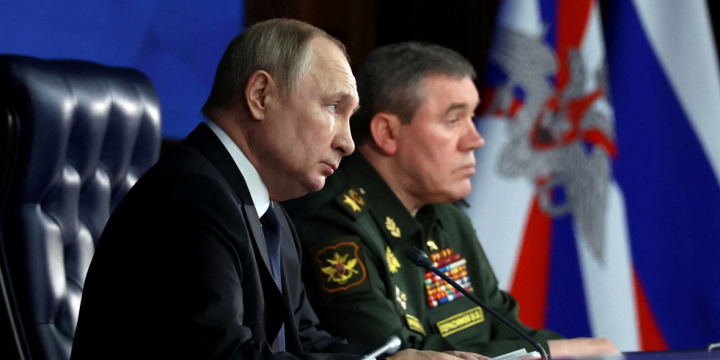
Russian President Vladimir Putin and then Chief of the General Staff of Russian Armed Forces Valery Gerasimov attend an annual meeting of the Defence Ministry Board in Moscow, Russia, December 21, 2022. Photo: Sputnik/Mikhail Kuravlev/Kremlin via REUTERS/File Photo
I was young when I first learned about the six million Jews who died in the Holocaust. I knew that this number represented two thirds of the Jews of Europe. To make matters worse, I learned that more than three million were trapped behind the Iron Curtain, in the Soviet Union and its satellite neighbors.
Then, a miracle took place, and Soviet Jews were given exit visas. In response to pressure from within and without, by the year 2000, two million Jews had left the Former Soviet Union.
According to the Israel Central Bureau of Statistics, more than 1.3 million individuals immigrated to Israel between the founding of the state in 1948 and the year 2021 from the Former Soviet Union.
Amazingly, the Russians are still coming. More than 83,000 emigres from Russia have come to Israel since the start of the Ukraine-Russia war in early 2022, according to figures from the Aliyah and Integration Ministry. Moreover, according to a report published on the anniversary of October 7 by The Moscow Times, these immigrants feel that political tensions in Russia are personally more dangerous than the multi-front war Israel is currently fighting.
In fact, Jews from both Russia and Ukraine have been immigrating to Israel since the start of the war. Most are not Jewish according to strict Jewish religious law. They are immigrating in accordance with the Law of Return, which gives an individual with one Jewish grandparent the right to Israeli citizenship. However, citing Israeli data, Interfax, a Russian non-governmental news agency in Moscow, reported that in 2023, nearly 70% of the 45,000 immigrants who came to Israel were from Russia, while only 4.5 % were from Ukraine.
If that information is indeed accurate, what explains this difference? Both Ukraine and Russia still have Jewish notable Jewish populations. Moreover, indiscriminate Russian attacks have killed thousands of Ukrainian civilians. There is no Iron Dome in Ukraine. If anything, civilian life in Ukraine is much more harrowing than that experienced by Israelis.
A blog in The Times of Israel by Anna Abramzon, an artist based in Los Angeles, may be relevant to answer that question. Abramzon writes that while many American Jews are shocked by the antisemitism unleashed after the brutal Hamas pogrom on October 7, those who grew up in the Soviet Union are not.
She cites several recent examples of discrimination toward American Jews. These include the cancellation of an exhibit by a Jewish artist, the reluctance by university presidents to renounce antisemitism, the retraction by an American literary magazine of an essay by a left-wing Israeli writer, and whether Pennsylvania Governor Josh Shapiro was considered too Jewish to be a vice presidential running mate in the US election.
Abramzon writes, “Jews knew their limits in Soviet society. There was only so far a Jew could get professionally, educationally, or socially in the Soviet Union. Universities had quotas; travel visas abroad were impossible. You could be talented, hardworking, and even a loyal Communist, but first and foremost, you would always be a Jew.”
To Abramzon, it is this kind discrimination, and the impact it has on limiting the freedom of an individual to make life choices, that may now be experienced by American Jews. Life for Jews in Ukraine may not be a bed of roses (the Democracy Index rates Ukraine to be a hybrid regime, not a democracy), but, this is a far cry from the autocratic regime that rules Russia today.
Abramzon ends her blog stating, “There is a vast space between ‘Globalize the Intifada’ and Auschwitz, but there is no reason we have to settle for living in it.”
Is she suggesting that North American Jews make aliyah too?
Jacob Sivak, a Fellow of the Royal Society of Canada, is a retired professor, University of Waterloo.