 Pod Save America Hosts Call on Democrats to Cut All Israel Military Aid, No Longer Accept AIPAC Funding
 Jews, Israelis Targeted in Austria Amid Surge in Antisemitic Incidents; Local Jewish Community Calls for Action
 ‘All of Our Strength’: Over 1,000 Pro-Israel Activists Gather in DC for Solidarity Conference
 ‘Devastated’: Wesley LePatner, Killed in Manhattan Mass Shooting, Was a Jewish Communal, Philanthropic Leader
 Sen. Angus King Vows to No Longer Vote for Israel Military Aid Until Gaza Conditions Improve
 Europe Won’t Pressure Israel to ‘Commit Suicide’ Amid Gaza Backlash, Palestinian State Push, Says Israeli FM
 Israel’s National Soccer Coach Attacked in Athens Before Soccer Fans Chant ‘F–K Israel, Free Palestine’ at Match
 New York Judge Sentences Neo-Nazi to 5 Years for Livestreaming Bomb Threats Against Jewish Hospitals
 US Pressures Lebanon to Issue Cabinet Decision to Disarm Hezbollah Before Talks Continue
 UK Plans to Recognize Palestinian State in September Unless Israel Meets Conditions, Starmer Says


There Is No International Law Demanding a Palestinian ‘Right of Return’
Error: Contact form not found.
 by Tamar Sternthal

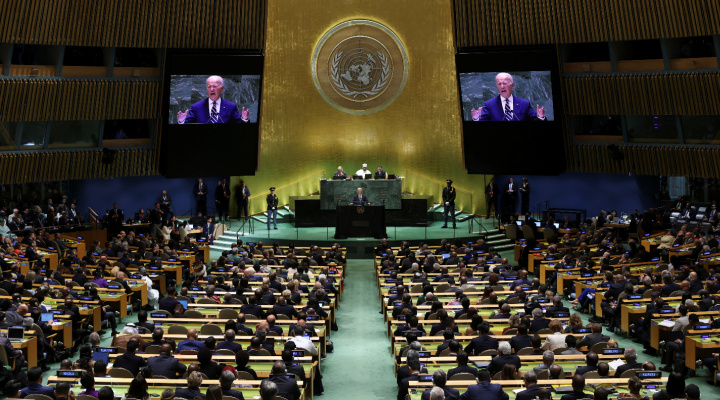
US President Joe Biden addresses the 79th United Nations General Assembly at UN headquarters in New York, US, Sept. 24, 2024. Photo: REUTERS/Mike Segar
The so-called “right of return” has been a fundamental Palestinian demand ever since the initial effort to eliminate the nascent state of Israel failed 76 years ago.
In recent days, however, the Associated Press (AP) upgraded the unfulfilled aspiration into international law.
In their Oct. 31 article, “Banning UNRWA will lead to a vacuum and more suffering for Palestinians, the agency’s chief says,” AP’s Baraa Anwer and Sara El Deeb invented: “International law gives Palestinian refugees and their descendants the right to return to their homes.”
An Oct. 29 AP article by Joseph Krauss, Julia Frankel, and Melanie Lidman also erred, citing a non-existent Palestinian right under international law to return to their 1948 homes: “Palestinians say refugees and their descendants, who now number nearly 6 million, should be allowed to exercise their right under international law to return home” (“Israel approves two bills that could halt UNRWA’s aid delivery to Gaza . . .”)
In fact, there is nothing in international law which gives Palestinian refugees and their descendants “the right to return to their homes.”
The non-binding UN Resolution 194, passed by the United Nations General Assembly, does not “give” Palestinians “the right to return to their homes.” Moreover, its language — “should be permitted” — denotes a suggestion, not a guarantee. The section of the resolution dealing with refugees states:
RESOLVES that the refugees wishing to return to their homes and live at peace with their neighbours should be permitted to do so at the earliest practicable date, and that compensation should be paid for the property of those choosing not to return and for loss of or damage to property which, under principles of international law or in equity, should be made good by the Governments or authorities responsible;
INSTRUCTS the Conciliation Commission to facilitate the repatriation, resettlement and economic and social rehabilitation of the refugees and the payment of compensation, and to maintain close relations with the Director of the United Nations Relief for Palestine Refugees and, through him, with the appropriate organs and agencies of the United Nations;
As CAMERA’s Alex Safian has previously detailed, the resolution conditions the return of refugees (Palestinian refugees are not specified, and therefore the resolution equally applies to Jewish refugees from Arab countries) on their willingness to “live at peace with their neighbors,” a condition that was not accepted by the Palestinian leadership or the vast majority of the refugees themselves who invoked Resolution 194.
Furthermore, the resolution placed repatriation, resettlement, and compensation on equal footing; meaning that return is one of several possible options.
Finally, the main part of the resolution called for the establishment of a Conciliation Commission, which convened in Lausanne, Switzerland, in 1949. While both the Arab states and Israel attended, the former declined to negotiate directly with the Jewish State and rejected any agreements.
In the past, the AP has accurately reported that Palestinians demand a right of return, or that they believe they have a right of return.
Examples of accurate AP coverage careful not to misreport that Palestinians have a right of return include:
Aug. 29, 2024: “Palestinians believe they have the right to return to their pre-1948 homes.”
Jan. 29, 2024: “The Palestinians say the refugees and their descendants, who now number nearly 6 million across the Middle East, have the right to return to their homes.”
Nov. 30, 2021: “The Palestinians say the refugees and their descendants have a ‘right of return’ to their homes in what is now Israel, a position supported by host countries.”
June 3, 2019: “Symbolically, Palestinians see UNRWA as sustaining their core demand that refugees have the ‘right of return’ to their lost homes in what is now Israel – a prospect that Israel rejects.”
Oct. 8, 2018: “It accuses the agency of perpetuating the conflict by helping promote what it considers an unrealistic Palestinian demand that refugees have the “right of return” to long-lost homes in what is now Israel.”
[emphasis added in all]
In short, while it’s entirely accurate to state that Palestinians demand a “right of return,” or Palestinians believe they have a “right of return,” it is completely false to say that international law gives Palestinians a “right of return” to homes some of them had in 1948.
CAMERA contacted AP to request a correction. As of this writing, no correction has yet appeared, suggesting a commitment to factual accuracy somewhat lagging behind the steadfast Palestinian insistence on the “right of return.” Stay tuned for any updates.
UPDATE (November 9, 2024):
In response to communication from CAMERA’s Israel office, the Associated Press removed its fallacious reporting wrongly claiming that “International law gives Palestinian refugees and their descendants the right to return to their homes,” and dozens of AP clients subsequently corrected as well.
The more accurate formulation now states:
Palestinians say they should be allowed to exercise the right generally recognized under international law for refugees to return to their home countries under certain conditions.
International legal experts have debated how that right applies to the Palestinian refugees. Israel says it does not and has refused their return, arguing it would end the country’s Jewish majority. The issue has been a stumbling block in past Israeli-Palestinian negotiations.
Notably, the AP entirely removed the reference to descendants having a Palestinian “right of return.” The Palestinian insistence that an untold number of future generations ad infinitum should be allowed to “return” is a glaring anomaly in refugee situations globally.
In addition, editors appended the following note to the bottom of the article:
This story was first published on Oct. 31, 2024. It was updated on Nov. 7, 2024 to make clear that Israel disputes that the right of return for refugees, generally recognized under international law, applies to Palestinian refugees.
Compared to the new language in the article itself, the appended note, which Athe P refrained from labeling a “correction,” contains significantly more muddled language. It’s not only Israel which disputes that the “right of return” applies to Palestinian refugees. Plenty of international law scholars do as well, as the improved article now notes.
Moreover, it’s a stretch to assert that the right of return for refugees is “generally recognized under international law.” As the International Association of Professionals in Humanitarian Assistance and Protection notes about international refugee law (IRL):
It is only in 1951 (and then through a broadening of the refugee definition in 1967) that the international community established a regime for the international protection of refugees. The Geneva Convention Related to the Status of Refugees is the main source of legal protections for refugees. IRL provides a specific definition of refugee, safeguards the right to seek asylum, and protects against being forcibly returned to a country where one would face persecution (non-refoulement). The UN High Commission for Refugees (UNHCR) is mandated by the UN General Assembly to provide international protection to refugees and seek permanent solutions to their plight.
The mission of UNHCR, the UN agency for the world’s refugees (aside from Palestinians, who are uniquely serviced by UNRWA) reflects the fact that international law does not generally provide for the return of refugees to their country of origin, but does ensure their right to asylum and their right to not be forcibly returned from a country where they would face persecution. Thus, UNHCR “defend[s] their right to reach safety and help them find a place to call home so they can rebuild their lives.”
“Under certain conditions,” as the improved AP reporting in the article itself qualifies, their country of origin may be a place where they can find safety enabling them to rebuild their lives.
Regardless, the AP’s removal of the unequivocal and blatantly false assertion that “International law gives Palestinian refugees and their descendants the right to return to their homes” is a significant win for accurate reporting hitting back at baseless Palestinian claims that have fueled generations of conflict.
The correction was republished in some three dozen Associated Press clients across North America, including The Washington Post, WTOP News (DC), ABC, San Mateo Daily Journal, Yahoo, Minnesota Star Tribune, Winnipeg Free Press, Jacksonville Journal Courier, WPLG Local 10 (Florida), Atlanta Journal Constitution, Connecticut Post, Houston Chronicle, Toronto Star, Las Vegas Sun, and many more.
The original error, however, continues to appear on numerous media outlets, including The Los Angeles Times and PBS, and CAMERA is reaching out to some of the more significant outlets on an individual basis.
Tamar Sternthal is the director of CAMERA’s Israel Office. A version of this article previously appeared on the CAMERA website.