 Pod Save America Hosts Call on Democrats to Cut All Israel Military Aid, No Longer Accept AIPAC Funding
 Jews, Israelis Targeted in Austria Amid Surge in Antisemitic Incidents; Local Jewish Community Calls for Action
 ‘All of Our Strength’: Over 1,000 Pro-Israel Activists Gather in DC for Solidarity Conference
 ‘Devastated’: Wesley LePatner, Killed in Manhattan Mass Shooting, Was a Jewish Communal, Philanthropic Leader
 Sen. Angus King Vows to No Longer Vote for Israel Military Aid Until Gaza Conditions Improve
 Europe Won’t Pressure Israel to ‘Commit Suicide’ Amid Gaza Backlash, Palestinian State Push, Says Israeli FM
 Israel’s National Soccer Coach Attacked in Athens Before Soccer Fans Chant ‘F–K Israel, Free Palestine’ at Match
 New York Judge Sentences Neo-Nazi to 5 Years for Livestreaming Bomb Threats Against Jewish Hospitals
 US Pressures Lebanon to Issue Cabinet Decision to Disarm Hezbollah Before Talks Continue
 UK Plans to Recognize Palestinian State in September Unless Israel Meets Conditions, Starmer Says


Iran Tells IAEA Chief It Will Negotiate but Not Under Pressure
Error: Contact form not found.
 by Reuters and Algemeiner Staff

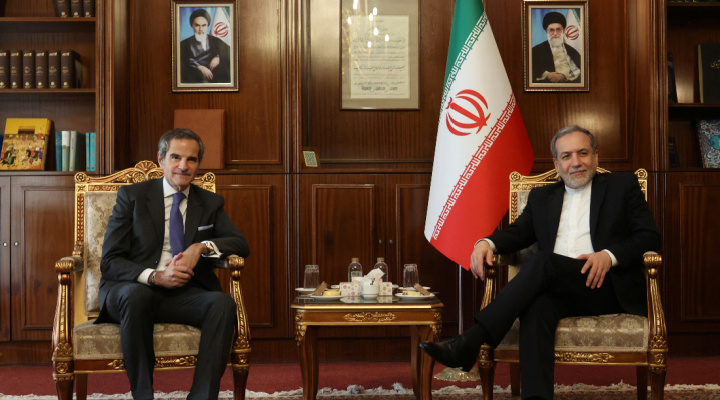
International Atomic Energy Agency (IAEA) Director General Rafael Grossi meets with Iran’s Foreign Minister Abbas Araqchi in Tehran, Iran, Nov. 14, 2024. Photo: Majid Asgaripour/WANA (West Asia News Agency) via REUTERS
Iran is willing to resolve outstanding disputes over its nuclear program but won’t succumb to pressure, its foreign minister told the UN nuclear watchdog head on Thursday, as European countries push for diplomacy before Donald Trump’s return to the White House.
“The ball is in the EU/E3 court,” Foreign Minister Abbas Araqchi wrote on X following talks in Tehran with IAEA chief Rafael Grossi, referring to three European countries — France, Britain and Germany — which represent the West alongside the United States at nuclear talks.
“Willing to negotiate based on our national interest and inalienable rights, but not ready to negotiate under pressure and intimidation,” Iranian state media quoted Araqchi as saying. “I hope the other side will adopt a rational policy.”
A senior Iranian official told Reuters that Tehran would send a message to the three European powers through Grossi about Tehran’s seriousness to resolve its nuclear standoff, while stressing that any pressure on Tehran would have the opposite effect.
Diplomats told Reuters on Wednesday that Britain, France, and Germany are pushing for a new resolution against Iran by the International Atomic Energy Agency board next week to pressure Tehran over what they view as its poor cooperation.
Grossi, in a televised joint press conference with Iran‘s nuclear chief, urged Tehran to take steps to resolve the remaining issues.
“It is in our power here to take concrete steps that will indicate clearly, to the US and the international community, that we can clarify things and move forward with concrete solutions,” Grossi said.
Grossi met Iranian President Masoud Pezeshkian for the first time since Pezeshkian was elected in July. The president told Grossi that Tehran was prepared to cooperate with the IAEA to clear up “alleged ambiguities” about Tehran’s nuclear work, state media reported.
Trump’s return to office as US president in January upends nuclear diplomacy with Iran, which had stalled under the outgoing administration of Joe Biden after months of indirect talks.
During Trump’s previous tenure, Washington ditched a 2015 nuclear deal between Iran and six world powers that curbed Tehran’s nuclear work in exchange for relief from international sanctions.
On Tuesday, Pezeshkian, seen as relatively moderate, said Tehran would not be able to ignore its arch-foe the United States and needs to “handle its enemies with forbearance.”
Trump has not fully spelled out whether he will continue his “maximum pressure” policy on Iran when he takes office.
SOURED RELATIONS
Relations between Tehran and the IAEA have soured over several long-standing issues including Iran barring the agency’s uranium-enrichment experts from the country and its failure to explain uranium traces found at undeclared sites.
In August, the agency said Iran‘s production of highly enriched uranium continues and it has not improved cooperation with it, despite a resolution passed by the IAEA Board of Governors in June.
Grossi, who has long sought progress with Tehran over its fast-advancing nuclear work, said: “Inspections are just one chapter of our cooperation and cannot be discussed.”
The US withdrawal from the nuclear pact in 2018 and the reimposition of sanctions prompted Tehran to violate limitations on its uranium enrichment — seen by the West as a disguised effort to develop nuclear weapons capability.
Tehran is now enriching uranium to up to 60 percent fissile purity, close to the roughly 90 percent required for an atom bomb. Tehran says its nuclear work is purely for peaceful purposes.
A senior Iranian official told Reuters on Wednesday that Tehran’s reaction to a resolution could be to limit diplomatic and technical cooperation with the IAEA.
On Friday Grossi is scheduled to visit Iran‘s Natanz nuclear plant and its Fordow site, which is dug into a mountain.