 Pod Save America Hosts Call on Democrats to Cut All Israel Military Aid, No Longer Accept AIPAC Funding
 Jews, Israelis Targeted in Austria Amid Surge in Antisemitic Incidents; Local Jewish Community Calls for Action
 ‘All of Our Strength’: Over 1,000 Pro-Israel Activists Gather in DC for Solidarity Conference
 ‘Devastated’: Wesley LePatner, Killed in Manhattan Mass Shooting, Was a Jewish Communal, Philanthropic Leader
 Sen. Angus King Vows to No Longer Vote for Israel Military Aid Until Gaza Conditions Improve
 Europe Won’t Pressure Israel to ‘Commit Suicide’ Amid Gaza Backlash, Palestinian State Push, Says Israeli FM
 Israel’s National Soccer Coach Attacked in Athens Before Soccer Fans Chant ‘F–K Israel, Free Palestine’ at Match
 New York Judge Sentences Neo-Nazi to 5 Years for Livestreaming Bomb Threats Against Jewish Hospitals
 US Pressures Lebanon to Issue Cabinet Decision to Disarm Hezbollah Before Talks Continue
 UK Plans to Recognize Palestinian State in September Unless Israel Meets Conditions, Starmer Says


When Abraham Challenged God
Error: Contact form not found.
 by Jeremy Rosen

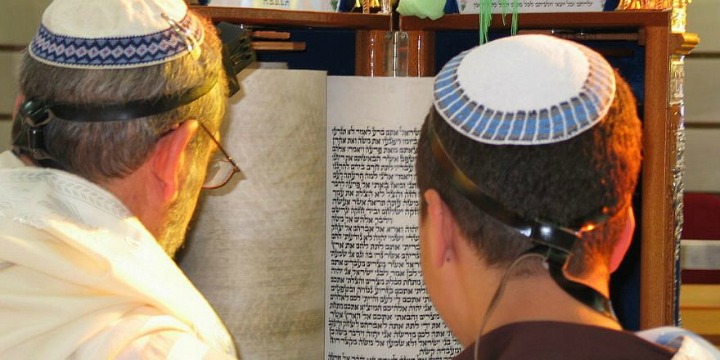
Reading from a Torah scroll in accordance with Sephardi tradition. Photo: Sagie Maoz via Wikimedia Commons.
The Torah portion of Vayera is a fascinating combination of episodes. It’s not just because of the range of different and significant incidents.
Theologically, there is an underlying current that presents two of the biggest challenges to faith in a critical world. The first centers on the conversation between God and Abraham before the destruction of Sodom. God says that he must inform Abraham in advance of what is going to happen, and then Abraham pleads with God not to destroy the city, in case there are some good people there — because it would be unfair that the innocent suffer at the hands of the guilty.
In the famous words of Abraham himself, “Will the judge of the universe not do justice” (Bereishit 18:22-25). This comes as a major surprise. How dare a human being say this to God. And yet, what a wonderful idea — because it implies that we have every right to do so.
The issue that most people who challenge religions today raise is how can God allow so much injustice and cruelty in the world.
There are two conclusions that we can draw from our Biblical story. The obvious one is that in the end, Abraham agrees that Sodom deserves its fate because it was a corrupt and evil place. The other is that God’s justice is not the same as our justice. To think of God as a human judge is to demean the idea of God. The Torah does indeed use language as if God were a human, but clearly God is not. All of us can think of situations in which innocents died, either for medical reasons, warfare, or natural disasters. We can debate forever as to whether we call this justice or fairness. After all, warfare in the Torah, with its casualties and collateral deaths, is seen as necessary sometimes. Abraham had to go to war to free his nephew, which means that people were killed.
God is not human, and Divine actions cannot be judged by the same standards as we humans are bound by. Then comes the story of the Akedah. It is interesting that in the non-Jewish world, this episode is described as the Sacrifice of Isaac. But we call it the Binding of Isaac. And that’s what Akedah means. We are introduced to this episode with the clear instruction to understand that this is a test. “And God tested Abraham.” It is not intended as a moral command. If Christianity chose generations later to draw a parallel between the Binding of Isaac and the crucifixion of its founding myth, only they will be able to see the logic in that.
The conclusions that I draw from these episodes are that in the realm of the Divine, we cannot understand the nature of something that is supposed to be totally non-physical. We may think that we can bargain with God, but consider all the conflicting demands humans expect God to resolve in their favor. They can’t all be granted.
In the end, the only thing we can be certain about (as opposed to having absolute faith in something) is where we have a clear written source or instruction. This is the genius of the Jewish emphasis on the idea of mitzvah, a commandment as being the ideal channel between us in the physical world and God in the spiritual world.
But we need to be aware of the danger of assuming that when we hear voices or where we think we hear God speaking to us, this is an instruction. We humans are so easily misled. We create false gods for ourselves. The lesson of the Akedah is that we should not be paying attention to voices as much as to the message.
The text says that God “cannot hide from what I’m going to do to Abraham because I know him, that he will command his sons and his household after him to keep the way of God which is to be righteous and to follow justice (Bereishit 18:19). It it is not some intangible abstract theological relationship that is the issue here, so much as having a way of life, which influences our behavior, and which enables us to pass on these values to the next generation. You cannot always pass on feelings, but you can pass on right actions.
The author is a writer and rabbi, currently based in New York.