 Pod Save America Hosts Call on Democrats to Cut All Israel Military Aid, No Longer Accept AIPAC Funding
 Jews, Israelis Targeted in Austria Amid Surge in Antisemitic Incidents; Local Jewish Community Calls for Action
 ‘All of Our Strength’: Over 1,000 Pro-Israel Activists Gather in DC for Solidarity Conference
 ‘Devastated’: Wesley LePatner, Killed in Manhattan Mass Shooting, Was a Jewish Communal, Philanthropic Leader
 Sen. Angus King Vows to No Longer Vote for Israel Military Aid Until Gaza Conditions Improve
 Europe Won’t Pressure Israel to ‘Commit Suicide’ Amid Gaza Backlash, Palestinian State Push, Says Israeli FM
 Israel’s National Soccer Coach Attacked in Athens Before Soccer Fans Chant ‘F–K Israel, Free Palestine’ at Match
 New York Judge Sentences Neo-Nazi to 5 Years for Livestreaming Bomb Threats Against Jewish Hospitals
 US Pressures Lebanon to Issue Cabinet Decision to Disarm Hezbollah Before Talks Continue
 UK Plans to Recognize Palestinian State in September Unless Israel Meets Conditions, Starmer Says


How the Radical Islamist Influence in Russian Prisons Can Pose a Threat to Israel and the West (PART ONE)
Error: Contact form not found.
 by Andrei Kazantsev-Vaisman

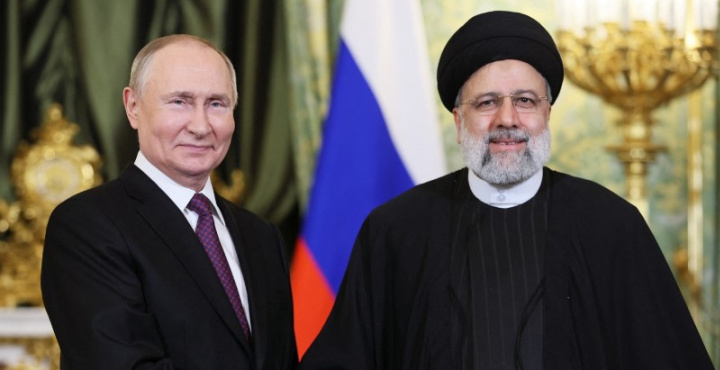
Russian President Vladimir Putin shakes hands with then-Iranian President Ebrahim Raisi during a meeting in Moscow, Russia, Dec. 7, 2023. Photo: Sputnik/Sergei Bobylev/Pool via REUTERS
Russian prisons have long been battlegrounds for influence among various criminal factions, each striving for control over the prison’s internal economy and hierarchies. Traditionally, the power in Russian penitentiaries has been held by groups following the thieves-in-law (“vor v zakone”) code. However, the prison landscape in Russia has been changing. As more individuals from Russia’s North Caucasus and Central Asia regions, many of whom follow Islam, are incarcerated, Islamist influence in prisons has grown. Some of these inmates, including those with ties to radical groups, have started to organize within the prison system, creating alliances based on religious beliefs rather than traditional criminal codes. This has shifted the balance of power, introducing new dynamics into the established prison hierarchy.
Islamist groups within Russian prisons often prioritize religious solidarity over traditional criminal loyalty, uniting along lines of faith and ethnicity. This religious affiliation offers a powerful alternative to the thieves-in-law code. These groups offer a strict, disciplined structure, sometimes enforcing adherence to Islamic practices and framing their activities as part of a broader religious struggle.
As these Islamist groups gain ground, a new trend has been observed: the emergence of so-called “green zones.” In contrast to the “black zones” and the “red zones,” green zones are areas within prisons where Islamist groups hold significant influence. In green zones, the leadership is largely driven by religious principles, and adherence to Islamic practices is encouraged or even enforced among inmates. Here, power structures revolve around religious loyalty rather than the thieves-in-law code, creating a unique social order within the prison.
The rise of green zones and Islamist influence has introduced new tensions and conflicts within the prison system. Traditional criminal groups and Islamist factions often find themselves in direct competition for power and control over resources within the prison. The two groups have fundamentally different worldviews, and their conflicting codes make cooperation difficult. Islamist groups may view the secular stance of thieves-in-law as incompatible with their religious beliefs, leading to conflicts and violence between factions. Conversely, thieves-in-law see Islamist influence as a threat to their long-established dominance and fear that religious factions might undermine their power base. Russian and Central Asian authorities are deeply concerned about the growth of Islamist influence in the prison system, as it not only disrupts the traditional criminal balance but also increases the risk of religious radicalization. The spread of green zones has heightened concerns about prisons serving as recruitment centers for extremist organizations. In response, prison authorities have introduced stricter controls, particularly over inmates who show signs of extremist affiliation, and increased monitoring of religious practices within prisons. However, the ideological strength of Islamist groups makes this issue particularly difficult to address, as radical beliefs offer followers a powerful sense of identity and community, especially in an environment as isolating as prison.
There is one important factor that makes Islamist groups more competitive than traditional criminal groups in Russian prisons. Traditional Russian prison culture, heavily influenced by the “thieves-in-law” ideology, operates on a rigid hierarchical structure. Within this system, inmates are divided into strata, each with specific roles, rights, and expectations. At the top of the hierarchy are the thieves-in-law themselves, respected as leaders who enforce the criminal code and manage conflicts. Below them are “blatnye” (seasoned criminals who support the thieves’ code), and further down are lower groups who lack influence, including outcasts relegated to the lowest “untouchable” status, often doing undesirable work and serving the needs of higher-ranking prisoners.
However, the rise of Islamism in Russian prisons has disrupted this traditional structure. Islamist ideology, by contrast, places less emphasis on criminal hierarchy and is more democratic in its appeal, focusing on shared religious identity over strict social stratification. This egalitarian nature allows Islamist groups to recruit widely, reaching across strata and even drawing in lower-ranking prisoners who previously held little power. Some of these recruits come from non-Muslim backgrounds but are drawn by the promise of protection, community, and status under a new, religiously driven order. Islamism offers them a chance to rise within an alternative structure that values loyalty to faith over criminal reputation and physical strength.
This inclusiveness gives Islamist groups a strategic advantage over the thieves-in-law hierarchy, which is exclusive and rigidly traditional. Islamist networks provide a sense of purpose and solidarity that transcends the traditional criminal code, attracting those who feel weak, oppressed and excluded from the thieves’ culture. By creating alliances with prisoners across different strata, Islamist groups have been able to build a broader base of influence, further challenging the authority of traditional prison leaders and reshaping the power dynamics within Russia’s prisons.
Prison Islam and Scenarios of Potential Growth of Radical Islamist Influence in Russia: Potential Repercussions for Israel and Europe
Scenario 1. Inertial development, moderate threats.
The most favorable scenario, both for Russia and for its neighbors in Europe and Asia, would be to follow an inertial path from the point of view of influence of prison Islam. Let’s call it Scenario 1. According to this scenario, the growing influence of radical Islam in prisons would remain under government control. Issues arising from the convergence of crime and jihadism would increase but remain a purely Russian problem (though neighboring Central Asian countries would continue to face similar challenges).
Scenario 2. Growth and trans-nationalization of radical Islamist networks based on prison Islam.
A more dangerous outcome for Russia itself and for many countries worldwide, including Israel, would be the realization of Scenario 2 “Growth and trans-nationalization of radical Islamist networks based on prison Islam” in Russia, Central Asia, and the Wider Middle East.
Let’s describe the tendencies that may lead to realization of this scenario. The ongoing Russian-Ukrainian war and the economic strain from Western sanctions have intensified Russia’s socioeconomic challenges, creating a volatile environment that could facilitate the rise of radical Islamist groups. With the Russian economy under increasing pressure, unemployment and poverty rates have grown, particularly affecting marginalized communities, including ethnic and religious minorities, including Muslims. The economic instability may drive disenfranchised youth and individuals from impoverished backgrounds towards radical movements, where promises of solidarity and purpose could provide an appealing alternative to dismal economic prospects.
The situation is further complicated by a demographic shift caused by the war. Mass emigration of middle-class Russians, particularly young professionals, has altered the demographic balance, increasing the proportion of economically and socially vulnerable populations, including migrant communities. This shift is occurring against the backdrop of a long-term trend of demographic growth of national minorities in Russia, driven by differences in birth rate patterns between the ethnic Russian population of Central Russia and the population of the North Caucasus, as well as by large-scale labor migration from Central Asia.
These trends, coupled with rising inter-ethnic tensions and widespread racist practices by Russian authorities, especially, against Central Asian ethnic groups, has created fertile ground for Islamist groups to gain influence. As violence and crime escalate amid the social disorganization of wartime Russia, radical groups may find it easier to recruit, using religious solidarity as a tool to address grievances and perceived injustices.
Moreover, the strained resources of Russian law enforcement, currently focused on internal security challenges and the demands of war, limit their ability to monitor and counter radical groups effectively. This vulnerability creates an opening for radical Islamist organizations to expand their networks and activities.
The likelihood of transnational connections between Russian and Central Asian-based radical Islamist groups and Middle Eastern organizations is also growing. As Islamist groups gain influence in Russia and Central Asia, they may establish stronger ties with larger networks across the Wider Middle East, accessing funding, ideological support, and strategic resources. This transnational element could enable Russian Islamist groups to solidify their influence domestically while extending their reach, posing a complex and multifaceted security challenge to Russia and other nations.
Additionally, the growth of ties between Russian criminal-Islamist groups and similar groups in the Middle East would create an added threat of terrorist attacks. In particular, some experts, such as Russian Afghanistan specialist Andrey Serenko, claim that ISIS-Khorasan is attempting to use criminal infrastructure (including drug trafficking networks) to organize terrorist attacks in Russia. In this context, one can recall the mass attack at Crocus City Hall near Moscow in March 2024, which was preceded by an attempt by ISIS-Khorasan to organize the bombing of a synagogue.
Through such networks, not only are terrorist attacks organized, but also the recruitment of fighters for the war in the Middle East (for example, in ISIS and groups affiliated with al-Qaeda, such as al-Nusra in Syria). In this context, it is worth recalling the phenomenon of mass recruitment into ISIS and other Sunni Islamist groups based in Syria, Iraq, and Afghanistan, a trend that has already been characteristic of Russia and Central Asian states over the past decade. So, such groups can organize terrorist acts or attacks affecting even the territory of Israel.
From the perspective of Israel’s interests, in this context, the threat of a recurrence of antisemitic pogroms, similar to those that took place in the fall of 2023 in the North Caucasus, would also probably sharply increase. In the specific context of the above-mentioned pogrom in the North Caucasus in the fall of 2023, networks of wrestler-athletes were utilized. However, in a number of other inter-ethnic pogroms, such as the Uzbek pogrom in Osh, Kyrgyzstan (2010), the mobilization of rioters occurred through criminal youth groups, albeit not Islamist in nature. The first instance of mobilization for mass pogroms through criminal-Islamist groups (connected to the relatives and associates of former President Nazarbayev, who controlled Kazakh secret police) occurred in January 2022 in Almaty, Kazakhstan. In connection with this case the former head of Kazakh National security committee (KNB) and former prime minister Karim Masimov and some other generals were sentenced for high treason.
Overall, given the trends outlined above, the possibility of mobilizing criminal-Islamist groups to organize pogroms, including those with an antisemitic component, is entirely feasible.
The author is an Affiliated Research Fellow at the PSCR Program, the Begin-Sadat Center for Strategic Studies, Bar-Ilan University, PhD (Israel), where a version of this article was first published.