 Pod Save America Hosts Call on Democrats to Cut All Israel Military Aid, No Longer Accept AIPAC Funding
 Jews, Israelis Targeted in Austria Amid Surge in Antisemitic Incidents; Local Jewish Community Calls for Action
 ‘All of Our Strength’: Over 1,000 Pro-Israel Activists Gather in DC for Solidarity Conference
 ‘Devastated’: Wesley LePatner, Killed in Manhattan Mass Shooting, Was a Jewish Communal, Philanthropic Leader
 Sen. Angus King Vows to No Longer Vote for Israel Military Aid Until Gaza Conditions Improve
 Europe Won’t Pressure Israel to ‘Commit Suicide’ Amid Gaza Backlash, Palestinian State Push, Says Israeli FM
 Israel’s National Soccer Coach Attacked in Athens Before Soccer Fans Chant ‘F–K Israel, Free Palestine’ at Match
 New York Judge Sentences Neo-Nazi to 5 Years for Livestreaming Bomb Threats Against Jewish Hospitals
 US Pressures Lebanon to Issue Cabinet Decision to Disarm Hezbollah Before Talks Continue
 UK Plans to Recognize Palestinian State in September Unless Israel Meets Conditions, Starmer Says


Syria’s Future Is Shrouded in Uncertainty; Israel Must Act Accordingly
Error: Contact form not found.
 by Itamar Tzur

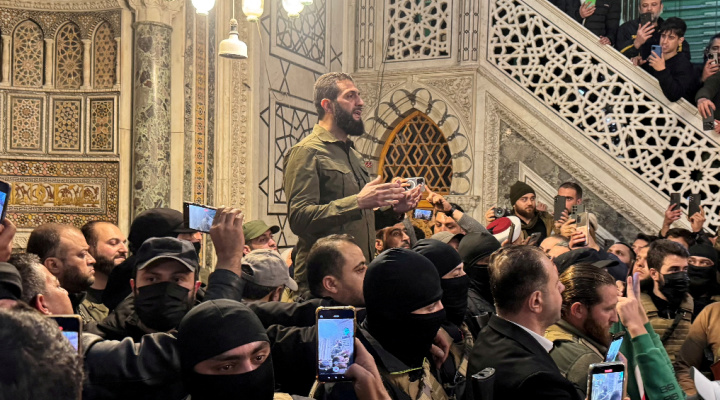
Top rebel commander Abu Mohammed al-Golani speaks to a crowd at Ummayad Mosque in Damascus, after Syrian rebels announced that they have ousted President Bashar al-Assad, Syria, Dec. 8, 2024. Photo: REUTERS/Mahmoud Hassano
Horrifying images recur daily on the streets of Damascus: Syrian families knocking on the doors of prisons and government offices, clutching faded photographs of loved ones who have disappeared. The Assad family dictatorship, much like the dark regimes of Pol Pot in Cambodia, Stalin in the Soviet Union, and the Junta in Argentina, has not only made people vanish, but also sought to erase their very existence.
For years, families have received conflicting answers and faced a system that both alienated them and exploited their despair. This is the grim reality of today’s Syria — a country that unraveled under the rule of the Assad regime.
Modern Syria was born from the mandate system established after the First World War. Under French rule, there was an attempt to divide the country into separate ethnic regions: Jabal al-Druze for the Druze, Damascus and Aleppo for Sunni Arabs, Latakia for the Alawite minority, and Alexandretta in the north for the Turkmen minority. However, this attempt failed, and in 1946, Syria emerged as a one unit state.
The profound hostility and instability in Syria stems from the lack of a unifying element among the diverse ethnic groups that make up this fragmented country. This fate is shared by other regional states like Lebanon, Iraq, and Libya. Since gaining independence in the 20th century, Syria has been characterized by political instability, military coups, and three failed wars against Israel. The significant turning point occurred in 1963 when the Ba’ath Party rose to power, paving the way for the Assad family’s ascent.
The Assad regime, both under Hafez and Bashar, relied on a combination of internal suppression and maneuvering between regional and international powers. Bashar al-Assad, initially seen as the West’s hope due to his ophthalmology training in Britain, continued his father’s legacy of repression but failed to maintain effective control over the country’s territories. Under his rule, Syria essentially fragmented into zones controlled by various forces, including ISIS, Turkey, and Russia.
The Syrian civil war exposed the hypocrisy of the international community. While crimes against humanity — including disappearances, mass killings, and chemical weapon use — occurred daily, the global response was minimal at best.
In contrast to the widespread protests seen when Israel is involved in conflicts, Syria’s tragedy received little attention on US campuses and in global media. The West chose not to intervene, even when ISIS took control of nearly half the country, responding only after the public executions of Western civilians began.
The rise of a new regime in Syria, led by figures with clear ties to Al-Qaeda, presents new challenges for Israel. Various declarations of a “new chapter” have garnered support in the West, but is this the reality on the ground? Wasn’t this also the Western perception when Erdogan rose to power in Turkey?
The Israeli capture of the Syrian side of Mount Hermon and the destruction of most of Syria’s military power were condemned at the UN, but met with surprising silence from Syria’s new leadership — a phenomenon that perhaps indicates greater antisemitism within the United Nations than in Syria’s new regime.
For Israel, it is imperative to remain vigilant while refraining from supporting any side in Syria’s internal conflicts. We must remember that we are not part of the Sunni-Shiite struggle. We are Jews. If the new administration in Damascus is genuinely seeking peace, let al-Joulani or any other leader commit to the following conditions:
- Public recognition of the State of Israel.
- An unequivocal and public renunciation of Syria’s claim to the Golan Heights.
- The return of Israeli spy Eli Cohen’s remains.
- Information on the fate of all IDF soldiers missing on the Syrian front.
As long as these conditions remain unmet, Israel must continue to live by its sword and maintain its military strength on the northern front. Only this firm stance, coupled with a willingness for dialogue under the right conditions, will secure the state’s security interests against Syria, whose future, as it has been since its inception, remains shrouded in uncertainty.
Itamar Tzur is an academic and writer specializing in Middle Eastern history, politics, and culture, holding honors degrees in Jewish History and Middle Eastern Studies.





